


Soros vs. the Bank of England (1992): The $1 Billion Trade That Shook Global Currency Markets
Inside the bold macro bet that earned George Soros over $1 billion, triggered Britain’s exit from the ERM, and reshaped how markets challenge central banks.
On September 16, 1992 (forever known as Black Wednesday), George Soros executed what became the most famous currency trade in financial history. By betting against the British pound, Soros made over $1 billion in profit, forced the United Kingdom out of the European Exchange Rate Mechanism (ERM), and earned the moniker “the man who broke the Bank of England.” It was a masterclass in macro investing, and a searing lesson in the limits of central bank defense.
The ERM was a system designed to stabilize European currencies ahead of full monetary union. Member countries agreed to maintain their exchange rates within a fixed band relative to the Deutsche Mark, then Europe’s anchor currency. For the UK, which joined the ERM in 1990, this meant defending the pound at a fixed level, despite rising economic divergence and domestic inflationary pressures.
By 1992, Britain’s economy was in recession, interest rates were high, and inflation was falling. Unemployment was climbing, and real estate markets were faltering. Yet to stay within the ERM, the Bank of England had to keep interest rates elevated to support the pound, an increasingly unsustainable position. Meanwhile, Germany, dealing with the post-reunification boom, had hiked rates to curb inflation, exerting even more pressure on the UK’s already fragile economy.
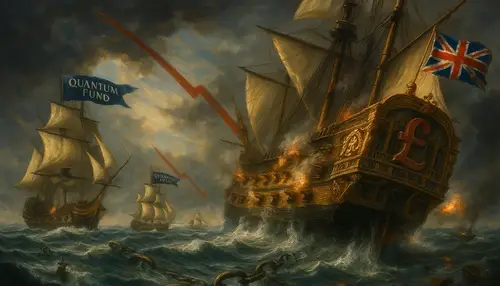
Soros, founder of the Quantum Fund, recognized the contradiction. He believed that sterling was fundamentally overvalued and that the Bank of England could not maintain its currency peg under growing economic strain. His thesis wasn’t contrarian (it was clear to many in the market), but Soros had the scale and conviction to act on it.
In the days leading up to Black Wednesday, Soros and his team began building a massive short position in pounds (reportedly as large as $10 billion), financed through a combination of leverage and dollar- and mark-denominated borrowing. As selling pressure mounted, speculation intensified that the UK would be forced to devalue or exit the ERM.
The Bank of England responded with classic tools of currency defense. It raised interest rates from 10% to 12% in a surprise move, with a further hike to 15% announced on the same day. It also intervened in foreign exchange markets, using billions in reserves to buy pounds. But the pressure was relentless. The market, emboldened by Soros’s aggressive positioning, kept selling.
By the evening of September 16, the British government conceded defeat. Chancellor of the Exchequer Norman Lamont announced that the UK would suspend its ERM membership and allow the pound to float freely. The currency immediately plunged, falling over 10% in a single day.
Soros’s Quantum Fund pocketed an estimated $1.1 billion in profits. The trade became a watershed moment in global macro investing, elevating Soros to near-mythic status. More importantly, it demonstrated that no central bank (no matter how powerful) could indefinitely defend an untenable exchange rate in the face of coordinated market opposition.
In the years that followed, the episode forced a reevaluation of fixed exchange rate systems and deepened skepticism about the political will needed to sustain currency pegs. It also ushered in an era where hedge funds and private capital could challenge sovereign monetary policy, and win.
In retrospect, Soros didn’t break the Bank of England single-handedly. He merely exposed the economic logic already crumbling beneath the surface. But by betting big, acting fast, and holding firm, he turned a thesis into a global inflection point, and a $1 billion payday.