


Hedge Fund Essentials: Landmark Trades, Legends, and Strategies

    Hedge Fund Essentials: Landmark Trades, Legends, and Strategies

    56 min read
    20 stories
    Featuring:Bridgewater AssociatesCitadelMillennium ManagementRenaissance TechnologiesPershing SquareThird PointTiger ManagementA.W. Jones & Co.Ray DalioKen GriffinIsrael EnglanderJim SimonsJulian RobertsonBill AckmanDan LoebMichael BurryDavid EinhornAlfred Winslow JonesLong/short equityGlobal macroQuantitative investingSharpe ratioActivist investing

    Introduction

    In 1949, a Fortune journalist with a PhD in sociology launched a fund that combined long positions with short sales and a modest amount of borrowed money. He kept 20% of the profits. Nobody had done any of that before. Today A.W. Jones is quietly credited with inventing an industry that manages more than $5 trillion and employs some of the most varied investing philosophies in finance. This twenty-story collection tracks how it got there.

    Expect an unusually diverse cast. Ray Dalio and his radical-transparency macro framework at Bridgewater. Ken Griffin's march from a Harvard dorm satellite dish to the top of global market making. Izzy Englander's pod army at Millennium. Jim Simons recruiting physicists and cryptographers to build Medallion, the most profitable quant fund ever run. Julian Robertson seeding an alumni network (the Tiger Cubs) that now manages hundreds of billions. Bill Ackman, Dan Loeb, David Einhorn, and Michael Burry each demonstrating what conviction-led investing looks like at scale, for better and for worse.

    Around the profiles sit a few ground-level explainers: how hedge funds differ from other buy-side pools like PE, VC, and growth equity, how the buy-side and sell-side sit opposite each other, how the Sharpe ratio and HFRI indices let allocators compare disparate strategies, and why accredited investor rules and prime brokerage lines of credit quietly determine who can access the industry and at what scale.

    Hedge Fund

    A private investment vehicle that uses strategies like long/short, leverage, short selling, and derivatives to pursue absolute returns regardless of market direction. Most are structured as limited partnerships, charge performance-based fees, and limit investors to accredited individuals or institutions.

    01 / 20

    Bridgewater Associates: Ray Dalio’s Principles-Based Approach to Macro Investing

    Bridgewater Associates: Ray Dalio’s Principles-Based Approach to Macro Investing

    Through macroeconomic research, risk-parity investing, and a culture of radical transparency, Ray Dalio built Bridgewater into the world’s largest hedge fund.

    Ray Dalio didn’t just build a hedge fund. He built a philosophy. Since founding Bridgewater Associates in 1975 from a two-bedroom apartment, Dalio has transformed his macroeconomic views and management principles into the core DNA of what would become the world’s largest hedge fund, managing over $150 billion at its peak. His approach (grounded in radical transparency, systematic thinking, and economic pattern recognition) set Bridgewater apart in both strategy and culture.

    At the heart of Dalio’s investment worldview is the belief that economies operate in repeatable cycles driven by debt, productivity, and human behavior. His influential writings on long-term debt cycles (most notably Principles for Navigating Big Debt Crises) distill centuries of economic data into frameworks that aim to anticipate policy responses and market inflection points. These insights informed Bridgewater’s flagship macro strategies, such as Pure Alpha and All Weather.

    The All-Weather portfolio, introduced in the 1990s, was an attempt to solve a core investor problem: how to build a portfolio that can perform across any economic regime. The concept was based on risk parity: allocating capital not by dollars, but by risk contribution. Traditional portfolios are heavily tilted toward equities, which perform well in growth and low-inflation environments. Dalio instead designed a mix of assets (including stocks, bonds, commodities, and inflation-linked securities) that would be balanced to thrive in four macro environments: rising growth, falling growth, rising inflation, and falling inflation.

    All Weather was not about predicting the future: it was about preparing for uncertainty. By ensuring that no single economic condition could dominate portfolio performance, Dalio provided institutional clients with a smoother return stream and better protection during dislocations. The strategy gained particular popularity after the 2008 crisis, when many traditional asset allocations failed.

    Yet, Dalio’s legacy extends beyond asset allocation. Inside Bridgewater, he cultivated a highly unconventional culture centered around what he termed “radical truth and radical transparency.” Employees are encouraged (required, even) to speak openly, debate ideas rigorously, and evaluate one another through constant feedback loops. Meetings are recorded, feedback is public, and decision-making is intended to be meritocratic and data-driven.

    Dalio codified these values in his book Principles, a management manifesto that blends life philosophy with corporate governance. The book, which became a bestseller, influenced not just investors but executives across industries. Bridgewater even developed proprietary tools like the “dot collector” to track real-time opinions and foster open discussion during internal debates.

    This culture has attracted both admiration and criticism. Some see it as a model for intellectual honesty; others view it as intense, even cult-like. But there’s no denying its impact. Bridgewater has become a case study in how a firm’s internal values can shape external performance.

    Dalio officially stepped down from Bridgewater’s day-to-day operations in 2022, handing over control to a new leadership team. But his intellectual imprint remains. The firm continues to operate with a focus on systematic macro investing, monitoring global flows, central bank policy, and political dynamics to inform its trades.

    In the end, Ray Dalio’s contribution to the hedge fund world is twofold: a deeply analytical, diversified approach to understanding markets, and a unique internal model of organizational decision-making. By seeking patterns in both economics and human behavior, Dalio didn’t just invest in the future: he tried to build systems that could anticipate it.


    02 / 20

    Ken Griffin’s Citadel: Building a Multi-Manager Powerhouse from a Harvard Dorm

    Ken Griffin’s Citadel: Building a Multi-Manager Powerhouse from a Harvard Dorm

    From Harvard dorm to Wall Street titan, Ken Griffin built Citadel into a hedge fund powerhouse while placing Citadel Securities at electronic trading's center.

    Ken Griffin’s journey from college trader to multi-billionaire hedge fund magnate is one of the most iconic in modern finance. What began with a satellite dish on the roof of his Harvard dorm in the late 1980s evolved into Citadel (one of the largest and most sophisticated hedge funds in the world) and Citadel Securities, a dominant force in global market making. Together, they represent Griffin’s dual vision: active investing at scale and ultra-efficient trade execution.

    Griffin’s start was audacious. Inspired by articles in Forbes and The Wall Street Journal, he began trading convertible bond arbitrage as a Harvard undergraduate in 1987, installing a direct quote feed in his dorm room to monitor markets in real time. After graduating, he founded Citadel in 1990 with $4.6 million in seed capital from Chicago investor Frank Meyer. From day one, Griffin emphasized quantitative rigor, risk management, and diversified alpha generation.

    By the early 2000s, Citadel had evolved into a true multi-manager platform, housing autonomous trading teams across asset classes, backed by centralized risk controls and cutting-edge technology. This model, later emulated by rivals like Millennium and Point72, became one of the most resilient structures in institutional investing. Citadel’s ability to navigate volatility, rapidly allocate capital, and reward top-performing teams made it a magnet for talent and results.

    But Griffin didn’t stop with asset management. In 2001, Citadel spun off a new venture: Citadel Securities. Initially designed to internalize and optimize trade execution for the hedge fund, the unit quickly grew into one of the largest market makers in the world. By leveraging technology, scale, and speed, Citadel Securities entered markets dominated by banks and legacy firms, and disrupted them.

    Today, Citadel Securities executes more than 25% of all U.S. equities volume and is the largest designated market maker on the New York Stock Exchange. It is also a leading player in options, ETFs, and fixed income, and it ranks among the top counterparties for institutional and retail flows alike. The firm’s high-speed infrastructure allows it to quote two-sided markets across thousands of securities with sub-millisecond latency, facilitating liquidity and price discovery at unprecedented scale.

    The rise of Citadel Securities has not been without scrutiny. As the principal market maker for many zero-commission brokers (including Robinhood) it found itself at the center of the 2021 GameStop saga. Critics raised questions about payment for order flow (PFOF), potential conflicts of interest, and the concentration of execution power in a few firms. Griffin defended the model as pro-retail, arguing that PFOF allows smaller investors to trade commission-free with tight spreads.

    Despite the controversy, Citadel and Citadel Securities continued to grow. In 2022, Citadel posted over $16 billion in profits, one of the largest annual gains in hedge fund history. Meanwhile, Citadel Securities raised outside capital for the first time, valuing the business at over $22 billion. The moves signaled that Griffin’s empire was not just built to trade, but to endure and expand.

    In retrospect, Ken Griffin’s career is a study in operational excellence and strategic ambition. By combining a world-class hedge fund platform with a best-in-class market-making operation, he built a vertically integrated financial powerhouse. Whether managing billions in risk or quoting fractions of a penny across millions of trades, Citadel’s influence, like Griffin’s legacy, is impossible to ignore.

    03 / 20

    Millennium Management: Israel Englander’s Diversified Pod-Based Investment Approach

    Millennium Management: Israel Englander’s Diversified Pod-Based Investment Approach

    Izzy Englander transformed $35 million in 1989 into Millennium's $70+ billion empire through relentless risk management and pioneer pod-based investing.

    When Israel “Izzy” Englander launched Millennium Management in 1989 with $35 million in capital, few would have predicted it would become one of the most formidable hedge funds in the world. But over the next three decades, Englander quietly built a platform unlike any other, defined not by a single investment strategy, but by a vast network of autonomous teams, or “pods,” each pursuing alpha under strict risk constraints. Today, with over $75 billion in assets under management, Millennium represents the pinnacle of the multi-manager model in institutional finance.

    Englander, a veteran of the American Stock Exchange, came to hedge fund management with a trader’s mindset and a deep appreciation for risk. His early experience taught him that markets reward discipline and punish concentration. From the outset, Millennium was designed to be different: instead of relying on a single star portfolio manager or concentrated bets, Englander embraced diversification at scale.

    At the core of Millennium’s strategy is its pod-based structure. Each pod functions as a self-contained team (typically composed of a portfolio manager, analysts, and execution traders) tasked with managing a defined slice of capital using their specific expertise. Pods are organized by strategy (long/short equity, macro, fixed income, statistical arbitrage, and more) but operate independently, with minimal correlation to one another.

    What ties them together is a centralized risk management and capital allocation framework. Millennium’s central team monitors factor exposure, drawdowns, leverage, and other portfolio metrics in real time. If a pod violates risk limits, it’s swiftly reined in, or cut. This strict discipline ensures that no single team can jeopardize the broader platform. Underperformance is tolerated only briefly; the bar for staying at Millennium is high, but the reward (generous payouts for consistent alpha) is equally compelling.

    Over the years, Englander has refined this model into a scalable machine. As of 2024, Millennium reportedly manages hundreds of pods across the globe, supported by thousands of employees, including technologists, data scientists, and operational staff. Offices span New York, London, Hong Kong, Singapore, Miami, and beyond. Despite its size, the firm’s decentralized model allows it to remain agile, rotating capital toward strategies and geographies as opportunities shift.

    Unlike many hedge funds that have sought publicity or public influence, Millennium has operated largely in the shadows. Englander rarely gives interviews, and the firm maintains a low media profile. But its performance and consistency have not gone unnoticed. Millennium has posted positive returns in nearly every year since inception, including through market crises in 2008 and 2020. Its Sharpe ratio (measuring risk-adjusted return) rivals or exceeds that of any peer in the space.

    The firm’s success has also made it a training ground for top talent. Portfolio managers often cut their teeth at Millennium before launching their own funds or joining competing platforms like Citadel or Balyasny. In an era where capital is plentiful but risk management is scarce, Millennium’s model of decentralized alpha with centralized oversight has proven uniquely durable.

    In retrospect, Israel Englander didn’t just build a hedge fund. He built a new architecture for active management. By institutionalizing diversification, accountability, and meritocracy at scale, he created a blueprint that reshaped the industry. Millennium’s rise is a testament to the power of structure over story, systems over stars, and the enduring edge of disciplined execution.

    04 / 20

    The Evolution of Quantitative Investing: From Factor Models to Machine Learning

    The Evolution of Quantitative Investing: From Factor Models to Machine Learning

    Quant funds are moving beyond traditional factor models to embrace machine learning and AI, adapting to evolving markets and improving trade execution.

    Quantitative investing has undergone a dramatic transformation over the past two decades. What began with linear regressions and simple factor models has evolved into a sophisticated fusion of computer science, statistics, and artificial intelligence. Today, hedge funds are not just crunching earnings and momentum. They're training models to learn from experience, adapt in real time, and navigate markets using techniques borrowed from robotics and gaming. At the frontier of this shift is reinforcement learning, a branch of AI reshaping how trades are executed and portfolios are optimized.

    Historically, quantitative funds relied on factor-based investing. These models ranked stocks based on attributes like value, quality, momentum, or volatility, betting that securities with favorable characteristics would outperform over time. The approach was systematic, scalable, and repeatable. Firms like AQR and Acadian built large businesses on this foundation, using econometric tools to build diversified, rules-based portfolios.

    But markets evolved. As more capital adopted similar factor strategies, alpha became scarcer. Signal decay, crowding, and mean reversion began to erode returns. In response, quant funds began exploring more complex, data-driven approaches, drawing on the vast toolkit of machine learning. Unlike traditional models, which rely on predefined relationships, machine learning algorithms discover patterns on their own, often by training on massive datasets that include not just prices and fundamentals, but also satellite imagery, credit card data, and even online sentiment.

    Within this paradigm, reinforcement learning (RL) represents the cutting edge. RL is not about predicting a stock’s next move: it’s about learning how to act optimally in a dynamic environment. Inspired by how humans and animals learn through trial and error, RL agents interact with a simulated environment, receive feedback (rewards or penalties), and iteratively improve their strategies. In financial terms, that might mean learning how to trade a portfolio to maximize risk-adjusted return while minimizing slippage, transaction costs, or drawdowns.

    Some of the world’s leading quantitative hedge funds (such as Citadel, D.E. Shaw, and Two Sigma) have begun integrating RL into their toolkits. For example, an RL algorithm might determine the optimal order execution strategy across multiple exchanges, factoring in latency, order book depth, and market impact. Another application might involve asset allocation, adjusting portfolio weights dynamically based on shifting macroeconomic conditions, volatility regimes, or news flows.

    One advantage of reinforcement learning is its adaptability. Unlike static models, RL systems continue to evolve as the environment changes. This is particularly valuable in markets where relationships between variables are unstable or where traditional assumptions (like normal distributions or linearity) break down.

    But RL also comes with challenges. Financial data is noisy, non-stationary, and often sparse compared to other domains like image or speech recognition. Moreover, the cost of learning through trial and error in real capital markets is high: mistakes mean real losses. As a result, quant funds typically train RL models in simulated environments, using historical data and carefully engineered constraints before deploying them live.

    Despite these hurdles, the rise of reinforcement learning and AI more broadly reflects a deeper truth: the nature of alpha is shifting. As information moves faster and traditional edges erode, hedge funds must find new ways to understand and act on complex, high-dimensional data. The promise of AI isn’t to eliminate human judgment, but to augment it with models that can learn, adapt, and evolve.

    In the long run, the firms that succeed may not be those with the best models, but those with the best integration of human insight and machine intelligence: a collaboration where algorithms don’t just execute decisions, but help shape them.

    05 / 20

    Accredited Investors Only: Why Hedge Funds Have Higher Entry Barriers

    Accredited Investors Only: Why Hedge Funds Have Higher Entry Barriers

    Hedge funds operate with fewer regulatory constraints but can only accept accredited investors deemed sophisticated enough to understand their risks.

    Hedge funds are known for their complexity, flexibility, and high potential rewards, but they’re also off-limits to most retail investors. Unlike mutual funds or ETFs, which are broadly accessible, hedge funds typically require investors to meet strict financial thresholds before they can invest. These restrictions stem from regulatory definitions of “accredited” or “qualified” investors, categories designed to protect the public while allowing private capital markets to operate with greater latitude.

    At the core of this barrier is the belief that hedge funds, by design, are riskier and less transparent than public investment vehicles. They use leverage, derivatives, short selling, and concentrated positions to pursue absolute returns. Many are also lightly regulated under exemptions like Regulation D or Section 3(c)(7) of the Investment Company Act of 1940, which free them from reporting requirements and liquidity mandates, but only if they limit their clientele to high-net-worth individuals or institutions.

    The accredited investor definition, set by the U.S. Securities and Exchange Commission (SEC), establishes who qualifies to invest in these private vehicles. For individuals, it traditionally means having over $1 million in net worth (excluding a primary residence) or income of at least $200,000 annually for the past two years ($300,000 with a spouse). Certain licensed professionals (such as holders of the Series 7 or Series 65) may also qualify. Institutions, like pension funds and endowments, typically meet the standard through asset size.

    The rationale is straightforward: investors in hedge funds must be financially sophisticated and capable of withstanding potential losses. Hedge funds are not required to provide the same level of disclosures as public funds, nor are they subject to daily liquidity, pricing transparency, or board governance rules. The assumption is that accredited investors can perform their own due diligence, or hire professionals to do it for them.

    Another classification, the “qualified purchaser,” sets an even higher bar. Often used for hedge funds that avoid registration under 3(c)(7), this standard requires $5 million in investable assets for individuals or $25 million for institutions. These thresholds aim to ensure that only the most sophisticated investors can access strategies with the fewest regulatory constraints.

    Critics of these rules argue that the wealth-based thresholds exclude capable investors merely due to income or net worth, rather than actual financial literacy. Others note that retail investors can buy highly speculative assets (like penny stocks or cryptocurrencies) with little restriction, while being barred from professionally managed hedge funds. In response, regulators have slowly expanded the definition to include certain credentials, but the overall framework remains intact.

    For hedge funds, these limitations come with tradeoffs. By restricting access, they avoid the compliance costs and restrictions of public funds, but they also limit their investor base. Many hedge funds have minimum investment levels of $1 million or more, though some offer feeder fund structures that pool capital from multiple smaller investors through wealth platforms or private banks.

    The accredited investor rule also helps hedge funds manage risk beyond the portfolio. Their client base typically includes institutional allocators, family offices, and high-net-worth individuals who understand illiquidity, volatility, and the potential for drawdowns. This stability allows funds to pursue long-term strategies without fear of sudden redemptions during market stress.

    In the end, hedge funds occupy a unique regulatory space: freer in their strategies, but gated by investor qualifications. The accredited investor rule is not just a legal formality; it’s a structural filter that shapes who can participate in the most complex and aggressive corners of modern capital markets.

    06 / 20

    How Prime Brokers Power Hedge Fund Trading: Inside the Infrastructure

    How Prime Brokers Power Hedge Fund Trading: Inside the Infrastructure

    Prime brokers provide the essential infrastructure of hedge fund operations, delivering leverage, trade execution, securities lending, and operational support.

    Behind every hedge fund’s trades lies an invisible yet indispensable partner: the prime broker. Often affiliated with major investment banks, prime brokers provide the infrastructure, financing, and operational support that allow hedge funds to function at scale. From clearing trades and lending securities to offering margin financing and capital introduction, prime brokers are the operational engine rooms of institutional trading.

    A hedge fund’s relationship with its prime broker begins with custody and execution, but it quickly expands. While custodians are primarily safekeepers of assets, ensuring settlement and recordkeeping, prime brokers go further. They act as the fund’s trading partner, extending leverage, facilitating short sales, and providing access to capital markets, all while offering reporting, portfolio analytics, and risk management tools.

    One of the most critical functions of a prime broker is providing leverage. Hedge funds often use margin (borrowing capital against the value of their portfolio) to amplify returns. Prime brokers offer this margin lending through bespoke agreements, typically secured by the fund’s long holdings. The degree of leverage depends on asset type, fund track record, and risk profile. For liquid equities, leverage can be generous; for structured credit or distressed assets, terms tighten.

    With this leverage comes credit exposure. Prime brokers constantly monitor a fund’s margin utilization, portfolio volatility, and liquidity to assess risk. If markets move sharply, they can issue margin calls or force asset sales to protect their loaned capital. The speed and precision of this oversight became a focal point after high-profile failures like Archegos Capital in 2021, which revealed lapses in prime broker risk controls across multiple banks.

    Shorting is another essential capability facilitated by prime brokers. To bet against a stock or bond, a hedge fund must borrow it, and the prime broker arranges that loan, sourcing inventory from institutional clients, internal holdings, or external counterparties. The availability and cost of borrowing vary with demand and float. Prime brokers maintain vast securities lending desks to manage these flows, and they charge fees known as borrow rates, higher for hard-to-borrow names, which can become crowded trades.

    Beyond financing and shorting, prime brokers provide operational glue. They offer trade settlement, reconciliation, collateral management, and performance reporting. Many also provide capital introduction services (connecting emerging funds with potential investors) and consult on compliance, regulation, and technology. For newer hedge funds, the prime broker relationship can be a critical resource in scaling infrastructure.

    Typically, large funds work with multiple prime brokers (a practice known as multi-prime) to diversify risk and improve execution. This became common after the 2008 collapse of Lehman Brothers, whose role as a prime broker left some funds frozen when it failed. Today, funds spread counterparty exposure across several banks, often using one as the lead while others provide niche services or serve as contingency options.

    But the relationship isn’t without risk. Prime brokers are incentivized to lend and earn fees, which can lead to competitive terms, and, at times, insufficient oversight. When multiple brokers extend leverage to the same fund without visibility into each other’s exposure, systemic risk can build quietly. The Archegos collapse highlighted this vulnerability, as several banks extended billions in margin loans without realizing the scale of total exposure.

    In short, prime brokers are more than service providers: they are partners in the mechanics of hedge fund investing. They enable scale, speed, and complexity. But they also introduce risk, both operational and financial. For hedge funds, the prime brokerage relationship is a powerful tool. But like all leverage, it must be managed with care.

    07 / 20

    The Tiger Legacy: How Julian Robertson Shaped a Generation of Hedge Fund Leaders

    The Tiger Legacy: How Julian Robertson Shaped a Generation of Hedge Fund Leaders

    Julian Robertson's Tiger Management pioneered global investing while seeding a generation of hedge fund managers who became industry legends themselves.

    Julian Robertson may have closed Tiger Management in 2000, but the influence of his hedge fund has only grown stronger in the decades since. More than just a top-performing global macro and long/short equity fund, Tiger became the birthplace of a dynasty. Its alumni (known collectively as the “Tiger Cubs”) have gone on to run some of the most successful and influential hedge funds in the world. Robertson didn’t just generate returns. He cultivated talent.

    Tiger Management, founded in 1980, was one of the first hedge funds to take a truly global view. Robertson applied rigorous fundamental analysis to equities worldwide, combining deep research with macro overlays. His fund grew rapidly through the 1980s and 1990s, peaking at around $22 billion in assets under management by the late ’90s.

    But by 2000, after struggling with the tech bubble’s distortions, Robertson shut Tiger down. He returned capital to investors and pivoted to a different role: mentor and seed investor. With a deep bench of talented analysts and portfolio managers (many of whom he’d trained personally) Robertson saw an opportunity to empower the next generation.

    He began allocating his own capital to former Tiger staffers launching their own firms, effectively giving them institutional-grade credibility from day one. These new funds were often dubbed “Tiger Cubs,” and their lineage became a mark of pedigree across the industry.

    Among the most prominent Tiger Cubs: Chase Coleman’s Tiger Global Management, which became a force in both public and private markets; Andreas Halvorsen’s Viking Global Investors, known for rigorous equity research and consistent performance; Philippe Laffont’s Coatue Management, a leader in technology-focused investing; and Lee Ainslie’s Maverick Capital, which mirrored Tiger’s research-intensive long/short model. Other notable Cubs include Bill Hwang (Archegos), John Griffin (Blue Ridge), and Stephen Mandel (Lone Pine), each with their own distinctive style and impact.

    What set Tiger alumni apart wasn’t just Robertson’s capital: it was the training and culture they absorbed. Tiger Management was known for its deep-dive research process, focus on valuation discipline, and high standards of integrity. Analysts were encouraged to challenge ideas, build detailed models, and form strong investment theses grounded in primary data. That intellectual rigor carried over into the Cubs’ own firms.

    Robertson also emphasized character. He backed people he trusted, often investing on personal conviction rather than elaborate due diligence processes. This high-trust model allowed managers to move quickly and build their own organizations with confidence.

    The results speak for themselves. Tiger Cubs have managed hundreds of billions of dollars in aggregate and have delivered some of the best risk-adjusted returns in the industry. Many have evolved into platforms of their own, mentoring a third generation of “Tiger Grandcubs,” perpetuating Robertson’s legacy even further.

    Importantly, the Cubs diversified beyond Robertson’s original playbook. Some, like Tiger Global, expanded aggressively into venture capital. Others, like Coatue, blended long/short strategies with data science and thematic investing. Viking and Lone Pine stayed closer to Tiger’s traditional equity roots. But all carried forward the emphasis on research depth, disciplined execution, and long-term thinking.

    In retrospect, Julian Robertson’s greatest legacy may not be his own track record, but the investment culture he created and the people he launched. By prioritizing mentorship, integrity, and intellectual rigor, he seeded not just funds, but an enduring investment philosophy. In an industry driven by star managers and fleeting performance, the Tiger Cubs have proved that great talent, when nurtured well, can multiply across generations.

    08 / 20

    Bill Ackman’s Activist Evolution: From Conviction Plays to High-Stakes Shorts

    Bill Ackman’s Activist Evolution: From Conviction Plays to High-Stakes Shorts

    How Bill Ackman’s activist journey has spanned from high-profile short positions to long-term value plays, reflecting his evolving strategy and the risks of bold bets.

    Bill Ackman’s career in activist investing has been anything but conventional. From early long-term value bets to headline-grabbing short positions, the founder of Pershing Square Capital Management has built a reputation for bold, high-conviction plays, some triumphant, others humbling. Over two decades, Ackman’s strategy has evolved, shaped by market cycles, public scrutiny, and the hard-earned lessons of activism at scale.

    Ackman first made a name for himself in the early 2000s through Gotham Partners, where he developed a taste for deep value investing and public engagement. But it was with Pershing Square, launched in 2004, that his brand of activism took hold. His early campaigns (like Wendy’s, where he pushed for the spin-off of Tim Hortons, and McDonald’s, where he advocated for real estate monetization) demonstrated his preference for structural reform over short-term trades. These were not scorched-earth tactics, but calculated, thesis-driven interventions.

    By the mid-2000s, Ackman had established a pattern: identify undervalued companies with strategic inefficiencies, build a concentrated stake, and press for change through detailed public cases. The hallmark was conviction. At Target, he proposed a REIT-like structure to unlock value. At General Growth Properties, he led a complex bankruptcy recovery that yielded billions in returns. Even when controversial, Ackman backed his views with meticulous analysis and personal credibility.

    But that same conviction could sometimes lead to overreach. His multi-year campaign against Herbalife, launched in 2012, became a defining (and divisive) moment. Betting $1 billion that the company was a pyramid scheme, Ackman went fully public, engaging regulators, producing documentaries, and sparring with rival investors like Carl Icahn. Despite partial regulatory vindication, the stock rebounded and Ackman ultimately exited the position with losses. The campaign exposed the reputational risks and execution challenges of activist short-selling.

    The Herbalife saga marked a turning point. While Ackman didn’t abandon activism, his approach grew more measured. His later successes (such as the dramatic turnaround at Canadian Pacific Railway) highlighted a more operationally focused activism, centered on management change and performance improvement rather than public confrontation. With CP, he not only replaced the board but brought in legendary operator Hunter Harrison to lead a multi-year transformation. The result was one of the most celebrated activist victories of the decade.

    In recent years, Ackman has broadened his toolkit. During the COVID-19 market collapse in 2020, he executed a $27 million credit hedge that returned over $2.6 billion, an unorthodox play that reflected market timing more than traditional activism. He has also experimented with SPACs, launching Pershing Square Tontine Holdings as a vehicle for large-scale acquisitions, though regulatory and execution hurdles limited its success.

    Today, Ackman presents a more complex activist profile. He continues to take long positions in high-quality companies like Chipotle, Lowe’s, and Hilton, often pairing capital with strategic suggestions rather than public pressure. His campaigns are less frequent but more focused, reflecting an evolution toward partnership rather than provocation.

    In retrospect, Bill Ackman’s journey captures the dual nature of activism: part investor, part reformer. He has been at his best when combining deep research with strategic clarity, and at his most challenged when conviction overpowered market reality. Yet few figures have had such a lasting impact on how shareholders engage with companies. Ackman’s evolution is not a retreat from activism: it’s a maturation of it.

    09 / 20

    The Visionary Bet: How Michael Burry Predicted the Housing Collapse

    The Visionary Bet: How Michael Burry Predicted the Housing Collapse

    How Michael Burry’s foresight and unconventional strategies led to a historic bet against the U.S. housing market, yielding substantial profits during the 2008 GFC.

    Michael Burry was not a typical Wall Street figure. A medical doctor turned hedge fund manager with a penchant for deep reading and independent analysis, Burry built his reputation not through flashy trades but through a forensic approach to markets. In the early 2000s, as most of the financial world remained entranced by the apparent strength of the housing boom, Burry was quietly combing through mortgage data, and seeing something very different.

    Through his hedge fund, Scion Capital, Burry began analyzing subprime mortgage-backed securities. While the consensus held that these securities were safe due to geographic diversification and rising home prices, Burry noticed a troubling pattern. Many of the mortgages were adjustable-rate loans with low introductory “teaser” rates that would reset to much higher payments after two or three years. These resets, he believed, would cause mass defaults, especially as borrowers often had poor credit and little equity in their homes.

    What set Burry apart was his willingness to trust his analysis even when it ran counter to conventional wisdom. Between 2005 and 2007, he worked with investment banks like Goldman Sachs and Deutsche Bank to buy credit default swaps (CDS), insurance contracts that would pay off if mortgage bonds defaulted. At the time, these instruments were obscure, and Burry’s position was regarded as eccentric at best, reckless at worst. But he persisted, pouring hundreds of millions into CDS premiums while his investors grew nervous and restive.

    By mid-2007, the cracks in the housing market began to widen. Subprime defaults surged, and mortgage-backed securities that once traded at near-par began to plunge in value. As the market unraveled, the value of Burry’s CDS positions soared. The payout was enormous: Scion Capital reportedly made more than $700 million in profits, with Burry personally earning around $100 million.

    Yet the path to that windfall was anything but smooth. Burry faced immense pressure from his own investors, many of whom doubted his strategy and pushed for redemptions. His insistence on secrecy (required to maintain pricing and availability of CDS trades) fueled distrust. At one point, Burry had to restrict investor withdrawals to prevent forced liquidation. Only in the aftermath of the crash did his prescience earn widespread recognition.

    The real significance of Burry’s bet wasn’t just the financial return: it was what it revealed about systemic risk, groupthink, and the limits of financial engineering. While rating agencies stamped subprime bonds with AAA labels, Burry looked beneath the surface and saw the fragility of the underlying loans. While Wall Street leveraged itself on the assumption that housing prices would never fall nationally, Burry built a position based on the view that fundamentals always win eventually.

    His story was later immortalized in Michael Lewis’s The Big Short, where Burry’s idiosyncratic character (a solitary thinker with Asperger’s traits, immersed in spreadsheets and financial footnotes) was portrayed as the archetype of independent insight in a market overrun by crowd psychology.

    In retrospect, Burry’s bet against the housing market remains one of the most iconic trades in financial history. It was not just a wager on market collapse: it was a conviction-driven investment rooted in patient analysis, intellectual independence, and the courage to be early, alone, and right.

    10 / 20

    Short Selling and ESG: When Ethical Investing Meets Activist Shorts

    Short Selling and ESG: When Ethical Investing Meets Activist Shorts

    Activist hedge funds now integrate ESG principles into campaigns, pushing companies to adopt sustainable practices and improve governance standards.

    Traditionally known for their sharp elbows and relentless focus on financial performance, activist hedge funds have long been cast as adversaries of management, often seeking board seats, cost cuts, or asset sales. But in recent years, a new dimension has emerged: the integration of environmental, social, and governance (ESG) goals into activist campaigns. Whether through proxy battles or public pressure, a growing number of funds are blending financial activism with sustainability, redefining the playbook for shareholder influence.

    This shift has not been driven by altruism alone. Activists argue that ESG is material: that companies ignoring climate risks, social responsibility, or governance flaws are exposing shareholders to long-term value destruction. For activists, ESG is increasingly a tool for value creation, not just virtue signaling. And for corporates, it adds a new layer of vulnerability: a failure to act sustainably may not only draw regulatory or reputational risk; it may now invite activist intervention.

    The most visible example came in 2021, when Engine No. 1, a relatively unknown activist firm, launched a campaign against ExxonMobil. The goal wasn’t just financial: it was strategic and environmental. Engine No. 1 argued that Exxon had no credible long-term plan to address the energy transition and that its capital allocation strategy was misaligned with global decarbonization trends. Despite owning just 0.02% of Exxon’s shares, the fund won three board seats, signaling that institutional investors were ready to back ESG-oriented activism.

    Other funds have followed suit. TCI Fund Management has pushed for carbon disclosure and emissions reduction at Alphabet and Canadian National Railway. ValueAct Capital has taken collaborative ESG positions, seeking boardroom influence at companies like Unilever and encouraging transitions toward sustainable growth models. Meanwhile, firms like Inclusive Capital Partners, led by ValueAct alum Jeff Ubben, focus entirely on impact investing through active engagement.

    This evolution also includes a more controversial practice: activist short selling with an ESG twist. Funds like Hindenburg Research and Muddy Waters have targeted companies whose practices raise environmental or ethical concerns, from electric vehicle firms with misleading environmental claims to social media platforms with poor governance. These campaigns often blend forensic accounting with public narratives around ESG failings, drawing media and regulatory scrutiny.

    But the alignment of ESG and activism isn’t always seamless. Skeptics argue that some funds are opportunistically using ESG language to build support for financially driven campaigns. Critics question whether hedge funds (traditionally short-term focused) can credibly advocate for long-term sustainability. There’s also tension between E, S, and G: pushing for environmental divestments may conflict with social goals like employment preservation or equitable transition planning.

    Still, the broader momentum is clear. Large institutional allocators are demanding ESG integration from asset managers. Boards are increasingly sensitive to ESG metrics. And proxy advisors like ISS and Glass Lewis are factoring sustainability into voting recommendations. For activist hedge funds, this creates a powerful lever: by framing their campaigns through ESG, they can broaden their coalition, appeal to passive investors, and increase pressure on management.

    In many ways, ESG activism represents a convergence of two powerful forces: shareholder influence and stakeholder accountability. It’s a bet that sustainable practices and shareholder value aren’t mutually exclusive, but mutually reinforcing. As the line between impact and alpha continues to blur, the role of activist hedge funds may expand, from agitators of change to architects of a more sustainable corporate future.

    11 / 20

    The Sharpe Ratio: A Standard Tool for Risk-Adjusted Hedge Fund Performance

    The Sharpe Ratio: A Standard Tool for Risk-Adjusted Hedge Fund Performance

    Widely used by investors and allocators, the Sharpe ratio standardizes performance by measuring return per unit of risk, helping separate true skill from raw volatility.

    In hedge fund investing, performance is only half the story. The other half is risk. A fund that delivers 15% returns with wild swings in value may be less attractive than one delivering 10% with consistency. That’s why allocators, consultants, and fund managers rely heavily on the Sharpe ratio: a tool that evaluates how much excess return a strategy delivers per unit of risk taken. Simple in form but powerful in application, the Sharpe ratio remains one of the most widely used metrics in assessing hedge fund performance.

    Named after Nobel laureate William F. Sharpe, the ratio compares a portfolio’s return above the risk-free rate to its volatility. The formula is straightforward:

    Sharpe Ratio = (Rp – Rf) / σp

    Where: Rp is the return of the portfolio, Rf is the risk-free rate (typically short-term Treasury yields), σp is the standard deviation of the portfolio’s returns.

    The result is a single number that expresses how efficiently a manager converts risk into return. A higher Sharpe ratio suggests better risk-adjusted performance. A Sharpe ratio of 1.0 is generally considered good, 2.0 excellent, and 3.0 or above rare, but context matters.

    For hedge funds, the Sharpe ratio helps distinguish true alpha from lucky (or leveraged) bets. A fund that doubles in a year may look impressive, but if its Sharpe ratio is below 1.0, that performance may have come with unacceptable volatility. Conversely, a fund with modest returns but a Sharpe ratio above 2.0 may be delivering consistent, low-risk alpha, exactly what institutions prize.

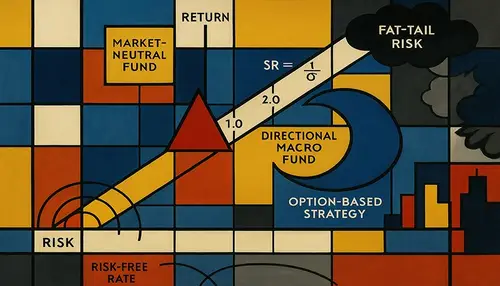
    Different strategies yield different Sharpe profiles. Market-neutral funds, like statistical arbitrage or equity long/short, often aim for steady returns with low volatility, resulting in high Sharpe ratios. Global macro or directional credit strategies may accept more risk and volatility, delivering strong returns but lower Sharpe ratios. Comparing funds across styles without accounting for this context can lead to false conclusions.

    Volatility is central to the Sharpe ratio, but also a limitation. Standard deviation treats upside and downside deviations equally, even though investors are typically more concerned with losses. This has led some allocators to also consider metrics like the Sortino ratio (which focuses only on downside deviation) or maximum drawdown, to supplement Sharpe in due diligence.

    Another complication arises with non-normal return distributions. Hedge fund strategies involving options, leverage, or illiquid assets often produce skewed or fat-tailed returns, which standard deviation doesn’t fully capture. For these funds, a high Sharpe ratio may mask hidden tail risk. It’s not uncommon for a strategy to show a stellar Sharpe right up until a major drawdown.

    Still, for all its limitations, the Sharpe ratio remains a cornerstone of performance reporting. Most institutional due diligence questionnaires (DDQs) require funds to report it, and consultants routinely use it to benchmark managers. It offers a standardized lens to compare disparate strategies and helps ensure investors are rewarded proportionately for the risk they bear.

    In the end, the Sharpe ratio is not a verdict: it’s a lens. It simplifies complex risk-return dynamics into a number, enabling comparison, benchmarking, and discipline. For hedge funds, maintaining a strong Sharpe isn’t just about performance: it’s about signaling skill, managing volatility, and delivering returns the institutional way, with risk under control.

    12 / 20

    What Are HFRI Indices? Understanding Hedge Fund Performance Benchmarks

    What Are HFRI Indices? Understanding Hedge Fund Performance Benchmarks

    HFRI indices from Hedge Fund Research serve as key benchmarks for evaluating fund performance, providing transparency across complex investment strategies.

    In a landscape where hedge fund strategies span from long/short equity and event-driven investing to global macro and relative value trades, assessing performance requires more than just absolute return figures. Investors need context: objective benchmarks that reflect how similar strategies have performed under comparable conditions. That’s where HFRI indices come into play. Published by Hedge Fund Research (HFR), these indices have become the industry standard for tracking hedge fund performance across a wide array of strategies and timeframes.

    The HFRI, short for Hedge Fund Research Index, was introduced in the early 1990s to provide a representative measure of hedge fund industry returns. Today, the HFRI indices are widely used by institutional allocators, consultants, and fund managers to assess performance, understand trends, and compare peer results within specific strategies.

    The flagship measure is the HFRI Fund Weighted Composite Index. This index captures the performance of a broad universe of hedge funds that report returns to HFR on a voluntary basis. Notably, the index is equal-weighted, meaning each fund contributes the same to the overall result, regardless of asset size. This prevents large funds from disproportionately influencing index performance and offers a more balanced view of the industry’s return profile.

    HFR further refines its benchmarking system by publishing sub-indices based on investment strategy. These include indices focused on equity hedge strategies, which encompass funds pursuing long and short positions in equities; event-driven strategies, which target opportunities around corporate events like mergers and restructurings; macro strategies, which take positions based on economic and geopolitical views; and relative value strategies, which seek to exploit pricing inefficiencies between related instruments. These sub-indices enable allocators and analysts to evaluate fund performance against peers executing similar mandates, rather than against broad market indices like the S&P 500.

    Beyond strategy, HFRI also offers indices that track performance across other dimensions, including geographic focus, market exposure, fund structure, and even firm size. These allow allocators to compare managers in more specific contexts, such as emerging markets or market-neutral strategies, and to better align due diligence with portfolio construction needs.

    While the HFRI indices are comprehensive, their methodology does introduce limitations. Inclusion in the index is based on voluntary reporting from hedge funds. This means that managers self-report their returns and can choose to stop reporting, often when performance deteriorates. As a result, the indices may suffer from survivorship bias and selection bias. Nevertheless, the breadth and consistency of the HFRI dataset make it one of the most useful tools for understanding the aggregate and relative performance of hedge fund strategies.

    It’s also important to note that HFRI indices are non-investable. They serve as benchmarks rather than replication products, which means investors cannot directly allocate capital to the index. Still, their utility in performance attribution and manager evaluation is enormous. A hedge fund running an equity long/short book, for instance, might compare its annualized return and Sharpe ratio to the HFRI Equity Hedge Index to assess whether it is delivering alpha relative to peers.

    In addition to investment evaluation, the HFRI indices are widely used in industry reporting. Analysts and consultants rely on them to track capital flows, volatility trends, and style rotation within hedge funds. By providing structure to an otherwise opaque segment of the investment world, the HFRI family of indices has become an indispensable tool for measuring success and understanding how hedge funds perform through different market cycles.

    13 / 20

    How Hedge Funds Took Over Argentina’s Sovereign Debt Crisis

    How Hedge Funds Took Over Argentina’s Sovereign Debt Crisis

    How hedge funds like NML Capital pursued aggressive strategies following Argentina's 2001 default, resulting in legal battles and major financial consequences.

    When Argentina defaulted on more than $100 billion in sovereign debt in 2001, it triggered one of the most complex and contentious battles in modern financial history. What followed was not just an economic crisis, but a legal and geopolitical drama involving hedge funds, courtrooms, and sovereign immunity. At the center of the fight was NML Capital, a subsidiary of Elliott Management, which took an aggressive stance on debt recovery that would shape sovereign debt restructuring for years to come.

    Most bondholders accepted significant haircuts in Argentina’s 2005 and 2010 debt exchanges, settling for roughly 30 cents on the dollar. But a group of hedge funds, led by NML Capital, rejected the offers. These so-called “holdouts” had purchased distressed Argentine bonds on the secondary market at deep discounts (often for just 20 to 30 cents on the dollar) with no intention of restructuring. Instead, they pursued full repayment of the original face value, leveraging legal systems to enforce collection.

    NML and its allies used an aggressive litigation strategy. Rather than merely suing for repayment, they pursued Argentina globally. In 2012, they famously succeeded in detaining an Argentine naval vessel, the ARA Libertad, in a Ghanaian port. Though later overturned by international courts, the incident symbolized how far holdouts were willing to go to pressure sovereign borrowers.

    The turning point came in U.S. federal court. NML argued that Argentina’s continued payments to restructured bondholders while refusing to pay holdouts violated the pari passu clause, a legal provision requiring equal treatment of creditors. Judge Thomas Griesa agreed. In 2012, he issued a ruling that prohibited Argentina from paying any of its restructured debt unless it also paid holdouts in full. This unprecedented interpretation gave hedge funds powerful leverage.

    Argentina refused to comply, choosing instead to default again in 2014 rather than pay holdouts. The standoff lasted until 2016, when newly elected President Mauricio Macri, seeking to restore market access, agreed to a $4.65 billion settlement with the litigating hedge funds. NML Capital alone received approximately $2.4 billion on bonds it had reportedly purchased for less than $50 million.

    The legal and financial outcome sparked global debate. Supporters argued that hedge funds were merely enforcing contracts and ensuring creditor rights. Critics accused them of predatory behavior, exploiting legal loopholes to extort full repayment at the expense of a recovering economy and restructuring process. The United Nations and several developing countries warned that the ruling could destabilize future debt workouts by encouraging holdouts to disrupt collective agreements.

    The case also reshaped sovereign debt markets. New bond contracts increasingly included “collective action clauses” (CACs), allowing a supermajority of bondholders to approve restructurings that would bind all holders, limiting the power of minority holdouts. Nonetheless, the Argentine saga remains a stark example of how hedge funds (armed with capital, patience, and aggressive legal strategies) can exert enormous influence over sovereign debt outcomes.

    For Argentina, the settlement marked a return to global credit markets. For hedge funds, it was a validation of event-driven investing in sovereign distress. And for sovereign issuers around the world, it served as a cautionary tale: even default does not always offer a clean slate when creditors have the will (and the resources) to litigate relentlessly.

    14 / 20

    Renaissance Technologies and the Medallion Fund: The Gold Standard in Algorithmic Trading

    Renaissance Technologies and the Medallion Fund: The Gold Standard in Algorithmic Trading

    Renaissance Technologies' Medallion Fund, built by Jim Simons, remains history's most successful hedge fund with 60%+ annual returns and unmatched secrecy.

    In the annals of hedge fund history, no fund has matched the mystique or the performance of Renaissance Technologies’ Medallion Fund. Founded by mathematician and former NSA codebreaker Jim Simons, Medallion has achieved what many deem impossible: sustained returns in excess of 60% annually before fees for more than two decades. It’s a fund that defies Wall Street logic: utterly quantitative, fiercely secretive, and closed to outside investors.

    The story begins not on Wall Street, but in academia. Jim Simons was a renowned mathematician and cryptographer who spent years at MIT, Harvard, and Stony Brook University before turning to finance in the late 1970s. Unlike most traders of his era, Simons believed that financial markets, like natural systems, contained hidden patterns: patterns that could be decoded with the right mathematics.

    In 1982, he founded Renaissance Technologies, hiring physicists, mathematicians, statisticians, and computer scientists, not traditional Wall Street talent. The mission was singular: use quantitative models, built from vast amounts of historical data, to uncover market inefficiencies and execute trades with scientific precision.

    The Medallion Fund was launched in 1988, and by the early 1990s, it had begun to post returns that seemed too good to be true. The fund trades thousands of instruments (equities, futures, currencies) across time horizons measured in hours or even minutes. The strategy is fully automated, with trades executed by algorithms built on predictive signals extracted from market data. The exact mechanics are a tightly held secret, protected by strict NDAs, proprietary technology, and an insular culture.

    What’s publicly known is that Medallion applies machine learning, statistical arbitrage, and pattern recognition techniques to identify short-term trading opportunities. Its systems are constantly updated with new data and recalibrated to adapt to changing market dynamics. Unlike discretionary traders, Medallion’s models operate without emotion, bias, or fatigue, an edge compounded by superior execution infrastructure.

    The fund’s returns are staggering. From 1988 to 2018, Medallion reportedly generated average gross annual returns of over 66%, with net returns (after its famously high 5% management and 44% performance fees) still north of 39%. No other hedge fund (quantitative or discretionary) comes close. For this reason, Renaissance restricted access to Medallion to employees and insiders by the mid-1990s. Outside capital was returned, and since then, only Renaissance staff can invest in the fund.

    This exclusivity has only added to its legend. While Renaissance runs other large funds for external clients (such as RIEF and RIFF) their performance has been respectable, not extraordinary. The Medallion Fund, by contrast, remains a financial outlier: a black box of unrivaled precision and consistency.

    Simons himself stepped down from day-to-day operations in 2010, but the culture he built endures. Renaissance still recruits from top universities, screens rigorously for collaborative aptitude, and prizes intellectual honesty over ego. Meetings are data-driven, research is peer-reviewed, and ideas are tested ruthlessly before being added to the models.

    In retrospect, Jim Simons didn’t just build a fund. He built a research laboratory for the financial markets. The Medallion Fund represents the convergence of mathematics, computing, and disciplined execution. It isn’t just a story about outperformance: it’s about how curiosity and scientific rigor, applied with consistency, can generate a truly unmatched edge.

    And for all the speculation about its “secret sauce,” the real lesson may be simpler: relentless innovation, rigorous process, and the courage to believe that the market is a puzzle waiting to be solved.

    15 / 20

    Dan Loeb’s Activist Style: How Third Point Blends Finance with Public Pressure

    Dan Loeb’s Activist Style: How Third Point Blends Finance with Public Pressure

    How Dan Loeb's hedge fund transformed shareholder activism by combining thorough investment analysis with confrontational aggressive public pressure tactics.

    Dan Loeb, founder of the hedge fund Third Point, has long stood out in the world of shareholder activism, not just for the size of his bets or the sharpness of his analysis, but for the blunt force of his words. Unlike the behind-the-scenes diplomacy practiced by some activists, Loeb brought a confrontational, high-profile style to Wall Street’s boardrooms, using public pressure as both a tactical tool and a brand-building mechanism.

    Launched in 1995, Third Point emerged from the hedge fund boom of the late ’90s with a distinct voice. Loeb’s early activist letters were famously caustic, blending financial critique with personal attacks, vivid metaphors, and withering assessments of executive performance. These letters didn’t just get read by boards; they got read by the media, investors, and employees. The point was clear: if Third Point was coming, expect scrutiny and spectacle.

    But beneath the bravado was serious financial discipline. Loeb is a trained credit analyst, and his campaigns were always underpinned by deep due diligence, capital structure understanding, and clear strategic recommendations. Third Point’s style may have been aggressive, but its substance was rooted in investor logic. Loeb didn’t just demand change. He presented blueprints for unlocking value.

    One of his most famous early campaigns was against Star Gas in 2004, where Loeb’s open letter eviscerated the CEO’s performance and led to a swift management turnover. That campaign set the tone for what would become a defining Third Point tactic: use public letters to shame boards into action while rallying support from shareholders frustrated with underperformance.

    Over time, Loeb refined his style: still direct, but increasingly strategic. His 2012 campaign against Yahoo! saw him secure three board seats and catalyze the ouster of CEO Scott Thompson, following revelations about inaccuracies in the executive’s academic credentials. Third Point didn’t just criticize; it reshaped Yahoo!’s governance, brought in Marissa Mayer as CEO, and positioned the company for a future sale of its core business.

    Loeb also demonstrated an ability to adapt to different corporate contexts. His campaign at Nestlé focused not on personal attacks but on long-term strategic drift, calling for a sharper focus on return on invested capital and a review of non-core assets. At Sony, he urged the Japanese conglomerate to spin off its entertainment division, a proposal that was ultimately resisted but sparked debate on portfolio optimization.

    In more recent years, Third Point’s activism has shown a greater willingness to engage constructively. At Disney, Loeb initially called for an ESPN spin-off and board refreshment, but later softened his stance after the company committed to cost-cutting and strategic realignment. The firm also pushed Intel to improve execution and explore new leadership, part of a broader campaign to reassert U.S. competitiveness in semiconductors.

    What has remained constant is Loeb’s belief in transparency, pressure, and persuasion. He understands that public sentiment (especially among large institutional shareholders) can move boards as much as balance sheets can. His letters are still newsworthy, his campaigns still aggressive, but his outcomes increasingly reflect negotiated settlements and boardroom influence rather than pure confrontation.

    In retrospect, Dan Loeb and Third Point helped professionalize a form of activist theater: using sharp rhetoric not as an end in itself, but as a lever for strategic change. His brand of activism blends analysis with edge, finance with flair. And in doing so, Loeb turned the shareholder letter into one of the most powerful tools in corporate America.

    16 / 20

    Expressing Global Macro Views Through Derivatives: A Hedge Fund Playbook

    Expressing Global Macro Views Through Derivatives: A Hedge Fund Playbook

    Macro hedge funds deploy derivatives to create asymmetric trades aligned with their views on inflation, central bank policy, and geopolitical developments.

    Global macro hedge funds operate at the intersection of economics, politics, and markets, seeking to profit from changes in interest rates, currencies, commodities, and sovereign credit. But while their views may be driven by big-picture narratives, their trades are executed with precision. The tools of choice: derivatives. These instruments allow macro funds to express complex views with controlled risk, asymmetric payoffs, and minimal capital outlay.

    At the core of the macro playbook is the ability to express directional or relative value bets across geographies and asset classes. Derivatives (futures, forwards, options, swaps, and credit instruments) allow funds to do just that. The appeal lies in their flexibility: a macro fund that believes the Federal Reserve will raise rates faster than expected can go long interest rate futures or pay fixed on an interest rate swap. If the view plays out, the return profile can far exceed that of simply holding bonds or cash equivalents.

    Interest rate derivatives are a staple for macro funds. Eurodollar futures, Fed funds futures, and swaps are used to position for shifts in central bank policy. Curve trades (like steepeners or flatteners) let funds express views not just on the direction of rates, but on the shape of the yield curve. For instance, if a fund expects short-term rates to rise while long-term rates remain anchored, it might sell short-term futures and buy longer-dated contracts.

    Currencies offer another prime arena. Rather than holding physical currency, macro funds trade forwards and options on FX pairs to profit from rate differentials, capital flows, or geopolitical developments. If a fund expects the euro to weaken against the dollar due to diverging monetary policies, it can short EUR/USD via forwards or buy USD call options. These positions are liquid, margin-efficient, and scalable.

    Options add another layer, allowing funds to tailor exposure to volatility and event risk. A macro fund concerned about a potential geopolitical shock might purchase out-of-the-money options on oil or gold, capturing upside in a crisis while capping downside to the premium paid. Skew and implied volatility metrics guide the pricing and selection of such instruments, especially around key catalysts like elections or central bank meetings.

    Credit derivatives have also become central to macro trading. During the European sovereign debt crisis, funds used credit default swaps (CDS) to short countries like Greece or Italy, expressing views on default risk without owning government bonds. CDS index options, tranche trades, and basis trades are now routine tools for macro desks navigating sovereign or systemic credit events.

    One of the most compelling features of derivatives for macro funds is the ability to structure asymmetric payoffs: trades where potential gains far outweigh losses. Tail-risk hedges, for example, use deep out-of-the-money options or convex rate structures to profit from extreme moves, such as a sudden spike in inflation or a currency devaluation. These trades may cost little to maintain but can deliver enormous returns in the right scenario.

    Importantly, derivatives also support relative value strategies. A fund might simultaneously go long Brazilian interest rate futures and short Turkish futures, betting on policy divergence. Or it might pair a short in Italian bonds with a long in German bunds to isolate sovereign spread risk.

    In retrospect, derivatives aren’t just tools: they’re the language of macro. They translate high-conviction views about inflation, growth, policy, and risk into precise financial expression. For the best macro managers, the art lies not just in the idea, but in how it’s executed. And that execution, more often than not, flows through the derivatives markets.

    17 / 20

    Balancing Beta: How Long/Short Equity Strategies Aim for Market Neutrality

    Balancing Beta: How Long/Short Equity Strategies Aim for Market Neutrality

    Long/short equity funds balance positions to generate alpha in all market conditions, managing market exposure while exploiting relative mispricings.

    Long/short equity is one of the oldest and most enduring hedge fund strategies. Its core idea is simple: go long stocks expected to outperform and short those expected to underperform. But within that basic premise lies a nuanced approach to navigating shifting market conditions. Whether in raging bull markets or steep downturns, long/short equity managers aim to deliver consistent alpha by managing directional exposure, factor risks, and idiosyncratic bets.

    In bull markets, the tailwind for long positions is strong. Skilled long/short managers capitalize on upward momentum while using short positions to hedge sector or market-specific risks. The goal isn’t always to remain fully market neutral: in many cases, funds will run net long exposure to participate in upside while still maintaining protection through selective shorts. In these periods, outperformance often hinges on stock selection: identifying growth stories, earnings revisions, or structural winners.

    During bear markets, the strategy’s value becomes even clearer. While long-only managers struggle with falling valuations, long/short funds can tilt net exposure lower or even net short, positioning for downside while exploiting weakness in vulnerable stocks. In severe dislocations like 2008 or March 2020, top-performing long/short funds often distinguished themselves by identifying overleveraged or structurally impaired businesses and profiting from their decline.

    The flexibility to adjust net exposure is key. Some managers run with a relatively static net long (e.g., 30–60%), while others are more tactical, modulating their beta to market conditions. Gross exposure, meanwhile, can be high even in neutral portfolios, with funds running 150% long and 100% short simultaneously. This allows managers to express strong relative value views: betting that longs will outperform shorts even if both decline in absolute terms.

    Short selling is not just a hedge: it’s an alpha source. Experienced managers use forensic accounting, channel checks, and thematic research to identify short opportunities. These can include companies with unsustainable business models, deteriorating fundamentals, or inflated valuations. But shorting is inherently riskier than going long: losses are theoretically unlimited, borrow costs can spike, and crowded trades can lead to violent short squeezes. Risk management on the short book is therefore critical.

    To enhance return potential and reduce directional risk, many funds employ pair trades: going long and short two stocks within the same industry. For example, a manager might go long a dominant e-commerce platform while shorting a struggling brick-and-mortar retailer. The idea is to isolate company-specific alpha while neutralizing sector exposure.

    Risk control is the backbone of successful long/short equity investing. Managers monitor beta (market sensitivity), sector and style exposures (like value vs. growth), and individual position sizing to avoid unintended bets. Exposure to macro factors (interest rates, inflation, FX) must also be accounted for, especially when they influence sector rotation or earnings multiples.

    Performance dispersion across long/short equity funds is wide. Some consistently outperform by leveraging deep industry expertise or proprietary data; others struggle to generate enough alpha to justify fees, especially during strong bull markets where short exposure becomes a drag. But over a full market cycle, the strategy’s appeal lies in its balance: delivering returns with lower volatility and better downside protection.

    In essence, long/short equity is about more than just stock picking: it’s portfolio construction, risk engineering, and market adaptability. By balancing offense and defense, these funds aim to generate alpha in any market environment. When executed well, it’s a strategy that turns volatility into opportunity, and benchmarks into a floor, not a ceiling.

    18 / 20

    Discretionary vs. Quantitative: Two Philosophies Competing for Hedge Fund Alpha

    Discretionary vs. Quantitative: Two Philosophies Competing for Hedge Fund Alpha

    The debate over quantitative versus discretionary approaches continues to divide hedge funds as both camps claim superior alpha-generation capabilities.

    In the world of hedge funds, two distinct schools of thought have long vied for dominance: discretionary and quantitative investing. The former leans on human judgment, deep industry knowledge, and pattern recognition honed by experience. The latter relies on data, models, and computing power to detect statistical edges in markets. Both camps have posted periods of outperformance and underperformance, and the debate over which delivers more durable alpha remains unresolved, but endlessly fascinating.

    Discretionary hedge funds are typically run by portfolio managers who rely on bottom-up research, macroeconomic insight, and qualitative judgment. A discretionary long/short equity manager, for example, might analyze company fundamentals, speak with management, attend industry conferences, and assess competitive positioning before building a position. Macro funds in this category make top-down calls based on inflation trends, monetary policy, or geopolitical developments.

    Quantitative, or “quant,” funds take a different route. These managers build models based on historical data, seeking patterns, anomalies, or relationships that can be statistically validated. Quant strategies may range from high-frequency trading to slower-moving factor models that exploit value, momentum, or volatility signals. Execution is typically automated, with computers scanning markets for opportunities and rebalancing portfolios without human intervention.

    The performance between the two approaches has oscillated over time. Discretionary funds performed well in the early 2000s, when style investing and long-term trends favored deep research and stock picking. But following the financial crisis, as central banks suppressed volatility and capital flooded into passive strategies, many discretionary funds struggled to keep up.

    Quants, meanwhile, began to shine. The growth of computing power, alternative data, and machine learning expanded their toolkit. Firms like Renaissance Technologies, Two Sigma, and D.E. Shaw delivered strong returns by uncovering inefficiencies invisible to the naked eye. Their ability to scale positions across thousands of instruments, react instantly to market shifts, and suppress behavioral bias gave them a competitive edge.

    Yet quant approaches are not invincible. When markets become highly reactive to narrative or event-driven risk (such as during political shocks or pandemics) quant models can break down. Signal degradation, crowding, and regime changes are persistent challenges. In March 2020, many systematic strategies faltered amid unprecedented volatility, while some discretionary managers adapted more quickly.

    Supporters of discretionary investing argue that human intuition and adaptability still matter, especially in complex, uncertain environments. They point to periods where judgment outperformed models and to the ability of experienced managers to foresee qualitative shifts that data may not capture. Critics counter that discretionary managers often underperform benchmarks, charge high fees, and are prone to emotional decision-making.

    For their part, quant managers tout the consistency, scalability, and repeatability of their models. They argue that a disciplined, rules-based approach avoids many of the pitfalls of gut-based investing. But skeptics warn that quants can become prisoners of the past, relying too heavily on historical relationships that may not hold in changing markets.

    Increasingly, the boundary between the two is blurring. Many discretionary firms now integrate quantitative tools, using data science to enhance idea generation, risk management, or execution. Likewise, quant funds employ discretionary oversight to vet model outputs or halt trading when signals degrade. This hybridization suggests that the future may not belong strictly to one camp.

    Ultimately, the quant vs. discretionary debate is not about which philosophy is superior: it’s about which approach best matches the environment, market structure, and opportunity set. In some years, code wins. In others, human judgment proves more adaptive. The real edge may lie in knowing when to rely on one, the other, or both.

    19 / 20

    How David Einhorn Warned Wall Street About Lehman Before It Collapsed

    How David Einhorn Warned Wall Street About Lehman Before It Collapsed

    David Einhorn's early Lehman Brothers short highlighted balance sheet weaknesses others missed, making him one of few to challenge the bank before collapse.

    In the months leading up to the 2008 financial crisis, David Einhorn did something rare on Wall Street: he publicly challenged the financial statements of a major investment bank. Through his hedge fund, Greenlight Capital, Einhorn took a short position in Lehman Brothers and publicly articulated his thesis. While many dismissed his warnings at the time, his prescient bet became one of the most iconic short trades of the crisis era, and a case study in forensic investing.

    Einhorn had already made a name for himself by the mid-2000s with successful short calls, including Allied Capital and a famous presentation on shorting tech stocks in the early 2000s. But in 2007 and 2008, his attention turned to the banking sector, where he believed leverage and asset opacity had created dangerous blind spots in investor understanding. Among the banks he scrutinized, Lehman Brothers stood out.

    In May 2008, Einhorn went public with his concerns. Speaking at the Ira Sohn Investment Conference, he laid out a detailed critique of Lehman’s balance sheet: arguing that the firm was underreporting risk exposure, using aggressive accounting to value illiquid real estate and mortgage-related assets, and operating with dangerously thin capital buffers. He questioned the integrity of the numbers behind Lehman’s reported earnings and openly accused management of obfuscation.

    At the center of Einhorn’s thesis was the firm’s exposure to commercial real estate and structured finance. He pointed to unusually optimistic marks on assets tied to residential and commercial mortgage-backed securities and to a significant buildup of Level 3 assets, those that relied on internal models rather than market prices for valuation. To Einhorn, this signaled that Lehman was sitting on losses it hadn’t yet recognized.

    Lehman CEO Richard Fuld and CFO Erin Callan dismissed the criticism, defending the firm’s financials and accusing Einhorn of self-serving fearmongering. But the questions kept mounting. In June 2008, Lehman reported a $2.8 billion loss and raised $6 billion in capital, leading Callan to resign shortly after. Still, the bank’s leadership continued to insist its liquidity and capital positions were sound.

    Einhorn didn’t back down. He intensified his criticism, arguing that Lehman’s assets were fundamentally mismarked and that the firm was at risk of a solvency crisis. He also pushed back against sell-side analysts who continued to issue “buy” ratings on the stock despite growing evidence of deterioration.

    By September 2008, the pressure was unrelenting. Confidence in Lehman eroded quickly, counterparties pulled funding, and the U.S. Treasury (unwilling to engineer another Bear Stearns-style rescue) allowed the firm to fail. On September 15, 2008, Lehman Brothers filed for bankruptcy, triggering a global financial panic.

    Greenlight Capital’s short position paid off handsomely, but Einhorn’s goal wasn’t just profit: it was transparency. His willingness to publicly confront a major financial institution (and lay out a clear, evidence-based thesis) was rare in a world where shorts typically operate in silence.

    In retrospect, Einhorn’s Lehman short was not just a winning trade: it was a high-profile warning that went unheeded. It highlighted the importance of balance sheet scrutiny, the dangers of excessive leverage, and the failure of both regulators and market participants to challenge implausible financial narratives.

    Einhorn’s stance remains one of the few well-documented, public warnings issued before Lehman’s collapse. It showed that sometimes, one doesn’t need inside information to predict a disaster: just the discipline to read the footnotes and the courage to say what they mean.

    20 / 20

    A.W. Jones & Co. in 1949: The Birth of the Modern Hedge Fund

    A.W. Jones & Co. in 1949: The Birth of the Modern Hedge Fund

    In 1949, Alfred Winslow Jones launched A.W. Jones & Co., pioneering long/short equity with leverage and incentive fees, founding modern hedge fund models.

    The hedge fund industry traces its origins not to Wall Street titans or Silicon Valley quant wizards, but to a former sociologist and journalist. In 1949, Alfred Winslow Jones, a writer for Fortune magazine, launched A.W. Jones & Co., combining two unconventional ideas (short selling and leverage) to create what would later be recognized as the world’s first hedge fund.

    Jones’s insight was simple yet revolutionary: instead of trying to time markets or pick the best sectors, he aimed to hedge overall market risk by going long on stocks he believed would outperform and short on those he expected to underperform. By balancing these positions, he could isolate stock-picking skill from general market movements. This approach (known today as long/short equity) was virtually unheard of in 1949.

    His innovation wasn’t purely academic. After earning a PhD in sociology and reporting on economic conditions in Nazi Germany, Jones became fascinated with markets. Drawing from his research background, he sought to build a more scientific, market-neutral portfolio. He launched his fund with $100,000, $40,000 of which was his own money, structured as a limited partnership, another groundbreaking decision at the time.

    To amplify returns on his long positions, Jones used leverage, borrowing capital to increase exposure. Meanwhile, his short positions helped offset market drawdowns. This combination of leverage and hedging allowed him to pursue absolute returns (profiting in both bull and bear markets) a stark contrast to traditional long-only mutual funds.

    Jones also introduced a performance-based compensation structure. Instead of charging a flat fee, he took 20% of profits, aligning his interests with those of his investors. This “incentive fee” model became a cornerstone of hedge fund compensation and distinguished the fund from traditional asset managers, who were paid based on assets under management, not performance.

    For years, A.W. Jones & Co. operated quietly and successfully. The fund outperformed most mutual funds in the 1950s and 1960s, but it wasn’t until a 1966 Fortune article spotlighted its results that the strategy gained attention. The article, titled “The Jones Nobody Keeps Up With,” highlighted the fund’s consistent returns and unusual methods. Almost overnight, a new wave of imitators emerged, many of whom had previously dismissed the strategy as unconventional.

    Among those influenced were future hedge fund legends like George Soros and Michael Steinhardt. Many early hedge fund managers would later trace their lineage (directly or indirectly) back to Jones’s innovation. While Jones didn’t trademark the term “hedge fund,” his model defined the category for decades to come.

    Despite his influence, Jones himself remained low-profile. His fund eventually struggled as the hedge fund space evolved and competitors grew more aggressive, but his structural innovations (hedging, leverage, limited partnerships, and incentive fees) became enduring features of the industry.

    Jones’s approach also highlighted key tensions that remain central to hedge funds today: how to balance risk and return, how to incentivize performance, and how to manage exposure across different market conditions. What began as a niche strategy by a part-time investor evolved into a global industry managing trillions of dollars.

    Today, long/short equity is one of the most widely used hedge fund strategies. While newer models rely on algorithms, big data, and machine learning, the core principle of hedging beta to isolate alpha remains a direct legacy of Alfred Winslow Jones.

    In retrospect, Jones didn’t just build a portfolio. He built a template. A.W. Jones & Co. was more than the first hedge fund. It was the prototype for an entirely new category of investing: one that challenged convention, redefined compensation, and sought to navigate markets with both offense and defense.

    Frequently Asked Questions

    Explore More

    Ready to Transform Your Interview Prep?

    Join 3,000+ students preparing smarter

    Join 3,000+ students who have downloaded this resource