


Epic Fund Failures: Blow-Ups, Frauds, and Forced Liquidations

    Epic Fund Failures: Blow-Ups, Frauds, and Forced Liquidations

    27 min read
    10 stories
    Featuring:Bill HwangArchegos CapitalBernie MadoffJohn MeriwetherMyron ScholesRobert MertonLTCMJulian RobertsonTiger ManagementTiger CubsRaj RajaratnamRajat GuptaGalleon GroupSteven A. CohenMathew MartomaSAC CapitalPoint72Gabe PlotkinMelvin CapitalKen GriffinCitadelSamuel Israel IIIBayou GroupBrian HunterAmaranth AdvisorsJames VelissarisInfinity QCredit SuisseNomuraFederal Reserve rescueTotal return swapPrime brokerageMargin callShort squeezePonzi schemeInsider tradingMosaic theorySplit-strike conversionFamily officeOperational due diligence

    Introduction

    On November 20, 2024, a federal judge in Manhattan sentenced Bill Hwang to 18 years in prison. Three years earlier, Hwang's family office, Archegos Capital Management, had built $160 billion of synthetic stock exposure on roughly $36 billion of actual capital using total return swaps, leaving each of its prime brokers unaware of the exposure the fund had at its competitors. When ViacomCBS and Discovery cratered in March 2021, Archegos defaulted on margin calls, prime brokers dumped stock into a falling market, and Credit Suisse and Nomura alone absorbed more than $7 billion of the $10+ billion in bank losses. The judge's 18-year term (later under review for reduction to 11.5 years) was one of the longest white-collar sentences in modern Wall Street history, a full generation longer than the 11 years Raj Rajaratnam received for insider trading and beyond the 22-year sentence for Bayou's Samuel Israel.

    The ten stories in this collection are all blow-ups like that. Funds that managed billions, produced decades of glowing track records, and then died in days or weeks when a single assumption broke. LTCM (1994 to 1998), built around Nobel laureates Myron Scholes and Robert Merton, nearly took the global financial system with it when Russia defaulted on its debt and the Fed had to orchestrate a private-sector rescue. Julian Robertson's Tiger Management, still the template for every Tiger Cub fund running today (Tiger Global, Lone Pine, Maverick), closed in March 2000 not because it lost its edge but because its founder refused to buy into a dot-com bubble that would peak weeks later. Madoff's $65 billion Ponzi scheme collapsed in December 2008 and took a generation of fund-of-funds with it. Galleon's Raj Rajaratnam was the first hedge fund titan brought down by federal wiretaps. Amaranth lost $6 billion on natural gas trades over a single week in September 2006. Bayou invented a fake auditor. SAC Capital pleaded guilty to insider trading and paid $1.8 billion in 2013, forcing Steve Cohen to convert to the Point72 family office. Infinity Q falsified $1.7 billion of derivative valuations. And Melvin Capital, run by former SAC protégé Gabe Plotkin, got squeezed out of existence by Reddit's r/wallstreetbets on GameStop and was wound down in May 2022.

    For bankers, these cases are foundational interview reference. "Walk me through a fund that blew up and why" shows up in every hedge fund, prime brokerage, and risk management interview. Each story here is a different failure mode: excess leverage and tail risk (LTCM, Archegos), concentration and a star-trader culture without risk controls (Amaranth, Melvin), outright fraud (Madoff, Bayou, Infinity Q), and legal boundaries crossed in the chase for alpha (Galleon, SAC). The common thread is not market volatility. It is the discipline that hedge funds either had, or conspicuously lacked, when their own models, traders, or egos stopped working.

    For the mechanics of how hedge funds actually run and how their strategies map to the jobs on the other side of the IB table, the investment banking to hedge fund guide covers the transition path and common strategy types. For the specific role of the desk that financed Archegos and Melvin, the sell-side vs buy-side explainer covers where prime brokerage sits inside the sell-side.

    Prime brokerage

    A suite of services that investment banks provide to hedge funds and other leveraged investors: securities lending (to enable short selling), financing (margin loans to amplify long positions), custody, trade execution, and OTC derivatives including total return swaps. Prime brokerage is the operational backbone of every hedge fund of meaningful size. The leverage ratios and margin terms a fund negotiates with its prime broker effectively determine how much gross exposure it can hold. Several of the stories in this collection (Archegos, Melvin, Amaranth) are in part stories of prime brokerage: Archegos hid exposure across multiple prime brokers to evade disclosure thresholds; Melvin's short squeeze triggered margin calls it could not meet; and Amaranth's concentrated natural gas positions unwound faster than its prime brokers could stabilize. In the aftermath of each, prime brokerage risk models and cross-bank visibility on client exposure tightened materially.

    01 / 10

    The Collapse of LTCM (1998): A Hedge Fund Nearly Took Down Wall Street
    The Collapse of LTCM (1998): A Hedge Fund Nearly Took Down Wall Street

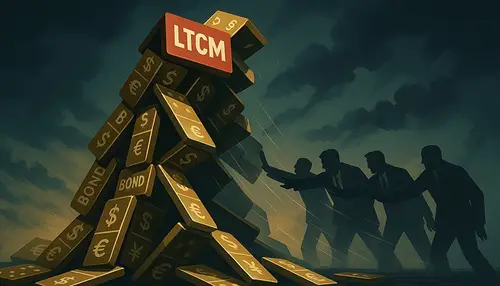
    LTCM's 1998 collapse revealed the dangers of extreme leverage and complex strategies, triggering a Fed-coordinated bailout to prevent global financial chaos.

    In the late 1990s, Long-Term Capital Management (LTCM) was considered one of the most elite hedge funds in the world. Founded in 1994 by former Salomon Brothers trader John Meriwether, the firm boasted an all-star team that included Nobel Prize-winning economists Myron Scholes and Robert Merton. With credentials like that, LTCM attracted billions in capital from the financial elite and then leveraged it to the hilt. By 1998, the fund’s collapse would send shockwaves through global markets, prompting a Federal Reserve-led rescue that remains one of the most dramatic episodes in financial history.

    LTCM’s strategy relied heavily on fixed-income arbitrage, placing sophisticated bets on price convergence between related securities, often in government bond markets. These trades typically offered slim spreads, so the fund relied on massive leverage (up to 25 or 30 times its capital) to amplify returns. At its peak, LTCM managed $4.7 billion in investor equity but had exposure to over $125 billion in assets and nearly $1.3 trillion in notional derivatives.

    For several years, the strategy worked brilliantly. LTCM posted returns of more than 40% in its first full year and continued to outperform through 1996. But as more hedge funds began mimicking similar strategies and spreads compressed, the fund’s edge began to fade. Undeterred, LTCM doubled down, both in size and complexity, betting that global markets would continue behaving according to models rooted in historical norms and mean reversion.

    Then came the Russian debt crisis of August 1998. Russia unexpectedly defaulted on its domestic debt and devalued the ruble, sending shockwaves through global bond markets. The fallout triggered a massive flight to quality. Spreads that LTCM had bet would narrow instead widened violently. Its positions, many of them illiquid, suffered catastrophic losses. Because LTCM was so heavily leveraged, even small market movements became existential threats.

    Within weeks, LTCM lost over $4 billion. As its positions deteriorated, its counterparties (major banks and dealers) faced the possibility of staggering losses. LTCM’s web of relationships meant that its collapse would not be isolated. A disorderly liquidation could trigger a fire sale across markets, impairing balance sheets and liquidity globally. Alarmed by the systemic risk, the Federal Reserve Bank of New York stepped in to orchestrate a private sector bailout.

    On September 23, 1998, a consortium of 14 major banks and financial institutions (including Goldman Sachs, J.P. Morgan, and Merrill Lynch) agreed to inject $3.6 billion into LTCM to stabilize the fund in exchange for 90% ownership. The intervention prevented an immediate market collapse but raised deep concerns about financial concentration, leverage, and the role of hedge funds in systemic risk.

    In the aftermath, LTCM was gradually unwound, and investors recovered much of their capital. But the event had lasting consequences. It exposed the vulnerabilities of financial models that failed to account for tail risks and market irrationality. It also underscored how interconnected the financial system had become, and how leverage, even in a single fund, could endanger global stability.

    In retrospect, LTCM’s collapse was a dress rehearsal for future crises. It was not a fraud, but a failure of assumptions, risk management, and humility. And it left an indelible mark on Wall Street, reminding the world that even the smartest investors can be undone when leverage meets the unexpected.

    02 / 10

    When Tiger Management Walked Away: Missing the Tech Boom and Calling the Top

    When Tiger Management Walked Away: Missing the Tech Boom and Calling the Top

    Tiger Management's collapse marked the end of Julian Robertson's legendary hedge fund, undone by his principled refusal to chase dot-com speculation.

    In March 2000, Julian Robertson shocked Wall Street by announcing the closure of Tiger Management, the storied hedge fund he had founded in 1980. With more than $20 billion under management at its peak, Tiger had been one of the most influential and admired investment firms of its era. But by the time the new millennium arrived, the fund was hemorrhaging capital, caught on the wrong side of a market increasingly dominated by tech stocks that Robertson simply didn’t believe in.

    Tiger’s downfall was not born of scandal or recklessness, but of principle. Robertson, a former stockbroker at Kidder Peabody, built his investment empire on the belief in strong fundamentals: undervalued companies with sound management, disciplined capital structures, and consistent earnings. For two decades, the strategy worked. Tiger posted annualized returns of more than 30%, minting billions for its founder and investors, and earning a reputation as a breeding ground for elite fund managers.

    But by the late 1990s, a new kind of market had taken hold. The dot-com boom was in full swing, and traditional metrics like earnings, margins, or cash flow were increasingly seen as irrelevant. Companies with little more than a website and a Nasdaq listing were trading at sky-high valuations. To Robertson, it looked like madness.

    Rather than join the frenzy, Tiger doubled down on its convictions. The fund shorted a number of tech names it viewed as overvalued, while remaining long on companies it believed were solid but out of favor, such as U.S. Airways and traditional industrials. Unfortunately for Robertson, markets remained irrational longer than he could remain solvent. Tiger’s flagship fund lost 19% in 1999, underperforming a Nasdaq that surged over 80%.

    Investors, once loyal to Robertson’s discipline, began pulling their money. The media questioned whether the old-school approach had become obsolete. Some critics labeled him out of touch. Robertson, for his part, remained steadfast. In his closing letter to investors, he cited the market’s speculative excess and his inability to “understand the values of these tech stocks.” Rather than compromise his principles or chase performance, he returned capital, walking away from one of the most celebrated hedge fund franchises in history.

    Ironically, Robertson’s timing was nearly perfect. Weeks after Tiger closed, the Nasdaq peaked and began its catastrophic descent. By late 2000, many of the very companies Tiger had shorted were in freefall. Within a year, the dot-com bubble had burst, wiping out trillions in market value. Yet Tiger’s redemption came too late. The fund’s closure was complete, and Robertson had exited the stage, vindicated but out of business.

    Despite the fund’s end, Robertson’s legacy endured. Many of his protégés went on to launch their own successful funds, known collectively as the “Tiger Cubs.” These included Chase Coleman (Tiger Global), Lee Ainslie (Maverick), and Stephen Mandel (Lone Pine), all of whom carried forward Robertson’s core principles with adaptations to new market realities.

    In retrospect, the fall of Tiger Management was not a failure of insight, but a consequence of conviction in the face of irrational exuberance. Robertson didn’t miss the future; he refused to finance what he believed was fantasy. And in doing so, he left behind not just a firm, but a philosophy that continues to shape hedge fund investing to this day.

    03 / 10

    The Madoff Fallout: A Wake-Up Call for Institutional Due Diligence Practices

    The Madoff Fallout: A Wake-Up Call for Institutional Due Diligence Practices

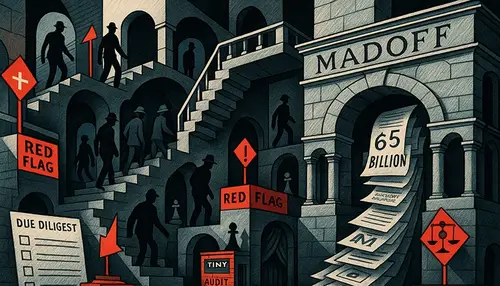
    Madoff's $65B fraud collapsed in 2008, shattering investor trust and exposing critical failures in the due diligence processes of fund of hedge funds.

    When Bernie Madoff’s massive Ponzi scheme unraveled in December 2008, the initial shock focused on the sheer scale of the fraud: over $65 billion in fictitious account statements, built over decades. But as the dust settled, a deeper and more systemic failure became clear: how so many sophisticated investors, especially fund of hedge funds, had funneled billions into Madoff’s strategy without detecting the glaring red flags.

    At the time, fund of hedge funds were considered a relatively safe, diversified way for institutional clients and high-net-worth investors to access alternative strategies. These intermediaries pooled capital and allocated it across multiple hedge funds, charging a second layer of fees in exchange for manager selection, portfolio construction, and, most critically, due diligence. That last function (evaluating the operational integrity and risk profile of underlying managers) became the central question in the Madoff scandal’s aftermath.

    Many prominent fund of funds, including names like Fairfield Greenwich, Tremont Group, and Ascot Partners, had placed significant assets with Madoff. In several cases, Madoff’s fund was their single largest allocation. These institutions vouched for his consistency, low volatility, and supposed “split-strike conversion” strategy, a vaguely described options-based arbitrage approach that yielded surprisingly smooth returns over decades.

    But those returns were fiction. Madoff wasn’t trading at all. Instead, he was operating the largest Ponzi scheme in history, paying older investors with new money while maintaining an illusion of stability through falsified statements and a complicit auditor. What the collapse exposed was not just a fraud, but a stunning failure of process across multiple layers of institutional investing.

    Despite marketing themselves as due diligence experts, many fund of funds failed to conduct even the most basic operational checks. Madoff used a single, obscure auditing firm with only one active accountant. He self-custodied assets, bypassing third-party clearing. He restricted transparency and denied investor visits to the trading floor. And yet, year after year, fund of funds not only stayed invested: they increased allocations and promoted him to clients.

    Why did so many miss the signs? For some, it was greed: Madoff’s strategy offered returns that were consistently positive and seemingly uncorrelated with markets. For others, it was complacency or overreliance on reputation: Madoff had served as chairman of NASDAQ and was deeply embedded in financial circles. In many cases, fund of funds simply accepted audited returns without questioning how they were generated.

    The repercussions were severe. Investors lost billions, and several fund of funds collapsed or faced lawsuits. The credibility of the entire industry came under scrutiny. In response, institutional investors began demanding deeper transparency, third-party custodianship, and verifiable trading records. The Madoff case redefined the standards for operational due diligence: no longer a formality, but a central risk control.

    In retrospect, Madoff’s fraud did more than expose a criminal; it revealed how easily sophisticated structures can fail when incentives override inquiry. Fund of funds, once viewed as gatekeepers, were revealed to be vulnerable links in the chain. The scandal wasn’t just about one man’s deception; it was about an ecosystem that chose comfort over skepticism.

    04 / 10

    The Galleon Group Case: How Wiretaps Revolutionized Insider Trading Investigations

    The Galleon Group Case: How Wiretaps Revolutionized Insider Trading Investigations

    A landmark investigation that introduced aggressive surveillance tactics into financial crime enforcement, reshaping the landscape of Wall Street.

    The 2009 arrest of Raj Rajaratnam, founder of the Galleon Group, marked a turning point in financial crime enforcement. At the center of one of the largest insider trading cases in U.S. history, Rajaratnam’s downfall wasn’t triggered by spreadsheets or whistleblowers: it was wiretaps. For the first time, federal prosecutors used techniques traditionally reserved for organized crime and narcotics cases to expose the inner workings of high-stakes financial manipulation. The case would lead to the collapse of Galleon, a once-celebrated hedge fund, and redefine how Wall Street polices itself.

    Galleon Group, founded in 1997, was a powerhouse in tech-focused equity investing. At its peak, it managed over $7 billion and was known for aggressive trading, deep industry networks, and a track record of delivering returns. Rajaratnam, a Sri Lankan-American with a reputation for data-driven analysis and sharp instincts, cultivated relationships with tech executives, analysts, and consultants. But prosecutors would later argue that his edge was not just insight: it was illegal information.

    The government’s case centered on a vast insider trading network involving tipsters at public companies, consultants at firms like McKinsey & Co., and employees at Intel, IBM, and Goldman Sachs. Unlike earlier cases that relied on circumstantial evidence or delayed reporting, the Rajaratnam investigation used court-authorized wiretaps to capture conversations in real time. It was a watershed moment: Wall Street’s most opaque behavior was now caught on tape.

    In one wiretap, Rajaratnam was heard discussing confidential earnings numbers days before their release. In another, he described specific stock movements based on insider tips. The recordings painted a picture of systemic misconduct, trading on material nonpublic information as if it were just another form of research. The audio evidence gave prosecutors extraordinary leverage in court and led to a cascade of guilty pleas from cooperating witnesses.

    Among those implicated was Rajat Gupta, a former McKinsey chief and Goldman Sachs board member. Gupta, who had once been a respected figure in global business circles, was convicted for leaking confidential information about Goldman’s financials and Warren Buffett’s $5 billion investment in the bank at the height of the 2008 crisis. The breach of fiduciary duty highlighted how even the most reputable boardrooms were vulnerable to personal and professional betrayal.

    The impact on Galleon was immediate. After the charges were filed, investors fled, and the fund began liquidating assets. By the end of 2009, Galleon was shuttered, its employees dispersed, its founder under house arrest, and its reputation in ruins. In 2011, Rajaratnam was convicted on 14 counts of securities fraud and conspiracy and sentenced to 11 years in prison, one of the longest sentences ever for insider trading.

    The broader implications of the Galleon case were seismic. It emboldened the Department of Justice and the SEC to expand their use of surveillance tools and led to a wave of insider trading investigations throughout the 2010s. Dozens of hedge fund professionals, analysts, and corporate insiders were charged in the years that followed, creating a culture of heightened compliance and legal caution on Wall Street.

    In retrospect, the Galleon Group case was not just about one fund’s collapse; it was about shifting the rules of engagement in financial crime enforcement. It showed that even the most sophisticated traders could be brought down not by balance sheets, but by their own words, recorded, replayed, and submitted as evidence in a courtroom where narrative no longer shielded behavior from the law.

    05 / 10

    The Fall of Amaranth: When a $6 Billion Gas Bet Brought Down a Hedge Fund

    The Fall of Amaranth: When a $6 Billion Gas Bet Brought Down a Hedge Fund

    Amaranth Advisors' 2006 implosion after losing $6B on natural gas trades revealed the dangers of concentrated positions and inadequate risk controls.

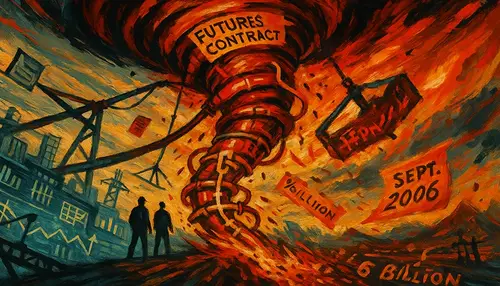
    In the fall of 2006, Amaranth Advisors, a multi-strategy hedge fund managing over $9 billion, collapsed almost overnight, losing more than $6 billion in a matter of weeks. At the heart of the implosion was a single trader, a concentrated bet on natural gas futures, and a failure of internal risk controls that turned a bold position into a cautionary tale.

    Founded in 2000 by Nicholas Maounis, Amaranth initially built its reputation as a diversified hedge fund focused on convertible arbitrage, credit strategies, and relative value trading. By the mid-2000s, it had delivered solid returns and attracted institutional capital. But under the surface, the firm was growing increasingly reliant on one profit center: energy trading, and specifically, the trades of a Canadian-born star named Brian Hunter.

    Hunter had made a name for himself in 2005 by producing massive profits through natural gas bets. He was promoted to co-head of energy trading and given expanded latitude in 2006. By that year, his trades accounted for the majority of Amaranth’s gains, and its risk.

    Hunter’s strategy was essentially a directional bet on the shape of the natural gas futures curve. He wagered that the spread between winter and summer gas prices would widen significantly, believing the market was underpricing future demand. To express this view, he amassed a highly leveraged position in long-dated futures contracts, betting that prices for the 2007 winter months would surge.

    But the market had other ideas. In September 2006, a combination of mild weather forecasts, high inventories, and shifting sentiment caused the natural gas curve to collapse. Prices for the contracts Hunter had bet on fell sharply. With his positions heavily leveraged, even a modest market move triggered cascading losses.

    Amaranth scrambled to contain the fallout. Over a single week in mid-September, it lost over $5 billion, more than half of its assets. The scale and speed of the losses stunned the market and rivaled the LTCM crisis of 1998, though without the same systemic implications. By the end of the month, the firm announced it would liquidate.

    The damage was not limited to Amaranth’s balance sheet. The event rattled investor confidence in energy trading strategies and raised concerns about hedge fund leverage and regulatory oversight in the natural gas market. Congressional hearings followed, as did investigations by the Commodity Futures Trading Commission (CFTC) and the Federal Energy Regulatory Commission (FERC).

    Brian Hunter, for his part, defended his strategy and blamed poor execution and market manipulation by rivals. Regulators later accused him of attempting to manipulate prices, though the legal outcomes were mixed. He was fined and banned from trading certain energy contracts but avoided prison.

    For the industry, Amaranth’s collapse became a textbook example of risk concentration and the limits of star trader autonomy. A multi-strategy fund had effectively become a single-strategy, single-trader operation without the infrastructure to manage that risk. It also highlighted the opacity of over-the-counter derivatives and the potential for market instability even when the broader economy remained stable.

    In retrospect, Amaranth’s fall was not a function of market volatility alone; it was a failure of governance, diversification, and humility. It showed how quickly a hedge fund’s fortunes can turn when conviction transforms into overexposure, and how risk, when unchecked, can undo even the most successful firms in a matter of days.

    06 / 10

    The Bayou Group Collapse: Fraud, Fabricated Audits, and Investor Deception

    The Bayou Group Collapse: Fraud, Fabricated Audits, and Investor Deception

    The 2005 collapse of Bayou Group revealed how weak oversight, fake audits, and unchecked trust enabled one of the earliest major hedge fund frauds.

    Before the name Madoff became synonymous with investment fraud, another scandal rocked the hedge fund world, smaller in scale, but just as revealing. The collapse of the Bayou Group in 2005 exposed critical weaknesses in hedge fund oversight and investor due diligence. It was one of the first high-profile hedge fund frauds of the modern era and served as a harbinger of more systemic failures to come.

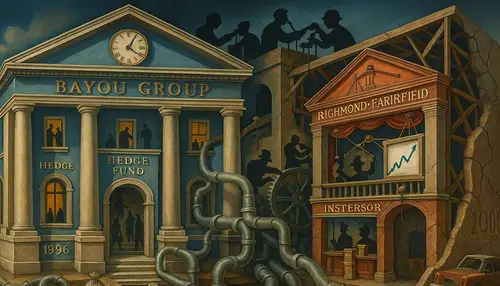
    Bayou Group was founded in 1996 by Samuel Israel III, a former commodities trader who marketed his fund as a low-risk, high-transparency alternative in an industry known for secrecy. Based in Stamford, Connecticut, Bayou promised strong returns using a disciplined, value-driven strategy. It raised over $450 million from investors, including wealthy individuals and institutions drawn to its performance track record and seemingly professional infrastructure.

    But from the beginning, Bayou’s returns were largely fiction. Within its first year, the fund suffered trading losses, and rather than disclose the setbacks, Israel and his team began falsifying performance data. They reported steady, positive returns while hiding mounting deficits. In order to avoid detection during audits, Bayou took a brazen step: it created a fake accounting firm, Richmond Fairfield Associates, to issue falsified audit statements and investor communications.

    The deception worked for nearly a decade. Investors continued to allocate capital based on glowing performance reports and clean audits. Bayou used new investor funds to pay out redemptions to earlier clients, a classic hallmark of Ponzi-like operations. Israel and his CFO, Daniel Marino, also siphoned off millions in investor money for personal use and luxury spending.

    The scheme began to unravel in 2005 when investors requested redemptions that the fund could no longer meet. Bayou announced it was shutting down and returning capital. But when investors demanded transparency, the truth emerged. Investigations revealed not only the scale of the losses, but the elaborate infrastructure of fraud. Federal prosecutors filed charges, and by year’s end, both Israel and Marino were facing criminal indictments.

    In 2008, Israel failed to appear for sentencing and staged a fake suicide by abandoning his car on a bridge over the Hudson River. He left a note suggesting he had jumped, prompting a manhunt and intense media scrutiny. Weeks later, he was found hiding in a friend’s garage and was arrested. He ultimately received a 22-year prison sentence.

    While the dollar amount involved in the Bayou scandal was modest compared to future frauds, the case had an outsized impact. It shattered the assumption that hedge funds, even small ones, operated with basic levels of integrity and oversight. It exposed how lightly regulated entities could exploit investor trust, and how easy it was to fabricate legitimacy without third-party verification.

    In the aftermath, the scandal prompted a reevaluation of operational due diligence across the alternative investment world. Investors became more cautious, demanding independent audits, custodianship of assets, and clearer separation of roles between fund managers and service providers. For regulators, Bayou was an early warning: a demonstration of how deception could thrive even in a post-SEC-registration environment.

    In retrospect, Bayou was the hedge fund industry’s early wake-up call. It proved that fraud didn’t require complex financial instruments, just opacity, arrogance, and a willingness to lie. And in doing so, it opened the door to a new era of scrutiny in hedge fund investing.

    07 / 10
    SAC Capital’s Downfall: A Tale of Insider Trading and Legal Repercussions

    An in-depth examination of the insider trading scandal that led to SAC Capital’s guilty plea, substantial fines, and the transformation of its operations.

    For years, SAC Capital Advisors was one of the most powerful and secretive hedge funds on Wall Street. Founded in 1992 by Steven A. Cohen, the firm managed over $15 billion at its peak, delivering consistent double-digit returns and cultivating a mystique around its founder’s intuition and trading prowess. But behind its outsized performance lay a culture that, according to federal prosecutors, encouraged the use of inside information and ultimately brought the firm to its knees.

    The unraveling began quietly in the late 2000s, as the Securities and Exchange Commission and the Department of Justice intensified their focus on insider trading in the hedge fund industry. SAC, known for its aggressive “mosaic theory” research approach (gathering bits of non-material data to build a trading thesis), had long operated in the gray areas of compliance. But prosecutors would later argue that some of its portfolio managers had crossed a clear legal line.

    The most damaging allegations centered around trades in pharmaceutical stocks, particularly the use of nonpublic information about clinical trial results and earnings guidance. In 2011, one of SAC’s portfolio managers, Mathew Martoma, was charged with using inside information from a doctor involved in an Alzheimer’s drug trial to execute trades in shares of Elan and Wyeth. The trades netted SAC over $275 million in profits and avoided losses, one of the largest insider trading windfalls in U.S. history.

    Martoma’s conviction in 2014 was a key moment in the government’s case, but it was part of a broader web of enforcement actions. Over time, more than half a dozen former SAC employees were charged or implicated in insider trading schemes. While Steven Cohen himself was never criminally charged, prosecutors alleged that he had failed to properly supervise his firm and turned a blind eye to suspicious trading activity.

    In 2013, the Department of Justice filed criminal charges against SAC Capital itself, an extraordinary step rarely taken against an entire hedge fund. The firm pleaded guilty to insider trading, agreed to pay a $1.8 billion penalty, and ceased managing outside capital. It was one of the largest financial crime settlements in history and a dramatic fall for one of Wall Street’s most storied firms.

    The repercussions were swift. SAC Capital shut down, and Cohen converted his operations into a family office, Point72 Asset Management, focused solely on managing his personal fortune. Though Cohen would later re-enter the public investing space, the reputational damage endured. SAC’s downfall became a case study in the limits of legal tolerance, no matter how successful or well-connected a fund may be.

    The case also had ripple effects across the hedge fund industry. It triggered a wave of compliance overhauls, more robust information barriers, and increased scrutiny of expert networks and research methods. For regulators, it marked a triumph: proof that even the most elite firms were within reach of prosecution when the law was broken.

    In retrospect, SAC Capital’s rise and fall reflected the extremes of modern hedge fund culture: performance-driven, secretive, and at times ethically ambiguous. Its downfall wasn’t merely about a few rogue traders; it was about systemic failure to enforce boundaries in the pursuit of alpha. And in bringing down SAC, the government sent a message that continues to echo through the halls of high finance: no one is above the rules.

    08 / 10

    When Valuation Models Lie: Inside the $1.7B Fraud at Infinity Q Capital

    When Valuation Models Lie: Inside the $1.7B Fraud at Infinity Q Capital

    Infinity Q's 2021 collapse exposed how complex derivatives and manipulated valuation models enabled one of the largest investment frauds in recent history.

    In early 2021, Infinity Q Capital Management abruptly halted redemptions from its flagship mutual fund, sending shockwaves through the asset management industry. At issue was not a market downturn or liquidity crisis, but something more troubling: alleged manipulation of valuation models tied to complex derivatives. By the time the dust settled, investors faced losses of up to $1.7 billion, one of the largest valuation-related frauds in recent memory.

    Infinity Q was founded in 2014 by James Velissaris, a former portfolio manager at Weiss Multi-Strategy Advisers. The firm positioned itself as a sophisticated alternatives manager, offering a mutual fund and a private fund that invested heavily in exotic derivatives, including customized over-the-counter (OTC) instruments linked to equity volatility, interest rates, and foreign exchange. With backing from institutions and a seemingly robust valuation framework, Infinity Q grew rapidly, managing over $3 billion at its peak.

    The trouble began in February 2021, when the SEC revealed that Velissaris had been overstating the value of complex derivative positions using manipulated inputs in pricing models. Rather than rely on independent third-party valuations, he allegedly altered key assumptions (such as volatility curves and correlation inputs) to inflate asset values. The mispricing was not minor. According to court filings, Velissaris’s adjustments created a discrepancy of over $1.7 billion between reported and actual portfolio value.

    One of the most concerning elements was that the mutual fund, the Infinity Q Diversified Alpha Fund, was registered under the 1940 Act and subject to daily NAV reporting. Investors believed they were accessing a liquid, regulated product with robust oversight. Yet, due to the complexity of the derivatives and the opacity of the valuation process, the manipulation went undetected for years.

    Infinity Q’s custodian and administrator relied on pricing data supplied by the firm, and Velissaris had allegedly bypassed internal controls by misrepresenting the models’ integrity. Even when questioned by internal compliance staff and auditors, he maintained that the values were accurate. It wasn’t until he was asked to take a leave of absence by the board that deeper scrutiny revealed the scale of the issue.

    The fund was liquidated under the supervision of a court-appointed receiver. Investors faced substantial losses, and litigation followed. In 2022, Velissaris was indicted on multiple counts of securities fraud, wire fraud, and obstruction of justice. He initially pleaded not guilty, but pleaded guilty in November 2022 to securities fraud, and in June 2023 was sentenced to 15 years in federal prison and ordered to forfeit tens of millions of dollars. The case highlighted not only individual misconduct but systemic weaknesses in how complex instruments are priced, audited, and communicated to investors.

    The Infinity Q scandal raised urgent questions about valuation practices across the asset management industry, particularly in funds that deal with illiquid or bespoke derivatives. It revealed the limitations of oversight mechanisms that rely too heavily on fund managers to self-report valuations and the need for truly independent pricing oversight in complex portfolios.

    In retrospect, the Infinity Q fraud was not about a single rogue trader; it was about the fragility of trust in a system where complexity and opacity can obscure risk. For regulators and investors alike, it served as a sobering reminder that even regulated funds can harbor unseen dangers when valuation becomes more art than science.

    09 / 10

    The Archegos Collapse: Margin Trading at Scale and the Limits of Leverage

    The Archegos Collapse: Margin Trading at Scale and the Limits of Leverage

    The 2021 collapse of Archegos Capital revealed the hazards of extreme leverage and hidden derivatives, triggering $10 billion in bank losses and regulatory action.

    In March 2021, Wall Street was rocked by the sudden implosion of Archegos Capital Management, a little-known family office run by former hedge fund manager Bill Hwang. In a matter of days, Archegos defaulted on margin calls, triggering a fire sale of more than $30 billion in equities and leaving global investment banks nursing losses that would ultimately exceed $10 billion. The collapse exposed not just the risks of concentrated bets, but also the systemic blind spots around leverage, transparency, and counterparty risk in modern financial markets.

    Archegos wasn’t a hedge fund in the traditional sense. Following a 2012 insider trading settlement with the SEC, Hwang had returned outside investor capital and converted his firm into a family office. That meant it was largely exempt from regulatory disclosure requirements that apply to traditional investment managers. Operating in this opaque space, Hwang quietly built massive positions in a handful of high-growth stocks (most notably ViacomCBS, Discovery, Baidu, and Tencent Music) using total return swaps to avoid public filings and maximize leverage.

    These derivatives, executed through prime brokerage agreements with banks like Credit Suisse, Nomura, Goldman Sachs, and Morgan Stanley, allowed Archegos to synthetically own large blocks of stock without directly holding them. Crucially, each bank was unaware of the full extent of Archegos’s exposure across its competitors. At its peak, Archegos was believed to have amassed more than $100 billion in stock exposure on a capital base of just $10 billion, leveraging some positions by as much as 5 to 1 or more.

    The house of cards began to fall when ViacomCBS, one of Archegos’s largest holdings, announced a secondary offering in late March 2021. The stock plunged nearly 30% over two days, triggering margin calls from prime brokers. Archegos, unable to meet the demands, defaulted. Banks scrambled to unwind positions, but the coordination was chaotic. Goldman Sachs and Morgan Stanley acted swiftly, dumping blocks of stock into the market. Others, like Credit Suisse and Nomura, were slower to respond, and bore the brunt of the damage.

    Credit Suisse alone reported losses of $5.5 billion, leading to the ouster of top executives and a major overhaul of its risk management systems. Nomura lost over $2 billion. UBS, Morgan Stanley, and Deutsche Bank suffered smaller hits. Archegos, for its part, was wiped out entirely.

    The scale and speed of the collapse stunned the financial community, not because a fund had failed, but because so little was known about its exposures until it was too late. Archegos’s use of swaps allowed it to accumulate significant positions without triggering disclosure thresholds under U.S. securities law. The event reignited debates over the regulation of family offices, the opacity of derivative markets, and the adequacy of bank risk controls in the prime brokerage business.

    Regulators and lawmakers responded with calls for reform. The SEC launched investigations into disclosure practices and proposed Rule 10B-1 to require disclosure of large swap positions. More consequentially, Hwang himself was convicted in July 2024 on 10 counts including wire fraud, securities fraud, and market manipulation, and on November 20, 2024 a federal judge sentenced him to 18 years in prison, one of the longest white-collar sentences in modern Wall Street history. Credit Suisse, whose $5.5 billion Archegos loss contributed to its broader crisis of confidence, was forced into an emergency sale to UBS in March 2023. Legislative changes to the family office regime itself remain limited, underscoring how difficult it is to regulate complexity once it’s embedded in market structure.

    In retrospect, the Archegos collapse wasn’t a traditional fraud or a mispriced asset; it was a failure of visibility and risk discipline. It revealed how even sophisticated institutions can be blindsided when leverage operates in the shadows. Archegos didn’t just lose money; it exposed the fragile seams of financial intermediation at scale.

    10 / 10

    Melvin Capital and the GameStop Short Squeeze: A Case Study in Leverage Risk

    Melvin Capital and the GameStop Short Squeeze: A Case Study in Leverage Risk

    In 2021, Melvin Capital's GameStop short position collapsed amid a retail investor squeeze, causing massive losses and exposing margin trading's systemic risks.

    In January 2021, Melvin Capital, once a rising star in the hedge fund world, found itself at the center of a financial firestorm, caught in one of the most dramatic short squeezes in market history. The target: GameStop, a struggling brick-and-mortar video game retailer. What began as a contrarian bet by a Reddit-fueled retail army morphed into a systemic stress event, and Melvin became the emblem of how leverage, short selling, and social media-fueled momentum could collide with devastating effect.

    Founded in 2014 by Gabe Plotkin, a protégé of Steve Cohen’s SAC Capital, Melvin Capital had quickly built a reputation for sharp equity research and consistent performance, managing nearly $12.5 billion by the start of 2021. Plotkin’s strategy focused heavily on shorting companies he viewed as structurally flawed or fundamentally overvalued. One such target was GameStop, a retailer that many viewed as a relic of a bygone era, with declining revenues and little digital presence.

    Melvin built a large short position in GameStop, betting the stock would continue to decline. But this time, the trade did not go unnoticed. Users on Reddit’s WallStreetBets forum, long aware of the outsized short interest in GameStop (more than 100% of its available float) began buying shares and call options en masse, aiming to force a short squeeze. Their thesis blended financial opportunism with cultural rebellion: take on Wall Street, profit in the process, and expose the vulnerabilities of institutional short selling.

    As GameStop’s stock surged from under $20 in early January to an intraday high of $483 by month’s end, Melvin’s position turned catastrophic. Forced to cover its short at increasingly painful prices, the fund suffered estimated losses of over 50% in just a matter of weeks. The firm required a $2.75 billion capital infusion from Citadel and Point72 to stay afloat, marking one of the fastest and most public hedge fund rescue attempts in recent history.

    The squeeze wasn’t just about Melvin. It became a cultural moment. Retail investors, empowered by zero-commission trading platforms like Robinhood, turned financial markets into a digital battleground. Meme stocks, companies with weak fundamentals but viral momentum, became symbols of populist finance. Meanwhile, platforms like Robinhood faced their own crisis when they restricted trading in GameStop and other heavily shorted names due to collateral demands from clearinghouses, sparking outrage and regulatory scrutiny.

    For Melvin, the damage was irreversible. Though the firm attempted to recover, its reputation, and its model, were deeply shaken. In May 2022, Plotkin announced the fund would shut down, returning capital to investors. Despite years of strong performance, the GameStop squeeze proved too costly, and too public, to overcome.

    The episode raised broader concerns about the mechanics of modern markets. It exposed the risks of high short interest in thinly traded stocks, the systemic stress caused by margin calls, and the growing influence of retail investors acting in coordination, whether through forums, sentiment, or shared ideology. Regulators began reexamining disclosure requirements for short positions, the role of payment for order flow, and the responsibilities of trading platforms during volatility.

    In retrospect, Melvin Capital’s downfall wasn’t just about a bad trade. It was about the fragility of confidence in leveraged positions, the speed at which sentiment can change, and the unpredictability of markets shaped as much by narrative as by numbers. The GameStop saga didn’t just humble a hedge fund; it rewrote the playbook for what market risk looks like in the social media age.

    Frequently Asked Questions

    Explore More

    Ready to Transform Your Interview Prep?

    Join 3,000+ students preparing smarter

    Join 3,000+ students who have downloaded this resource