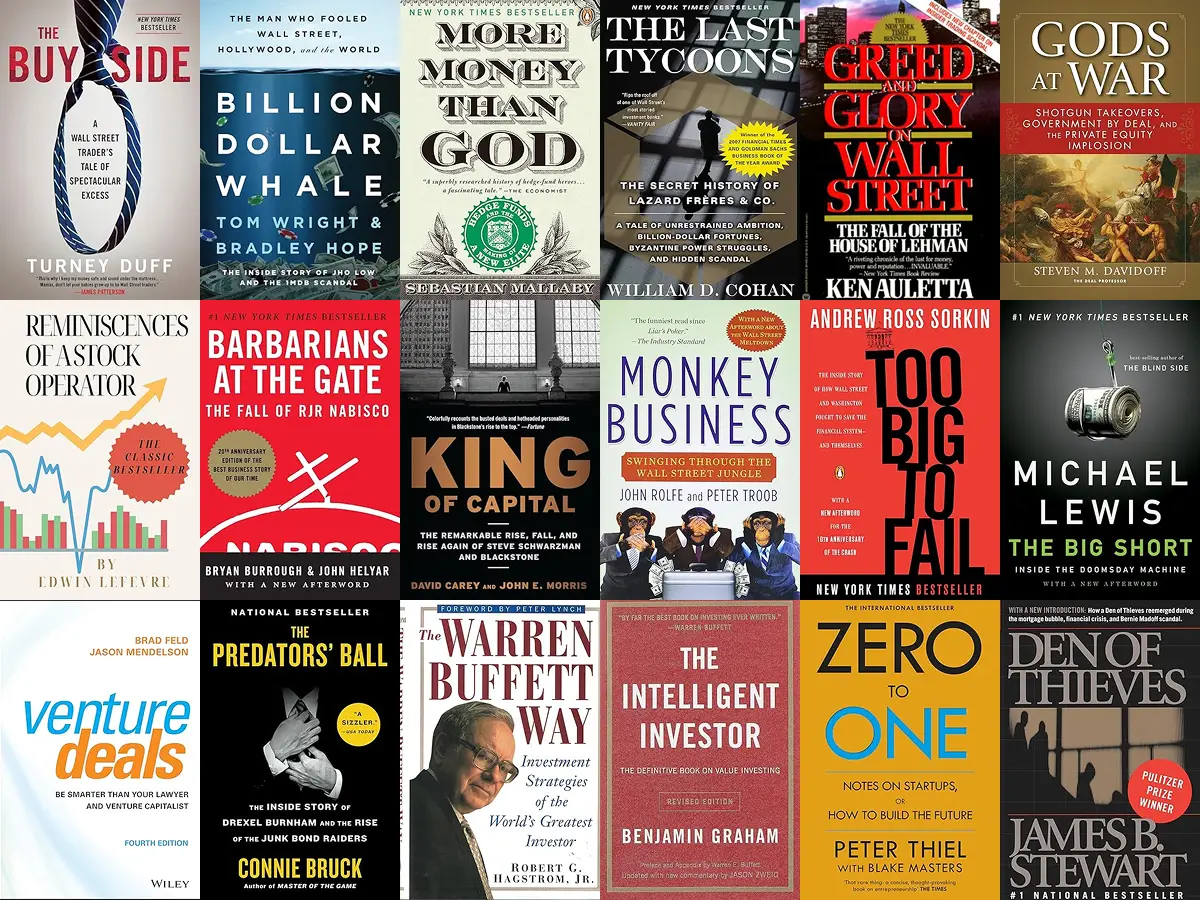
Best Private Equity Books
If you are targeting private equity or want to understand how buyouts actually work, these books take you inside the firms and deals that shaped the industry. They cover everything from LBO mechanics to the personalities driving billion-dollar transactions.
Last updated: February 2026
Key Topics Covered
Fund Economics and How PE Firms Make Money
King of Capital provides the clearest explanation of how a private equity firm actually operates as a business. From management fees and carried interest to fund lifecycle and LP relationships, the book uses Blackstone's history to illustrate the economics that drive the entire industry. The New Tycoons extends this across the major firms, covering how KKR, Carlyle, TPG, and Apollo each built their own variations on the buyout model.
Leveraged Buyouts and Deal History
Barbarians at the Gate remains the most detailed and dramatic account of a single leveraged buyout ever written. The RJR Nabisco deal is a complete case study in LBO mechanics: the management buyout proposal, the competing bids, the financing structures, and the final resolution. The Predators' Ball explains the junk bond revolution that made these deals possible in the first place, tracing how Michael Milken's innovations at Drexel Burnham created the high-yield debt market that still underpins leveraged buyouts today.
Regulation, Ethics, and Industry Controversies
Den of Thieves covers the insider trading scandal that nearly destroyed the 1980s deal-making culture, following the investigation and prosecution of Milken, Boesky, Siegel, and Levine. It provides essential context for understanding the regulatory environment that shapes private equity today, and the compliance standards that firms now operate under. The ethical questions raised by the book remain relevant as the industry continues to grow in scale and influence.
How We Selected These Books
We chose these five private equity books because they cover the full arc of the industry's history: from the junk bond revolution and the first wave of hostile LBOs, through the insider trading scandals and regulatory backlash, to the rise of modern mega-funds like Blackstone. Each book provides a different perspective on how private equity works, and together they give you a comprehensive understanding of the industry's origins, business model, and ongoing evolution.
Top 5 Private Equity Books for 2026

King of Capital: The Remarkable Rise, Fall and Rise Again of Steve Schwarzman & Blackstone
by David Carey & John Edward Morris

Our Review
The best book for understanding how a private equity firm actually works, not just the deals but the business model itself. Carey and Morris trace Blackstone from its founding with $400,000 to its position as one of the largest alternative asset managers in the world, and they explain fund economics, deal sourcing, operational improvements, and exits with real clarity. Schwarzman comes across as relentless and deeply competitive, which makes the founding story genuinely compelling. If you want to understand how PE firms make money, start here.
About This Book
The story of Steve Schwarzman, Blackstone, and a financial revolution, King of Capital is the greatest untold success story on Wall Street.

The New Tycoons: Inside the Trillion Dollar Private Equity Industry That Owns Everything
by Jason Kelly
Our Review
A solid overview of the major PE firms and the people who built them. Kelly profiles KKR, Blackstone, Carlyle, TPG, and Apollo, and does a good job explaining the competitive dynamics between them and how the industry evolved from a controversial niche into a mainstream asset class. It is broader than King of Capital but less deep on any single firm. Best read as a complement to the other books on this list rather than as a standalone. You will come away with a good sense of the landscape and the key personalities.
About This Book
What do Dunkin' Donuts, J. Crew, Toys 'R' Us, and Burger King have in common? They are all currently or just recently were owned, operated, and controlled by private equity firms. The New Tycoons: Inside the Trillion Dollar Private Equity Industry That Owns Everything takes the reader behind the scenes of these firms: their famous billionaire founders, the overlapping stories of their creation and evolution, and the outsized ambitions that led a group of clever bankers from small shops operating in a corner of Wall Street into powerhouse titans of capital.

The Predators' Ball: The Inside Story of Drexel Burnham and the Rise of the Junk Bond
by Connie Bruck
Our Review
This book is essential context for understanding why leveraged buyouts exist in their current form. Without Michael Milken and his junk bond machine at Drexel Burnham, the PE industry as we know it would not exist. Bruck's reporting is excellent, and her portrait of Milken is genuinely fascinating: a brilliant financial innovator who built an entire market from a trading desk and then watched it collapse around him. The connection between high-yield debt and LBO financing clicks in a way that no textbook can replicate. Reads faster than you would expect for 400 pages.
About This Book
'Connie Bruck traces the rise of this empire with vivid metaphors and with a smooth command of high finance's terminology.' - The New York Times

Den of Thieves
by James Brewer Stewart
Our Review
Part financial history, part legal thriller. Stewart won a Pulitzer for this book, and it is easy to see why. The insider trading ring involving Milken, Boesky, Siegel, and Levine is a genuinely wild story, and Stewart traces the investigation and prosecution with incredible detail. It is less about deal mechanics and more about the culture of the 1980s deal-making era, the lines that were crossed, and the consequences. A great read on its own merits, and also valuable context for understanding the regulatory environment that shapes the industry today.
About This Book
A #1 bestseller from coast to coast, Den of Thieves tells the full story of the insider-trading scandal that nearly destroyed Wall Street, the men who pulled it off, and the chase that finally brought them to justice.

Barbarians at the Gate: The Fall of RJR Nabisco
by Bryan Burrough & John Helyar
Our Review
This book appears on the M&A list as well, and it deserves to be on both. From a private equity perspective, what makes it essential is the financing structure of the deal, the management buyout dynamics, and the competitive bidding between KKR, the management group, and other players. The RJR Nabisco LBO was the moment private equity went from a relatively obscure corner of finance to front-page news. Burrough and Helyar tell the story with precision and energy, and the deal remains one of the most instructive case studies in buyout history.
About This Book
A book that stormed both the bestseller list and the public imagination, a book that created a genre of its own, and a book that gets at the heart of Wall Street and the '80s culture it helped define, Barbarians at the Gate is a modern classic - a masterpiece of investigatory journalism and a rollicking book of corporate derring-do and financial swordsmanship.
What Makes a Good Private Equity Book
Private equity books tend to fall into two categories: those that explain how the industry works, and those that tell the stories of the deals and personalities that shaped it. The best ones do both. King of Capital is the strongest example, combining Blackstone's founding narrative with a clear explanation of fund economics and deal mechanics. On the other end, Den of Thieves is pure narrative, focused on the insider trading scandal that nearly brought down the 1980s deal-making culture.
One thing to keep in mind is that private equity has changed significantly since most of these books were written. The 1980s-era hostile takeovers described in Barbarians at the Gate and The Predators' Ball are not how modern PE firms operate. Today's buyouts are friendlier, more operationally focused, and far larger in scale. But the underlying principles, leverage, value creation, exit timing, remain the same, and these books illustrate them better than any textbook.
If you are reading this list to build a serious understanding of private equity, start with King of Capital for the modern industry, then read Barbarians at the Gate for the historical foundation. The Predators' Ball and Den of Thieves fill in the story of how junk bonds and the regulatory backlash shaped what PE became. The New Tycoons works best as a survey after you already have context from the other books.
Frequently Asked Questions
Want More Interview Prep?
Download the IB IQ app for 1,000+ practice questions and AI mock interviews, or our free interview PDF guide.