


Overview
The deal that broke a taboo
In February 2000 a British mobile-phone company barely a decade into its independence bought a 110-year-old German industrial icon for roughly $180 billion, against the wishes of its board, its unions, and its government. Vodafone AirTouch's acquisition of Mannesmann AG was the largest merger ever completed, a record it held for years, and it was something Germany had been told could never happen: the first successful hostile takeover of a major German company by a foreigner. The combined group was worth around $350 billion, and Mannesmann's shareholders ended up owning 49.5% of it.
The deal is remembered for two opposite reasons, and the tension between them is the whole story. To admirers it was the moment European capital markets grew up, when a national champion could be bought by whoever paid the most regardless of which flag flew over headquarters. To critics it was a hostile raid that trampled a German model built on consensus between owners, workers, and managers, and that paid a wildly inflated price at the exact peak of the telecom bubble.
Triumph or catastrophe
Both readings are supported by what happened next. Vodafone did become exactly what Chris Gent set out to build, the world's largest mobile operator, with a footprint stretching from Germany and Italy to the United States. And six years later it wrote off about £28 billion of the goodwill it had booked on Mannesmann and reported a net loss of £21.8 billion (roughly $40.9 billion) for the year, one of the largest in British corporate history.
So the case sits on a genuine paradox: a strategic triumph and a financial catastrophe inside the same transaction. Resolving it requires separating three things the headlines usually blur, the precedent the deal set, the price it paid, and the legacy it left, and the rest of this study takes them in turn, from the spark that started it to the criminal trial it ended in.
How Orange Lit the Fuse
Mannesmann's surprise grab for Orange
For most of its history Mannesmann made steel tubes and industrial machinery. In the 1990s it reinvented itself with startling speed into one of Europe's most successful mobile operators, running Germany's D2 network and stakes across the continent. By 1999 it was a telecom champion wearing the body of an engineering conglomerate, and it was growing aggressively. In October 1999 it made its boldest move yet, agreeing to buy the British mobile operator Orange for around £20 billion.
That acquisition is what started the war, because it put a German company directly into Vodafone's home market. Vodafone, the largest mobile group in the world, suddenly faced an enlarged rival on its own soil. Mannesmann's management saw the Orange purchase as a triumphant expansion; in hindsight it was the move that exposed it, because it gave Vodafone both a reason to attack and the strategic logic to justify swallowing the whole company.
- Hostile takeover
An acquisition pursued over the objection of the target's board, by taking the offer directly to shareholders rather than negotiating a recommended deal. It is routine in the United States and Britain and was, before this deal, almost unheard of for a large German company, where boards, banks, and labor representatives had long combined to keep ownership stable.
Why Vodafone had to respond
Chris Gent, Vodafone's chief executive, could not allow a rival to entrench itself in Britain, but the bid that followed was far more than defensive. Gent saw a once-in-a-generation chance to assemble the first genuinely global mobile network at a stroke. Mannesmann owned precisely the European assets Vodafone lacked, a controlling position in Germany and a strong presence in Italy, and combining them would create a continent-spanning operator no rival could match. The bid was both a shield against Orange and a sword aimed at building an empire.
The strategic case, considered apart from the price, was strong. Mobile was consolidating into a few global scale players, and the logic of telecom consolidation rewarded whoever moved first and biggest. Vodafone had the currency to move, a richly valued stock at the height of the telecom boom, and Gent intended to spend it.
Two companies, two systems
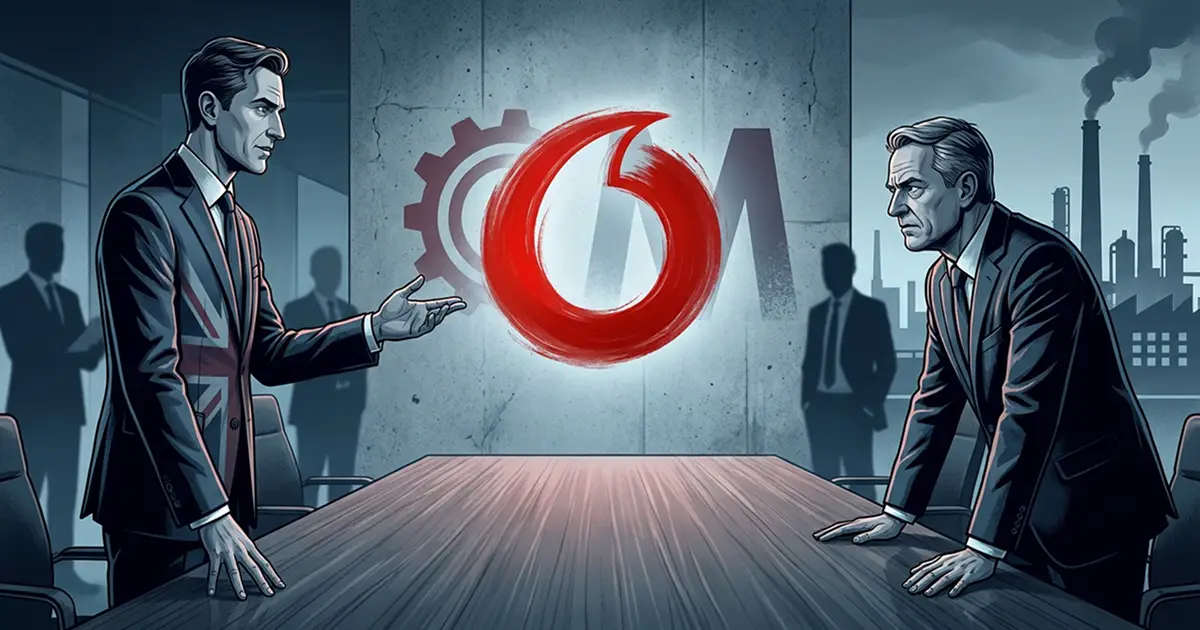
What made the fight historic was that it was never only company against company. Vodafone was an Anglo-American creature: a pure-play mobile operator, run for shareholders, comfortable with hostile tactics, financed through capital markets. Mannesmann was the product of the German social-market model, with employees represented on its supervisory board, close ties to its banks, and a management culture that treated the firm as a community of stakeholders rather than a bundle of shares.
The Bid Germany Said Could Not Happen
"An inferior offer"
On November 13, 1999, after Klaus Esser, Mannesmann's chief executive, rebuffed a friendly approach, Vodafone took its all-stock offer public and hostile. The bid was an exchange of shares, initially around 53.7 Vodafone shares for each Mannesmann share, with no cash component. Esser and his board rejected it immediately and in scathing terms.
an inferior offer which is extremely unattractive for Mannesmann shareholders.
An all-stock hostile bid placed the decision squarely with Mannesmann's shareholders, who would choose whether to swap their stock for Vodafone's. That was a problem for Esser, because a large share of Mannesmann's register was held by Anglo-American institutional investors who had no attachment to German tradition and every interest in the highest price. The structure of the bid, share-for-share with no financing condition, meant the contest would be settled not in a boardroom but on the share register.
- All-stock exchange offer
A takeover in which the bidder offers its own shares rather than cash, at a fixed exchange ratio. The target's shareholders become shareholders of the combined company. Because no cash changes hands, the offer's value rises and falls with the bidder's stock price, and the bidder can pursue a very large target without raising debt, paying instead in its own paper.
Predator capitalism versus the Rhineland model
The bid detonated a national argument about what Germany wanted to be. Trade unions and Mannesmann's works councils condemned it as an assault on the German way of running companies. The most quoted attack came from Klaus Zwickel, the head of the powerful IG Metall union and deputy chairman of Mannesmann's supervisory board.
Vodafone's "brutal behaviour" was an expression of a "predator capitalism" aimed only at short-term shareholder profits.
The political establishment lined up behind the defenders. The argument was about the foundations of German corporate governance.
- Co-determination and the stakeholder model
Co-determination is the German legal requirement that employees hold a substantial share of the seats on a large company's supervisory board, giving labor a formal voice in major decisions. It anchors a stakeholder model in which a company is run for workers, lenders, and the broader community as well as owners. A hostile takeover driven purely by share price is, in this model, an attack on the system itself.
Vodafone understood that winning the shareholders meant reassuring everyone else. Gent took out an open letter in German newspapers pledging no additional job losses and full respect for co-determination and employee representation, and he met Mannesmann's worker representatives in person to repeat it. The promises were sincere enough, but they also revealed the deeper point: an Anglo-American raider was now negotiating with German labor over the terms on which it would be allowed to win.
The white knight that never came
Esser's best hope was a defensive merger that would put Mannesmann beyond Vodafone's reach. He courted Vivendi, the French conglomerate run by Jean-Marie Messier, as a potential partner, the classic move of seeking a friendlier suitor to break up a hostile bid.
- White knight
A friendly third party that a target company invites to acquire or merge with it in order to escape a hostile bidder. The white knight defense works only if the friendly partner actually closes; if the hostile bidder can peel the would-be rescuer away, the target is left exposed with its defenses spent.
That is exactly what happened. Rather than rescue Mannesmann, Vivendi cut a side deal with Vodafone, agreeing to a joint internet venture, Vizzavi, that aligned Messier's interests with Gent's. The white knight switched sides. With its escape route closed and Vodafone's share-for-share offer climbing in value as the telecom market rose, Mannesmann's position became untenable. The defense had failed, and the only question left was price.
The share register that decided it
The reason the German defenses ultimately failed lies in who actually owned Mannesmann, and the answer contained a bitter irony rooted in the Orange deal itself. When Mannesmann bought Orange in October 1999, it paid the seller, Li Ka-shing's Hutchison Whampoa, $14.6 billion, partly in cash and partly in a roughly 10% stake in Mannesmann. The very acquisition that triggered the war had handed a large block of Mannesmann to a profit-driven Hong Kong investor with no loyalty to German tradition and every reason to take the highest bid.
Hutchison was the visible edge of a broader truth. By 2000 a majority of Mannesmann's shares sat with international institutional investors, index funds, and the merger arbitrageurs who pile into any contested target, none of whom cared about co-determination or the Rhineland model. When Vodafone offered them stock rising with the telecom boom, their decision was a matter of arithmetic. Esser could rally unions, works councils, and the chancellor, but none of them owned the shares. The works councils had board seats; the arbitrageurs had the votes. For the rescue to work, Hutchison and the institutions had to say no to a richer offer, and they had no reason to. When the deal closed, Hutchison rolled its Mannesmann stake into about 5% of Vodafone and promptly sold much of it for roughly $5 billion, exactly the behavior the stakeholder model was built to prevent and powerless to stop.
Capitulation at 49.5%
On February 3 and 4, 2000, after a three-month battle, Esser agreed to a recommended deal. The final terms gave Mannesmann shareholders 58.96 Vodafone shares each and a 49.5% stake in the combined company, a meaningful improvement on the opening bid. Esser framed his surrender as victory for his shareholders: he had forced Vodafone to raise its offer substantially and had won them close to half of one of the world's largest companies.
| Terms | Hostile bid (Nov 1999) | Final agreed (Feb 2000) |
|---|---|---|
| Exchange ratio | 53.7 Vodafone shares | 58.96 Vodafone shares |
| Mannesmann holders' stake | below 49.5% | 49.5% |
| Board response | Rejected as "inferior offer" | Recommended to shareholders |
| Implied deal value | rejected | ~$180 billion |
The deeper meaning was unmistakable. A German national champion had been delivered to a foreign acquirer by its own shareholders, over the objections of its board, its unions, and its chancellor. The exchange-ratio mechanics had done what no German institution wanted done, and the stakeholder model had discovered that when ownership is global, shareholders decide.
What Vodafone Actually Bought
An all-stock deal at the telecom peak
Vodafone paid for Mannesmann entirely in its own shares, and the timing of that choice is the financial heart of the case. In early 2000 telecom and internet valuations were at their absolute peak, and Vodafone's stock was a currency inflated by the same mania that was about to collapse. Using that paper to buy Mannesmann's mobile assets booked an enormous amount of goodwill, on the order of $130 billion, the gap between the price paid and the tangible value acquired.
- Goodwill
When an acquirer pays more than the fair value of the target's identifiable net assets, the excess is recorded as goodwill, an intangible asset standing for brand, market position, and expected synergies. A megadeal struck at peak valuations and paid for in overvalued stock generates vast goodwill, which accounting rules later force the company to write down if the acquired business underperforms.
The parallel with the AOL Time Warner merger, struck weeks earlier at the same market peak and also paid for in bubble-era stock, is exact and instructive. In both deals the acquirer used a richly valued currency to buy real assets, and in both the choice to pay in stock rather than cash looked brilliant at the top and disastrous afterward. The difference is that Vodafone's underlying business was real and would endure, where much of AOL's would not. The structure embedded the bubble in the price either way.
Selling Orange to make the deal legal
There was an awkward problem with the prize. Mannesmann had just bought Orange, but Vodafone could not keep it, because European competition rules would not let it own two mobile networks in Britain. So the very asset whose purchase had triggered the entire war had to be sold immediately. In a deal announced in May 2000, Vodafone sold Orange to France Télécom for around €39.7 billion.
The empire it created
Set against the price, the strategic result was everything Gent had promised. Mannesmann brought D2, the number-two mobile network in Germany, and a controlling stake in Omnitel, a leader in Italy, two of the richest mobile markets in Europe. Bolted onto Vodafone's British base and, through the earlier AirTouch merger, a major stake in the United States that would become Verizon Wireless, the combination made Vodafone the largest mobile operator in the world. No competitor could match its scale or its geographic reach.
This is why the deal cannot be dismissed as a simple blunder. Judged as strategy, building a global mobile champion before anyone else could, it succeeded completely, and the cross-border logic of assembling national operators into one network was sound. The failure, when it came, was not strategic. It was a failure of price, and it arrived through the same goodwill that had made the deal possible.
The Bonuses That Became a Crime
Appreciation awards worth $97 million
Once the takeover succeeded, Mannesmann's supervisory-board compensation committee approved a series of payments to departing executives, appreciation awards and pension top-ups totaling roughly $97 million (about 150 million marks), including more than €15 million for Esser himself. Some of these were encouraged from the Vodafone side, which had every reason to want the deal closed smoothly. To Anglo-American eyes this was ordinary, even modest, the kind of reward a chief executive who had raised the price by tens of billions might expect.
- Untreue (breach of trust)
A criminal offense under German law in which someone entrusted with managing another party's assets damages those interests. Approving large discretionary payments that arguably served no benefit to the company, after it had already been sold, was alleged to be exactly such a breach, turning a compensation decision into a potential crime.
In Germany the payments looked very different: like a reward for surrendering a national champion, paid out of Mannesmann's own treasury at the moment of its defeat. What was unremarkable in London was, in Düsseldorf, potentially criminal.
Putting a CEO and a banker on trial
Prosecutors charged Esser, the chairman of the compensation committee Joachim Funk, the union leader Klaus Zwickel who had sat on the board, and, most explosively, Josef Ackermann, the chief executive of Deutsche Bank, who had been a Mannesmann supervisory-board member. The spectacle of Germany's most powerful banker in the dock over takeover bonuses made the trial a national event and a referendum on whether Anglo-American deal culture could be imported wholesale.
Awards approved
The supervisory-board committee grants the appreciation awards after the takeover succeeds.
Prosecutors charge breach of trust
Düsseldorf prosecutors indict Esser, Ackermann, Zwickel, Funk and others.
Acquittal
2004. A Düsseldorf court clears all defendants of wrongdoing.
Retrial ordered
Germany's Federal Court of Justice overturns the acquittals and orders a new trial.
Settlement
2006. The defendants settle for €5.8 million in total, with Ackermann paying €3.2 million, none admitting guilt.
The defendants were acquitted in 2004, but Germany's highest court overturned that result and ordered a retrial, and in 2006 the case ended in settlements rather than verdicts. The lasting significance was not who paid what. It was that the largest deal in history had collided so violently with German law that it put a sitting bank chief executive on trial, proof of how alien the transaction was to the system it had conquered.
The symmetry was almost too neat. While German prosecutors pursued Mannesmann's directors over their awards, Vodafone's own board handed Chris Gent a bonus of about £10 million for delivering the deal, and British shareholders revolted against it. Both sides of the transaction paid out controversial sums for getting it done, and on both sides the payments drew fire as rewards detached from any value created. The difference was jurisdiction: what produced a shareholder protest in London produced a criminal indictment in Düsseldorf.
Was It Worth $180 Billion?
The £28 billion admission
The financial verdict arrived in stages and then all at once. The telecom and dot-com bubble burst within months of the deal closing, and the inflated value of Mannesmann's mobile business deflated with it. For several years Vodafone carried the goodwill at close to its original value, but the gap between that figure and reality could not be sustained. In 2006 Vodafone wrote down about £28 billion of Mannesmann-related goodwill and reported a net loss of £21.8 billion (around $40.9 billion) for the year.
| Measure | Figure |
|---|---|
| Deal value, February 2000 | ~$180 billion |
| Goodwill recorded | ~$130 billion |
| Orange resold to France Télécom, 2000 | ~€39.7 billion |
| Mannesmann goodwill written down, 2006 | ~£28 billion |
| Vodafone FY2006 net loss | £21.8 billion ($40.9 billion) |
A goodwill writedown of this size is the accounting system formally conceding that the price paid was far above the value received. Like AOL Time Warner, the number did not represent fresh cash leaving the building; the loss had been incurred in 2000, in the form of shares issued at a peak that would never return. The writedown simply recognized it. By the measure of the premium it paid over any defensible value, Mannesmann stands among the most expensive acquisitions ever made.
Strategically right, financially ruinous
Here the two halves of the case finally meet. The strategic thesis was correct: Vodafone built the global mobile champion it intended to build, and that business generated cash and scale for two decades. But it paid a peak-bubble price with peak-bubble paper, and the return on the capital it deployed never came close to justifying the cost. For years afterward Vodafone's stock was valued less like a growth company than like a utility, the market's quiet verdict that the empire, however impressive, had been bought far too dear.
That is the uncomfortable synthesis a serious analyst has to hold. Being strategically right does not redeem overpaying, and overpaying does not erase a genuine strategic win. The right valuation lens for a mobile operator, measured per subscriber and per unit of cash flow, would have flagged the price as extreme even in 2000. Vodafone went ahead anyway, because the prize was singular and the currency felt free. It was neither.
There is a final twist that sharpens the point. Vodafone's single most valuable asset over the following decade turned out to be not Mannesmann's European networks but the American one it had acquired earlier through AirTouch. In 2014 Vodafone sold its 45% stake in Verizon Wireless back to Verizon for $130 billion, one of the largest divestitures in history and the deal that actually rewarded its shareholders. The German prize it had fought a national war to win underperformed, while the US stake it had almost incidentally inherited delivered the returns. Mannesmann made Vodafone the biggest mobile operator in the world; Verizon Wireless made its shareholders their money.
The Country It Changed
The end of Deutschland AG
The deal's largest consequence was not financial but institutional. For decades German capitalism had been organized as Deutschland AG, a dense web of cross-shareholdings in which big banks and insurers held large stakes in industrial companies, sat on their supervisory boards, and shielded them from outside buyers. That structure, paired with co-determination, made hostile takeovers all but impossible and was widely seen as a source of German stability. Mannesmann's fall dealt it a debilitating blow. If a company as large and as well-connected as Mannesmann could be taken by a foreign bidder over the objection of its board, no German company was truly safe, and the premise that ownership was a national matter rather than a market one no longer held.
The law the takeover forced
Mannesmann also exposed a gap: Germany had no comprehensive statutory regime for public takeovers, and the chaos of the fight made one unavoidable. In 2002 Germany enacted the Takeover Act (the Wertpapiererwerbs- und Übernahmegesetz, or WpÜG), its first full set of rules for public bids. The act enshrined the equal treatment of all shareholders and regulated the offer process, but it carried a distinctly German compromise: rather than impose the strict board neutrality that Anglo-American practice favored, it let target boards mount defensive measures with prior shareholder approval, preserving more room to resist than a London or New York target would have.
That compromise foreshadowed a longer fight in Brussels. When the EU negotiated its Takeover Directive, finalized in 2004, Germany resisted a mandatory board-neutrality rule and won the right for member states to make such provisions optional, a stance critics called protectionism and supporters called a defense of the stakeholder model. The German system never fully converted to the Anglo-American norm: US-style poison pills remain impossible there, because issuing discounted shares to blunt a bidder violates the equal-treatment and preemption rights built into German and EU law. Mannesmann opened Germany to the market for corporate control, but it did not turn Germany into a copy of Wall Street. It produced a hybrid, more open than before and still distinctly its own.
The Verdict
What is settled
Several conclusions are no longer in dispute. Vodafone-Mannesmann was the largest hostile takeover ever attempted and the first to topple a major German company, and it permanently changed European M&A, helping push Germany toward a formal takeover law in 2002 and proving that a national champion with global shareholders is for sale. It created the world's largest mobile operator. And it was, financially, a massive overpayment, written down by about £28 billion and never earning a return to match its cost. The strategic success and the financial failure are both established facts.
What is still argued
What remains open is the harder question of what the deal proved. One view holds that it was a healthy modernization: capital flowed to its most efficient use, an entrenched management was overruled by its owners, and Europe took an overdue step toward open markets for corporate control. The other view, voiced at the time by Germany's own chancellor, is that something valuable was destroyed.
A hostile takeover would "damage the corporate culture" and "underestimates the virtue of co-determination.
The financial crisis of 2008, which many blamed partly on the short-termism of shareholder capitalism, gave that warning a second life, and the debate over whether Germany's stakeholder model was backward or wise has never been settled. Vodafone-Mannesmann is therefore two things at once and will likely always be: the founding template of modern cross-border European M&A, and the cautionary tale most often cited against it. It opened a market and overpaid in the same motion, and which of those facts you emphasize still depends on what you believe a company is for.
Sources
- 1"Vodafone Acquires Mannesmann in the Largest Acquisition in History," Goldman Sachs.
- 2"Vodafone's hostile takeover bid for Mannesmann highlights debate on the German capitalist model," Eurofound.
- 3"Mannesmann agrees on friendly takeover by Vodafone," Eurofound.
- 4"Sale of Orange to France Telecom," Vodafone Group regulatory announcement, 2000, Investegate.
- 5"Deutsche Bank CEO's Future at Stake," 2006, The Washington Post.
- 6"In Brief: Ackermann Cleared in Mannesmann Case," American Banker.
- 7"Vodafone books $40.9 billion loss," May 30, 2006, CNN.
- 8"Vodafone's goodwill write down sends shock waves through City," 2006, Accountancy Age.