


Overview
The deal that defined the top of the bubble
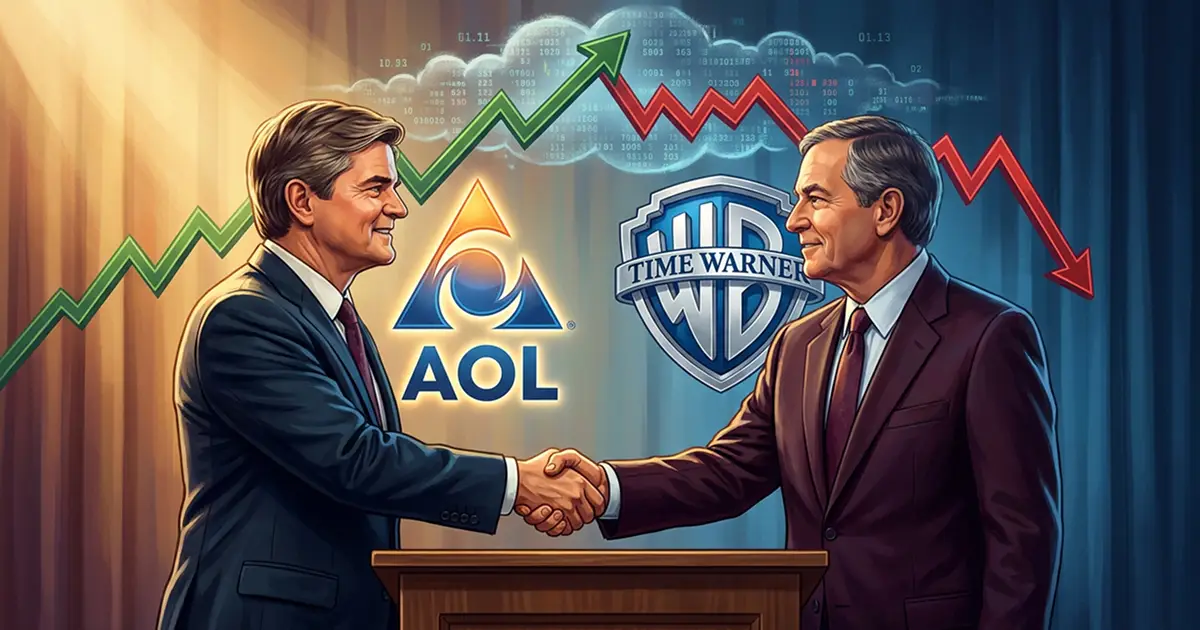
On January 10, 2000, with the Nasdaq days from its all-time high, America Online and Time Warner announced the largest merger ever attempted. AOL, a dial-up internet provider barely fifteen years old with more than 20 million subscribers, would combine with Time Warner, the storied owner of HBO, CNN, Warner Bros., Time Inc., and the second-largest cable system in the United States. The two called it a merger of equals and promised the world its first fully integrated media and communications company, a combination worth roughly $350 billion.
It became the most studied failure in the history of corporate finance. Within three years the combined company would report a $98.7 billion annual loss, write off about $99 billion of goodwill, shed the AOL name, and watch the careers of the men who built it end. The deal is now the benchmark every value-destroying merger is measured against, and the interesting question is not whether it failed but why, because the answer that survives scrutiny is not the obvious one.
Who actually bought whom
The phrase merger of equals did a lot of concealing. AOL's shareholders would own 55% of the combined company and Time Warner's 45%, and AOL's chairman, Steve Case, would become chairman of the whole. In form this was AOL acquiring Time Warner, valued at about $165 billion. What made it possible was not cash or borrowing but AOL's own overvalued stock, which the market priced at a multiple that assumed the internet's first winner would dominate forever.
That single fact frames everything that followed. AOL was paying for a company of real cash flows, cable systems, film libraries, and magazine titles, with a currency whose value rested on a belief about the future. Whether the deal was a triumph of timing or an act of hubris depended entirely on whether that belief held. It did not, and the two halves of this case, the currency and the premise, are still argued over by people who agree on nothing except that the result was a catastrophe.
The Convergence Thesis
AOL's wasting asset
Steve Case understood something about AOL that its soaring stock price obscured: the business underneath was living on borrowed time. AOL had won the 1990s by mastering dial-up, mailing out installation discs and charging a monthly fee for a walled-garden internet. But dial-up was a transitional technology, and the future plainly belonged to broadband delivered over cable and telephone lines, where AOL owned no infrastructure at all. Its 20-million-plus subscribers were a lead that the shift from dial-up to broadband could erase within a few years.
What AOL did own was a stock market valuation that, at the bubble's peak, exceeded the value of nearly every old-media company on earth. Case saw that paper wealth for what it was, an asset that could evaporate, and concluded that the smart move was to convert it into something durable while it still spent like real money. Time Warner offered exactly that: hard assets, real earnings, and a cable system reaching some 13 million households that could carry AOL into the broadband era it could not reach alone.
- All-stock acquisition currency
When an acquirer pays with its own shares rather than cash, those shares are the currency of the deal. An overvalued stock is a powerful currency, because the buyer can offer a high nominal price while parting with paper the market may be mispricing. The risk transfers to the seller's shareholders, who now hold the acquirer's stock and bear the loss if it falls back to earth.
There is a less flattering way to read the same logic, and it matters. If buying Time Warner was a way to lock in AOL's inflated value before it fell, then AOL's own leadership was implicitly betting that its stock was overpriced. The genius of the timing and the admission of the overvaluation are the same decision seen from two angles, and Time Warner's shareholders were on the other side of it.
Levin's fear of being left behind
If Case was selling at the top, Gerald Levin, Time Warner's chief executive, was the man buying. Levin had spent the late 1990s haunted by the sense that Time Warner was missing the internet. His company had poured money into an interactive-television experiment, the Full Service Network in Orlando, that had failed expensively and embarrassingly. Time Warner had no meaningful online presence of its own, and Levin was determined not to let the most important technological shift of his career happen without him.
AOL offered an instant answer. In one transaction Time Warner would acquire tens of millions of internet subscribers, a recognized digital brand, and a story to tell Wall Street about its place in the future. The roots of the deal trace to a private dinner in Manhattan in October 1999, where Case and Levin sketched the combination that would be announced twelve weeks later. Levin embraced it with the conviction of a man who had found his legacy, and that conviction is precisely what later observers would identify as the flaw.
the world's preeminent, fully integrated media and communications company.
The seller, in other words, was not being handed cash. Time Warner's shareholders were exchanging an interest in real businesses for an interest in a narrative about convergence, and the narrative was doing the heavy lifting on both sides of the table.
Why the premise sounded airtight
The strategic logic was elegant enough that very few serious people opposed it at the time. Time Warner made content the world wanted; AOL had the distribution and the internet relationship with more than 20 million households. Put them together and the combined company could promote HBO to AOL subscribers, push AOL through Time Warner's cable systems, sell Time Inc. magazines online, and bundle everything into a single subscription no standalone rival could match. Convergence of content and distribution was the defining idea of the era, and this was its grandest expression.
The assumptions underneath were more fragile than they looked. Cross-promotion between divisions assumed a cooperation that two proud and very different cultures would resist. The synergy projections assumed AOL's growth would continue. And the whole edifice assumed that owning both the pipe and the content was an advantage rather than a conglomerate's burden. Each assumption was defensible in 1999 and each would be tested to destruction within twenty-four months. The tragedy of the deal is that the direction was right, convergence did reshape media, while the execution was wrong in almost every particular.
Paying With Bubble Currency
An all-stock deal at the exact top
The mechanics of the consideration are where a banker should focus, because they determined who bore the risk. This was an all-stock deal with a fixed exchange ratio. Each AOL share converted into one share of the new holding company; each Time Warner share converted into 1.5 shares. There was no cash and no collar, the protective mechanism that adjusts a ratio if the buyer's stock moves between signing and closing. Time Warner's holders were locked into receiving AOL paper at a fixed rate no matter what happened to AOL's price.
That structure is the single most important fact in the case. Paying with stock rather than cash at the peak of a bubble transfers the overvaluation risk from the buyer's existing shareholders to the seller's. AOL's holders effectively diversified out of a single overpriced stock into a company half made of real assets. Time Warner's holders did the reverse: they swapped real assets for a claim that was about to deflate. The absence of a collar meant they had no protection when it did. The choice of a fixed exchange ratio over a collar was not a technicality; it was the mechanism through which the loss was delivered.
| Item | Detail |
|---|---|
| Announced | January 10, 2000 |
| Structure | All-stock merger |
| AOL exchange ratio | 1 new share per AOL share |
| Time Warner exchange ratio | 1.5 new shares per TW share |
| Ownership split | 55% AOL holders / 45% TW holders |
| Implied deal value | ~$165 billion |
| Combined market value | ~$350 billion |
| AOL adviser | Salomon Smith Barney |
| Time Warner adviser | Morgan Stanley |
Each bank earned a reported $60 million for its work, and each delivered the opinion its client needed. The fairness opinions were not wrong on their own terms, the relative values were defensible against the market prices of the day, but those prices were the very thing in question.
A subscriber business valued above HBO, CNN, and Warner Bros.
Step back from the ratio and the asymmetry is stark. At announcement AOL carried a market capitalization around $163 billion, built on the revenue multiples that investors apply to high-growth businesses when they believe the growth is limitless. Time Warner's value rested on decades of cash flows from cable, film, television, music, and publishing. The market was saying that AOL's roughly 20 million dial-up accounts were worth more than HBO, CNN, Warner Bros., and Time Inc. combined.
The Year It All Reversed
Closing into a crash
One cruel feature of the deal is that it took a full year to close, and that year was the worst possible one to be exposed. Regulators scrutinized the combination of the country's largest internet provider with one of its largest cable and content owners. The Federal Trade Commission worried about access to Time Warner's cable lines; the Federal Communications Commission worried about AOL's dominance in instant messaging.
Merger announced
January 10, 2000. AOL and Time Warner file for antitrust and license review.
FTC antitrust review
Concern centers on cable broadband access and instant messaging dominance.
FTC clears with conditions
December 14, 2000. AOL Time Warner must open its cable lines to at least three competing internet providers.
FCC clears with conditions
January 11, 2001. Approval is conditioned on interoperability for future instant-messaging services.
Deal completes
January 11, 2001. The merger closes into an already-breaking market.
While lawyers negotiated consent decrees, the Nasdaq peaked in March 2000 and began its long collapse, and the online advertising market that powered AOL's growth started to roll over. By the time the deal formally closed on January 11, 2001, the world it had been designed for was already gone. The combination took effect fully loaded with bubble-era assumptions, at the moment those assumptions were being falsified in real time.
- Goodwill
When one company buys another for more than the fair value of its identifiable net assets, the excess is recorded on the balance sheet as goodwill, an intangible asset representing brand, market position, and expected synergies. An all-stock megadeal struck at peak valuations creates enormous goodwill. If the acquired business later underperforms, accounting rules require the company to write that goodwill down, recognizing the loss it has already suffered.
The $99 billion admission
The reckoning came in 2002. New accounting rules forced companies to test goodwill for impairment, and the test on AOL Time Warner produced a number with no precedent. Across 2002 the company wrote off about $99 billion of goodwill, the largest writedown in corporate history, a record that still stands. The full-year 2002 net loss came to $98.7 billion, the largest annual loss any company has ever reported. AOL's standalone value, which had been near $226 billion, fell toward $20 billion.
A goodwill writedown does not destroy cash; the cash was already gone, spent in the form of overvalued shares issued at the top. The writedown is the accounting system finally admitting what the market had concluded, that the price paid for AOL bore no relation to what AOL was worth. The number was so large because the overpayment had been so large, and because the currency used to overpay had since lost roughly nine-tenths of its value.
| Measure | Figure |
|---|---|
| AOL market value, near peak | ~$226 billion |
| AOL market value, after collapse | ~$20 billion |
| 2002 goodwill writedown | ~$99 billion |
| Full-year 2002 net loss | $98.7 billion |
| Ted Turner's personal loss | ~$8 billion |
| AOL advertising revenue restated | ~$500 million |
The round-trip revenue that propped AOL up
There was a further problem, and it was not merely a market problem. Part of the advertising growth that had justified AOL's valuation was not real. Federal investigators later found that AOL had inflated its online-advertising revenue through round-trip transactions, arrangements in which AOL effectively funded the customers who bought ads from it, so that money paid out came back as reported revenue. The clearest example involved a software company, PurchasePro, and investigators identified roughly seventeen counterparties in all.
- Round-tripping
A round-trip transaction is one where a company channels money to a counterparty that the counterparty then pays back as purchases, creating the appearance of genuine revenue where none exists. The cash makes a loop and returns, but the company books the inbound leg as sales. It is a classic way to manufacture growth, and it is fraudulent when used to mislead investors about a business's real trajectory.
The consequences were formal and expensive. Time Warner restated results from late 2000 through 2002, reducing AOL's advertising revenue by about $500 million. It paid $300 million to settle with the Securities and Exchange Commission and $210 million to settle with the Department of Justice, which deferred prosecution on a securities-fraud charge tied to the PurchasePro dealings. Senior finance executives were sanctioned. The episode reframes the valuation story: some of the growth that made AOL's currency so valuable, and that made Time Warner willing to accept it, had been fabricated.
The Company That Could Not Combine
A merger of equals with no one in charge
The market collapse explains the writedown, but it does not explain why the businesses never delivered the cooperation the deal depended on. That failure was built into the governance. Levin became chief executive of the combined company and Case its executive chairman, while the day-to-day was split between two co-chief operating officers: AOL's Robert Pittman, given subscription, advertising, and commerce, and Time Warner's Richard Parsons, given the content businesses in film, television, music, and publishing. Two co-COOs dividing a company is a structure that works only when the two agree, and these two represented opposed cultures.
- Merger of equals
A deal framed as a union of two comparable companies rather than an acquisition, typically with shared board seats, split leadership, and no control premium paid. The label is often diplomatic cover: it softens the target's loss of independence and spreads authority so widely that no one can impose hard decisions. Power-sharing that looks fair on the org chart frequently means no one is actually in charge.
The imbalance underneath the equals framing was extreme. AOL executives filled the majority of the top jobs despite AOL being, in revenue and assets, roughly the size of a single Time Warner division and run by a far younger, more centralized organization. When Pittman pushed his synergy initiatives onto Time Warner's divisions, the old-guard heads of HBO, the film studio, and the magazines resisted, and Parsons' consensual style declined to force them. The friction reached the boardroom: a Ted Turner outburst at a board meeting helped trigger an attempt by Case to push Levin out, which Parsons and other directors rebuffed. Levin, unable to regain his footing, resigned in the fall of 2001. Parsons, not the AOL heir-apparent Pittman, was chosen as the next chief executive, and Pittman left in July 2002. The people meant to fuse the company instead spent two years fighting over who controlled it.
The synergies that never came
Set against that dysfunction was a specific promise. At announcement the companies told analysts to expect roughly $1 billion of incremental EBITDA in 2001 from merger synergies, and they guided to aggressive 2001 targets of about $40 billion in revenue and $11 billion in EBITDA. Those numbers were the quantitative case for the deal, the bridge between the convergence story and a valuation. Within a year management was walking them back toward $38 billion of revenue and $10 billion of EBITDA, and the gap only widened from there.
- Synergies
The incremental value a combined company is supposed to create beyond the sum of the two standalone businesses, through cost savings (cutting duplicated functions) or revenue synergies (cross-selling, bundling, shared distribution). Cost synergies are relatively reliable; revenue synergies from cross-selling are notoriously hard to realize because they depend on customers and on divisions changing behavior. Deals justified mainly by revenue synergies disappoint far more often than deals justified by cost cuts.
The cross-promotion did technically happen, which is what makes the failure instructive. AOL generated something like 100,000 Time Inc. magazine subscriptions a month, ran exclusive online contests for Warner Bros. shows, and coordinated marketing across film, cable, and online launches; a Global Marketing Solutions unit assembled more than $1 billion in cross-platform marketing agreements in 2001. None of it mattered to the outcome. These were revenue synergies of exactly the kind that are real but small, and they were rounding errors against the collapse of AOL's advertising business, the engine on which the entire valuation rested. The deal had promised that owning both content and distribution would compound; instead the divisions kept separate profit-and-loss statements, separate cultures, and no incentive to subsidize one another, and the convergence that did occur produced a trickle of magazine subscriptions while the multiple it was meant to justify evaporated.
| Metric | Initial 2001 target | Walked back to |
|---|---|---|
| Revenue | ~$40 billion | ~$38 billion |
| EBITDA | ~$11 billion | ~$10 billion |
| Merger synergies | ~$1 billion EBITDA | never delivered |
The Human Wreckage
Ted Turner's $8 billion
No one embodied the cost more than Ted Turner. He had built CNN and Turner Broadcasting and sold them to Time Warner in 1995, becoming the company's largest individual shareholder and, in the merger, vice chairman of AOL Time Warner. He had backed the deal. Then he watched it destroy a fortune he had spent a lifetime building. Turner later estimated that the merger cost him roughly $8 billion, about 80% of his wealth.
I lost more money than anybody in the history of capitalism!
In 2001 Levin stripped Turner of his remaining operating authority, and a humiliated Turner dumped nearly all his Time Warner stock in 2003, after the shares had already fallen some 80%. That a media operator as shrewd as Turner, sitting on the board, lost more than almost anyone is the most pointed evidence in the case. If the insider who understood the assets best could not protect himself, the failure was structural, not a matter of one bad decision a sharper person would have avoided.
The executives the deal consumed
The architects fared no better than the assets. Levin's position became untenable as the losses mounted, and he stepped down in 2002, succeeded as chief executive by Richard Parsons, whose main task was to stabilize the wreckage. Steve Case, the deal's true author, came under sustained pressure and resigned as chairman in early 2003. In October 2003 the company removed AOL from its name and reverted to Time Warner, a quiet admission that the combination the name had celebrated was a mistake.
What the Deal Got Right and Fatally Wrong
Convergence happened, just not here
The cruelest irony is that the thesis was correct. Content and distribution did converge; the internet did remake media; the company that controlled both programming and the pipe into the home did become the defining model of the industry. Netflix, Disney's streaming pivot, and the wave of media mergers built around streaming consolidation all vindicated the basic idea that Case and Levin articulated in 1999. Even Time Warner's own later sale to AT&T in 2018 was an attempt to marry content with distribution, the same logic a second time.
The unwinding
Everything after 2003 was a slow, deliberate undoing of the 2000 logic. Richard Parsons spent his years as chief executive not building synergies but dismantling the conglomerate and paying down the debt the deal had loaded on. Time Warner sold its 50% stake in Comedy Central to Viacom for $1.225 billion in 2003, sold Warner Music Group for $2.6 billion in March 2004, and shed assets as disparate as the Atlanta Hawks and Thrashers, hitting its net-debt-reduction target nearly a year ahead of schedule. The work of management was subtraction, the precise opposite of the combination the merger had promised.
The market wanted even more subtraction. In 2006 the activist investor Carl Icahn, backed by a detailed Lazard study, campaigned to break Time Warner into pieces and return cash to shareholders, arguing that the parts were worth more separated than the conglomerate was together. He did not win a full breakup, but he extracted a large buyback and board changes, and his core claim, that the combination was a conglomerate to be discounted and dismantled rather than a synergy machine, had become the consensus view of the company AOL had bought.
The dismantling finished in stages. In early 2009 Time Warner spun off Time Warner Cable, and on December 9, 2009 it spun off AOL itself as an independent company, formally ending the marriage. The remaining content business was acquired by AT&T in 2018 in another attempt to fuse content with distribution, then spun out and merged into Warner Bros. Discovery in 2022. Every later move undid a piece of what the 2000 deal had assembled, and no subsequent owner tried to put AOL and Time Warner back together.
The Verdict
What is settled
On the central fact there is no dispute. AOL Time Warner destroyed more shareholder value than any merger before or since. The $99 billion writedown remains the largest on record; something like $200 billion of market value evaporated; part of the growth that justified the deal was fraudulent; the promised synergies never materialized; and both companies, by the evidence of their later histories, were worth more apart than together. The man who built it does not contest the verdict.
I presided over the worst deal of the century, apparently.
Levin went further than the quote, telling viewers in a 2010 television appearance that he took personal responsibility and apologizing to the employees and shareholders who had lost so much. That an architect of a deal would so completely disown it is rare, and it tells you how thoroughly the outcome settled the question of success or failure.
What is still argued
What remains genuinely open is the diagnosis, and the answer determines the lesson. One camp blames the currency and the timing: a sound strategic idea was ruined by paying with bubble-inflated stock through a fixed-ratio, all-stock structure at the exact top, then closing into the crash. On this reading the deal was a financing failure, and the lesson is never to spend, or accept, a currency you suspect is overvalued. The other camp blames the premise: content-and-distribution convergence was never going to work for these two companies, whose cultures and incentives were incompatible, and the synergies were a mirage no structure could have rescued. On this reading the deal was a strategic failure, and the lesson is to distrust grand convergence stories regardless of price.
Steve Case has spent the years since arguing a version of the first view, that the vision was right but early. Many analysts hold the second. The evidence supports a synthesis the principals rarely state plainly: the premise was directionally sound but oversold, and the currency and structure converted an overpriced bet into an unrecoverable one. Both failures were real, they compounded, and either alone might have been survivable. Together they produced the deal against which every other disaster is still measured.
Sources
- 1AOL Time Warner, Form S-4 registration statement, 2000, SEC EDGAR.
- 2"AOL-Time Warner merger announced, January 10, 2000," HISTORY.
- 3"FTC Approves AOL/Time Warner Merger with Conditions," December 2000, Federal Trade Commission.
- 4"Fact Sheet: FCC's Conditioned Approval of AOL-Time Warner Merger," January 2001, FCC.
- 5AOL Time Warner, Form 10-K for fiscal 2002, SEC EDGAR.
- 6"Time Warner, SEC Settle AOL Fraud Charges," March 2005, The Washington Post.
- 7"15 years later, lessons from the failed AOL-Time Warner merger," Fortune.
- 8"I lost more money than anybody in the history of capitalism: Remembering Ted Turner," Fortune.
- 9"Gerald Levin apologizes for AOL-TW merger," The Hollywood Reporter.
- 10"Time Warner to spin off AOL, ending ill-fated deal," May 2009, Phys.org.