


Overview
The breakup that beat the merger
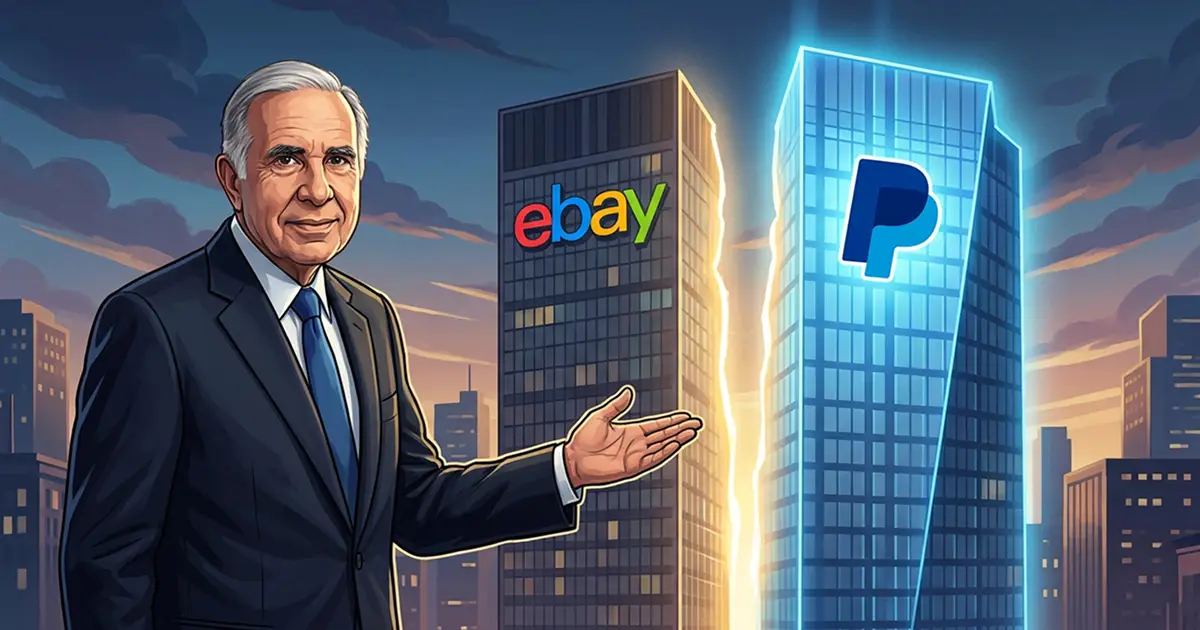
In an era defined by ever-larger mergers, eBay created enormous value by doing the opposite: it split itself in two. On July 20, 2015, PayPal began trading on its own again, separated from the company that had owned it for thirteen years, and on its first day the payments business was worth more than the marketplace it had just left. On its first day PayPal's market value reached roughly $49 billion, against an eBay worth around $35 billion. The child had outgrown the parent, and the market said so the moment it could price them apart.
The separation was the largest activist-driven breakup of its time, and it is unusual in one important respect: the activist turned out to be emphatically right. Carl Icahn had spent early 2014 demanding the split, been rebuffed, and appeared to lose. Then eBay reversed itself and did exactly what he had asked. Over the following six years PayPal grew into one of the most valuable financial-technology companies on earth, while eBay settled into a smaller, slower life. The deal is the clearest case study in modern finance of a question every conglomerate faces: when does owning two businesses help them both, and when does it cage one of them.
A deal defined by separation, not scale
This study is the mirror image of the convergence megadeals of the same era. Where the AOL Time Warner merger tried to create value by fusing content and distribution and destroyed it instead, eBay created value by pulling two businesses apart. The lesson the two cases teach together is that bigger is not always better and focus is not always worse, and that the right answer depends entirely on whether the businesses genuinely help each other or merely share a stock ticker.
So three threads run through what follows. The first is the focus thesis itself, the idea that a conglomerate discount was holding PayPal back and that separation would release it. The second is the activist drama, how a man with a tiny stake forced one of Silicon Valley's most admired companies to reverse a strategy it had defended for months. The third is the verdict, which is mostly a triumph but carries a caveat: some of the value the breakup appeared to unlock was a bubble that later burst.
How eBay and PayPal Grew Apart
The $1.5 billion payment engine
eBay bought PayPal in 2002 for about $1.5 billion, and at the time the logic was impeccable. PayPal had been independent only months before; it had gone public on Nasdaq that February, the creation of a band of founders later dubbed the PayPal Mafia, among them Peter Thiel, Elon Musk, and Max Levchin, before eBay acquired it in July. eBay was an online marketplace whose entire business depended on strangers trusting each other enough to send money for goods they could not touch, and PayPal had solved exactly that problem. Owning the payment rail that ran through its own auctions let eBay control the checkout experience, capture the marketplace transaction economics, and remove friction that might otherwise have cost it sales. For a marketplace, owning payments was vertical integration of the most natural kind.
When the child outgrew the parent
By 2014 the relationship had inverted. PayPal was the faster-growing, arguably more valuable half of the company, riding a global explosion in digital payments that had nothing to do with auctions. It had around 169 million active accounts and processed roughly $235 billion in payments a year, a large and rising share of it from outside eBay entirely. The marketplace, by contrast, was a mature business growing slowly. The payments-processing revenue pool PayPal was tapping was vastly bigger than the auction market that had birthed it.
- Conglomerate discount
The tendency of a company that owns several different businesses to trade for less than the sum of those businesses would be worth as independent companies. Investors apply the discount because diversified firms are harder to analyze, capital can be allocated across divisions in ways the market cannot see, and a fast-growing unit can be obscured by a slow-growing one. Breaking the company up, through a spin-off, is the classic way to release the trapped value.
When a high-growth business is buried inside a slow-growth one, the market struggles to value it properly, and capital and attention get spread across two very different needs. The strategic reason eBay had bought PayPal, to own checkout on its marketplace, had not disappeared, but it had become a small fraction of what PayPal now was. The rationale for joint ownership had quietly expired, and the only question was whether anyone would force the issue.
The mismatch showed up directly in how the market valued eBay. Analysts who pulled the company apart on paper, applying the rich revenue multiples that independent payments companies commanded to PayPal and the more modest marketplace multiples to eBay, repeatedly arrived at a sum-of-the-parts value well above where eBay's combined shares traded. That gap was the conglomerate discount made visible: a fast-growing payments business priced as if it were merely an appendage of a maturing auction site. A standalone PayPal would be followed by the payments and fintech specialists who understood its economics and would pay up for its growth; buried inside eBay, it was analyzed by retail investors who did not. The discount was not a rounding error. It was tens of billions of dollars of value that existed only if someone separated the two, which is precisely the prize Icahn had identified and the reason his argument resonated with the institutions that actually owned the stock.
The conflict inside one company
There was also a harder problem than mere valuation, and it cut to PayPal's growth. To expand, PayPal needed to become the payment option everywhere, in the apps and checkouts of the world's largest retailers. But many of those retailers, from Amazon to the big-box chains, viewed eBay as a competitor, and they were understandably wary of routing their payments and customer data through a service owned by a rival marketplace. Being part of eBay was not just a valuation drag on PayPal; it was a commercial liability that limited the partnerships at the heart of its future.
The Activist Who Called It a No-Brainer
Icahn's 0.8% and a big idea
In January 2014 Carl Icahn made his move. Through entities he controlled, he had assembled an economic interest of only about 0.8% of eBay, a tiny position by any measure, and from it he launched a campaign to force the company to spin off PayPal, nominating two of his own people to the board. The size of the stake was almost the point: activism works through argument and publicity, not control, and Icahn's argument was that the separation was obvious.
A spin-off of PayPal was, in his words, a "no-brainer.
Icahn was playing a familiar and well-honed game.
- Activist investor
An investor who buys a stake in a company specifically to pressure its management or board into changes intended to lift the share price, such as a spin-off, a buyback, a sale, or new directors. Activists rarely own enough to win by votes alone; their leverage comes from public campaigns that persuade the company's other, much larger shareholders to back the same demand.
A stake that small cannot dictate anything on its own. Its power lay in Icahn's ability to make a public case that the company's far larger institutional owners would find persuasive, and the case here was strong: a fast-growing payments business was trapped inside a slow-growing marketplace, suppressing its value and constraining its partnerships. Icahn simply said out loud what a growing number of investors were already thinking.
The Silicon Valley brawl
The campaign turned personal and bitter, pitting a Wall Street raider against a Silicon Valley establishment that regarded him as a barbarian. Icahn attacked eBay's board, singling out the prominent venture capitalist Marc Andreessen and chief executive John Donahoe, alleging conflicts of interest in how the company had handled past investments and the relationships among its directors. eBay fired back, defending its people and insisting that the company and its shareholders were best served by keeping PayPal in house.
eBay's board was unequivocal at this stage: it concluded that breaking up the company was not the best way to maximize shareholder value, and that the two businesses benefited from being together. That public commitment matters to the story, because it is the position management would shortly abandon. Companies that dig in hard against an activist, and then adopt the activist's plan a few months later, hand that activist a victory more total than any proxy vote.
The settlement that looked like a defeat
In April 2014 the fight appeared to end, and to end in Icahn's defeat. He dropped his proxy contest and his demand for a full spin-off, settling for the addition of a single mutually agreed independent director to eBay's board, David Dorman, while the company kept PayPal. He had floated a compromise, a partial public offering of perhaps 20% of PayPal, and even that had not been adopted. By the conventional scorecard of activism, securing one board seat in exchange for dropping the central demand is a loss.
The Reversal
eBay changes its mind
On September 30, 2014, five months after settling with Icahn and insisting the businesses belonged together, eBay announced that it would spin off PayPal into an independent public company after all. The board framed it not as a capitulation but as the conclusion of its annual strategic review, which had found that keeping the two together beyond 2015 would leave each worse positioned in a fast-changing landscape. Days earlier, Apple had launched Apple Pay, a vivid reminder that the payments world was being remade and that PayPal would need to move fast and partner widely to compete.
For more than a decade eBay and PayPal have mutually benefited from being part of one company.
Donahoe's careful phrasing, praising the very combination he was dissolving, captured management's awkward position. The company maintained that the union had created value and that separating now was simply right for the next phase, not an admission that the activist had been correct. Whatever the framing, the substance was unambiguous: eBay had adopted the exact plan it had spent the winter fighting, and the idea Icahn had been told was wrong was now official strategy.
New leaders for two companies
The separation came with a clean break at the top, which underlined that these were to be two genuinely independent futures rather than one company in two wrappers. eBay recruited Daniel Schulman from American Express to run PayPal as an independent company, a payments-industry veteran for a business that was now all about payments. Devin Wenig took over eBay's marketplace, and Donahoe, who had led the combined company, stepped away. Each business would now be run by leadership chosen for its specific challenge, free of the compromises that come from serving two masters.
How a Tax-Free Spin-Off Works
Splitting one company into two
The mechanism eBay used was a spin-off, and its details matter because they determine who ends up owning what and at what tax cost. Rather than sell PayPal or float a slice of it, eBay distributed PayPal to its existing shareholders directly: every holder of an eBay share received one share of the new PayPal for each eBay share they owned, and now held two separate stocks instead of one. Structured to qualify as tax-free under Section 355 of the tax code, the distribution created PayPal as a standalone public company without triggering a tax bill for eBay or its shareholders, the same tax-free spin mechanism that featured in deals like Disney's acquisition of Fox.
- Tax-free spin-off (Section 355)
A spin-off distributes a subsidiary's shares directly to the parent company's shareholders, creating two independent public companies from one. If the transaction meets the requirements of Section 355 of the US tax code, including genuine business purposes and continuity of ownership, neither the parent nor its shareholders pay tax on the distribution. That tax efficiency is why a spin-off, rather than a sale, is usually the chosen route to separate a business and hand its value to existing owners.
The separation itself unfolded over about a year, in a clear sequence.
Strategic review
Mid-2014. eBay's board weighs whether the two businesses are stronger together or apart.
Separation announced
September 30, 2014. eBay says it will split into two independent public companies.
Form 10 filed
2015. PayPal files its registration statement with the SEC, laying out the standalone business.
Distribution
July 17, 2015. eBay distributes one PayPal share for each eBay share, tax-free, to its shareholders.
PayPal trades
July 20, 2015. PayPal begins trading on Nasdaq as PYPL, opening near $41.63 a share.
The point of a spin-off is precisely what eBay needed: it lets the market value each business on its own merits, with its own management, strategy, and shareholder base. The table below shows what the market saw the moment it could finally price the two apart.
| Metric | eBay (marketplace) | PayPal |
|---|---|---|
| Active accounts / users | ~155 million buyers | ~169 million accounts |
| Annual volume | ~$83 billion GMV | ~$235 billion payments |
| Approx. value at separation | ~$35 billion | ~$49 billion |
| Growth trajectory | maturing | fast-growing |
The strings that remained
A separation is never quite as clean as the announcement implies, and the two companies remained bound for a time. They signed a five-year operating agreement under which eBay stayed a major PayPal customer, with commitments around how much of the marketplace's payment volume would continue to flow through PayPal, alongside standstills and other terms governing their conduct toward each other. The agreement cushioned the divorce, but it also embedded a slow-acting cost.
- Dis-synergies and stranded costs
Dis-synergies are the value lost when a combined business is split: shared functions must be duplicated, joint purchasing power is reduced, and guaranteed internal demand disappears. After a spin-off, the parent may route business elsewhere and the spun-off company must replace that captive volume with outside customers. The breakup thesis is that the value released by focus and a fair market valuation exceeds these dis-synergies, but they are real and they are why separation is not free.
For PayPal, the largest dis-synergy was the eventual loss of eBay's guaranteed volume, which would taper as the operating agreement wound down and eBay became free to steer payments to other providers. The bet underlying the entire spin-off was that PayPal, unshackled and able to court the whole market, would more than replace that volume with new merchants who had previously kept their distance precisely because PayPal was owned by eBay.
Was Icahn Right?
The value the split unlocked
The verdict came in fast and overwhelmingly in the activist's favor. PayPal, free to partner with anyone and valued on its own merits, grew into one of the defining fintech companies of the era. Its shares, which opened near $41.63 in July 2015, climbed to a record $308.53 by July 2021, a gain of more than 640%, lifting its market value above $350 billion, far more than the entire eBay-plus-PayPal company had ever been worth as one. Freed of the conflict, PayPal signed the merchant partnerships it had been unable to pursue inside eBay and scaled its Venmo peer-to-peer business into a cultural phenomenon.
| Moment | PayPal's value |
|---|---|
| eBay's acquisition, 2002 | ~$1.5 billion |
| At spin-off, July 2015 | ~$49 billion |
| Peak, July 2021 | ~$350 billion |
eBay, for its part, was not obviously harmed by losing PayPal. A focused marketplace was easier for investors to understand and for management to run, and the company went on to streamline further, later shedding its StubHub ticketing and classifieds businesses. The clearest evidence for the breakup thesis is the simplest: the two companies together were soon worth several times what the single combined company had commanded, exactly the outcome that a sum-of-the-parts view of the conglomerate had predicted.
eBay Inc. Will Spin Off PayPal in 2015: Carl Icahn Wins Again.
What PayPal did with its freedom
The clearest proof that eBay's ownership had constrained PayPal is what PayPal did the moment it was gone. Freed to be neutral, it struck the partnerships a rival marketplace could never have allowed. In 2016 it ended years of antagonism with the card networks, reaching a détente with Visa and Mastercard under which it stopped steering customers away from their cards in exchange for better economics and broader acceptance, and it signed a sweeping alliance with American Express. As an arm of eBay, PayPal had been a competitor to be contained; as an independent company, it became a neutral partner that almost anyone could plug into.
It also went shopping. PayPal acquired the international money-transfer service Xoom for $890 million in 2015, the European in-store specialist iZettle for $2.2 billion in 2018, and the shopping-rewards platform Honey for more than $4 billion in 2020, building a business far broader than the checkout button it had been inside eBay. Above all it scaled Venmo, the social peer-to-peer app it had inherited through an earlier acquisition, from a niche product into a cultural habit; Venmo was processing roughly $17 billion of payments a quarter by late 2018 and growing nearly 80% a year. By 2019 PayPal's total payment volume reached about $712 billion, a scale unimaginable for eBay's in-house cashier. The freedom to partner and to buy, not merely a cleaner stock-market valuation, was the real substance of what separation unlocked.
The breakup that kept going
The focus thesis did not stop with PayPal; it kept compounding on both sides of the split. eBay, now a standalone marketplace, set about doing to itself what Icahn had done to it. In 2018 it signed the payments processor Adyen to handle its own checkout and began bringing payments in-house, steadily ending the captive volume PayPal had once enjoyed as its owner. The dis-synergy the operating agreement had only delayed arrived on schedule: by the early 2020s eBay was intermediating its own payments, and the guaranteed flow PayPal had relied on inside the family was gone, replaced many times over by the outside merchants that independence and a clean fintech valuation had won it.
Then the activists returned. In 2019 Elliott Management and Starboard Value, two of the most powerful activist funds, took stakes in eBay and won board seats, pressing the company to shed still more. eBay obliged, selling its StubHub ticket marketplace to viagogo for $4.05 billion in 2019 and its Classifieds business to Adevinta for about $9.2 billion in a deal completed in 2021. The same logic that had freed PayPal kept running: a focused business was worth more than a sprawling one, and a fresh wave of activists arrived to enforce the point. The eBay that remained was a fraction of the conglomerate it had been, by design rather than decline.
The bubble in the vindication
Honesty requires a caveat that the triumphant version omits. PayPal's spectacular 2021 peak was inflated by the pandemic e-commerce boom, a once-in-a-generation surge in online payments that the market extrapolated far into the future. When that surge faded, PayPal's stock fell roughly 80% from its high, and by 2022 and 2023 it traded at a fraction of its peak. A meaningful share of the value the breakup appeared to unlock was therefore cyclical, a product of the moment rather than the structure.
The structural win, though, survives the bubble. Even after the crash, PayPal remained a far larger, more focused, more independent company than it could ever have been as eBay's in-house cashier, with a merchant network and a valuation that reflected the payments business on its own terms. The right way to read the outcome is to separate the durable gain, focus and a fair market valuation, from the temporary one, a fintech mania that lifted and then dropped every payments stock. The breakup created the first. It merely happened to coincide with the second.
The Verdict
What is settled
The core facts are not in dispute. eBay separated PayPal in a tax-free spin-off completed in July 2015; PayPal immediately traded at a higher value than eBay itself; and over the following years it became dramatically larger and more valuable as an independent company than it had ever been inside eBay. The activist who had been told his idea was a non-starter saw it adopted and vindicated, and the case stands as the model of a successful activist-driven separation. Whatever one thinks of Carl Icahn, on this he was right.
What is still argued
The open questions are about attribution and degree. How much of PayPal's success belongs to the separation, and how much to a secular fintech boom that would have lifted it regardless of its corporate parent? Did eBay's ownership genuinely hold PayPal back, through the partner conflicts and the valuation drag, or did it simply fail to add value that an independent PayPal would always have captured? And does the 2021 peak prove the thesis or merely a bubble? Reasonable people weigh these differently, and the honest answer blends them: the conflict was real and the separation released it, but the headline numbers flatter the structural case with a cyclical tailwind.
Set beside the convergence disasters of the same era, the eBay-PayPal split is the cleanest argument in modern finance that focus can beat scale, that a business sometimes grows faster once it is set free than it ever could inside a parent that meant it well. It is the exact inverse of the lesson of AOL and Time Warner. There, combining two businesses destroyed a fortune. Here, separating them created one. The skill, and it is the hardest judgment in corporate strategy, is knowing which situation you are actually in.
Sources
- 1"eBay Inc. to Separate eBay and PayPal Into Independent Publicly Traded Companies in 2015," September 30, 2014, eBay Inc..
- 2"eBay and PayPal to split into two separately traded companies," September 30, 2014, CNBC.
- 3PayPal Holdings, Form 10 registration statement, 2015, SEC EDGAR.
- 4"eBay buys PayPal for $1.5 billion," July 8, 2002, CNN Money.
- 5"eBay reverses course, will spin off PayPal after all," Retail Dive.
- 6"PayPal Splits from eBay as an Independent Company," July 20, 2015, Retail Relates.
- 7"eBay Inc. Will Spin Off PayPal in 2015: Carl Icahn Wins Again," October 1, 2014, The Motley Fool.