


Overview
The biggest pharma deal of its era
On January 3, 2019, two days before the industry gathered in San Francisco for its largest annual conference, Bristol-Myers Squibb announced that it would buy Celgene for about $74 billion. It was the largest pharmaceutical acquisition in years and one of the largest in history, combining two of the biggest names in cancer drugs. The reaction was not applause. Bristol-Myers Squibb's own stock fell more than 12% on the news, and within weeks the company's largest shareholders were in open revolt, arguing that it was overpaying for a business with problems as serious as its own.
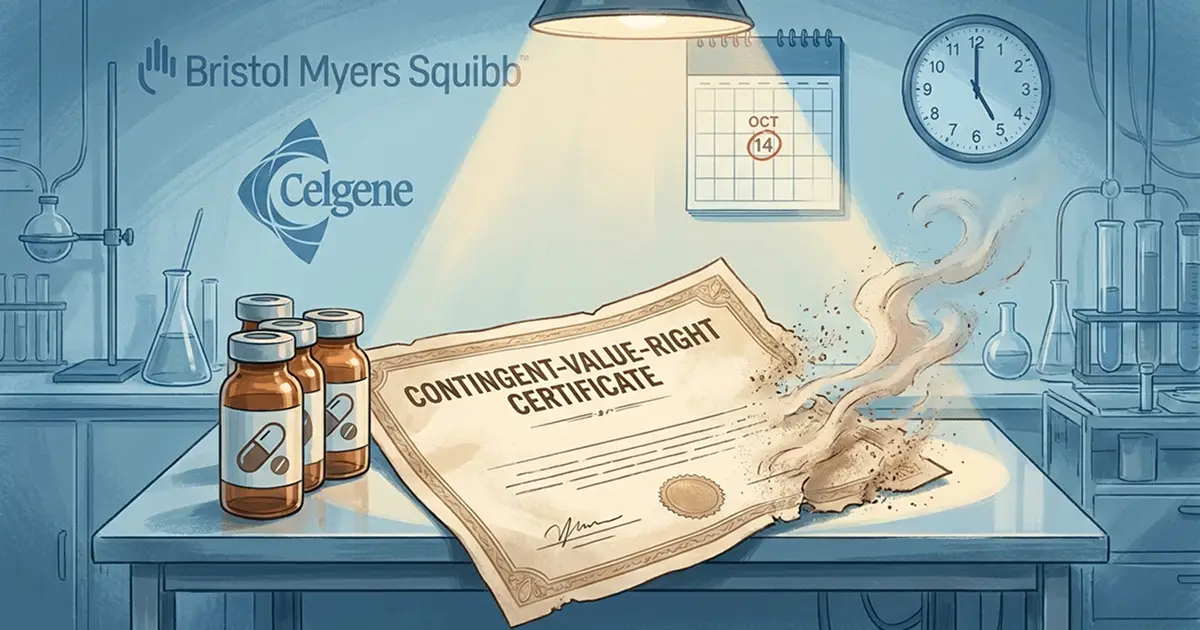
What makes the deal worth studying is not its size but its structure, because Bristol-Myers Squibb did not simply write a check. It paid in three parts: cash, its own shares, and a contingent value right, a security that promised a further payment only if Celgene's pipeline delivered on a precise schedule. That third piece is where the real story lives. It was a clever attempt to bridge a genuine disagreement about what Celgene's risky drugs were worth, and it ended in one of the strangest outcomes in modern dealmaking.
A deal defined by what it might be worth
The contingent value right promised Celgene's shareholders an extra $9.00 a share, roughly $6.4 billion in total, but only if three specific drugs won approval from the Food and Drug Administration by fixed deadlines. The payment was all or nothing: miss one deadline and the entire sum vanished. For two years the question of whether that money would ever be paid hung over the deal, and the answer, when it came, satisfied no one and produced years of litigation.
So this study follows three threads that the headline number hides. The first is whether Bristol-Myers Squibb overpaid for a company running from the same patent cliff it was, the charge its own investors leveled. The second is how the contingent value right was designed, and why a structure meant to protect the buyer ended up transferring a fortune to no one. The third is the verdict, which depends on the uncomfortable fact that the deal can be judged a success for the acquirer and a travesty for the sellers at the same time.
Two Companies Running From the Same Problem
Bristol-Myers Squibb's looming patent cliff
Bristol-Myers Squibb did not buy Celgene out of strength. It bought Celgene because it could see, a few years out, the edge of a cliff. Two of its biggest products, the blood thinner Eliquis and the cancer immunotherapy Opdivo, faced the loss of patent protection in the mid-2020s, and when a blockbuster loses exclusivity its revenue can fall by most of its value within a year or two as generics and biosimilars flood in.
- Patent cliff and loss of exclusivity
A patent cliff is the sharp drop in a drug's revenue when its patents expire and cheaper copies enter the market. For a branded medicine, loss of exclusivity can erase the large majority of sales within a couple of years. Because pharmaceutical companies depend on a handful of blockbusters, an approaching cliff forces them to refill the pipeline, by their own research or by acquisition, or watch earnings collapse.
The cleanest way for a large drugmaker to answer a cliff is to buy growth and a pipeline, and the logic of how big pharma acquires biotech pointed Bristol-Myers Squibb toward exactly the kind of late-stage assets Celgene owned. The company needed scale, new products, and time, and it needed them before its own blockbusters rolled off. Celgene offered all three in a single transaction.
Celgene's Revlimid problem
The difficulty was that Celgene was running from a cliff of its own, and a steeper one. Its dominant product was Revlimid, a blood-cancer drug generating around $10 billion a year, which is to say that a single medicine accounted for the majority of the company's value. Revlimid faced its own loss of exclusivity, with generic competition set to ramp from 2022 and accelerate through the middle of the decade. Celgene's attempts to diversify had stumbled: a high-profile bowel-disease drug had failed in trials, and a key pipeline candidate had been rejected by the FDA on a technicality in 2018.
Why the two fit, or didn't
The strategic case, stated charitably, was elegant. Revlimid would throw off enormous cash for several more years, and that cash could fund Bristol-Myers Squibb through its own coming cliff. Meanwhile Celgene's late-stage pipeline, three drugs near approval plus an anemia treatment called Reblozyl, would provide the new products both companies needed. Chief executive Giovanni Caforio framed it as a combination that would create a dominant cancer-drug business.
The combined pipelines would create "the number one oncology franchise" in both solid and blood tumors.
The bear case was just as simple: two companies facing patent cliffs do not cancel each other out, they stack. If Revlimid and Eliquis and Opdivo all erode at once in the mid-2020s, the combined company would face a wall of lost revenue that the pipeline might not refill in time. The entire deal therefore rested on a single fragile assumption, that Celgene's late-stage drugs would arrive on schedule and sell as projected. Bristol-Myers Squibb was confident. The market was not, and that gap in belief is what the deal's structure had to solve.
The CVR: Pricing a Disagreement
Bridging a gap with a contingent value right
When a buyer and the market disagree about the value of risky assets, the buyer faces a choice: pay the high price the seller wants and risk overpaying, or offer less and risk losing the deal. Bristol-Myers Squibb found a third path. Rather than pay full cash value for Celgene's unproven pipeline, it offered to pay for that pipeline only if it actually delivered. The instrument that made this possible was a contingent value right.
- Contingent value right (CVR)
A contingent value right is a security that pays its holder only if a defined future event occurs, such as a drug winning regulatory approval or a product hitting a sales target by a set date. In a deal, a CVR lets the buyer and seller bridge a disagreement about uncertain value: the seller gets paid if the optimistic case comes true, and the buyer pays nothing if it does not. It shifts the risk of the contested assets back onto the people who believe in them.
The structure also let Bristol-Myers Squibb hold down the price it actually committed to. Reporting on the proxy materials later showed that the company had earlier floated a richer, more cash-heavy offer worth around $57 a share, then pulled it days before a deadline as Celgene's stock fell, and returned with a headline package of $50.00 in cash, one Bristol-Myers Squibb share, and one contingent value right per Celgene share. The CVR was the elegant part of a hard-nosed renegotiation: it offered Celgene's holders upside without forcing Bristol-Myers Squibb to pay for it up front.
| Component | Per Celgene share |
|---|---|
| Cash | $50.00 |
| Bristol-Myers Squibb stock | 1.00 share |
| Contingent value right | $9.00 if all milestones met |
| Implied value at announcement | ~$102.43 |
| Premium to unaffected price | ~54% |
The CVR was made tradeable and listed on the New York Stock Exchange, so holders who did not want to wait could sell their bet to someone who did. Pricing that security required the kind of risk-adjusted pipeline valuation that biotech investors do every day, weighing the probability and timing of each approval. The market's verdict was visible in the CVR's price, which traded well below $9.00 from the start, a quiet signal that investors doubted all three milestones would be hit on time.
Three drugs, three deadlines, all or nothing
The genius and the flaw of the CVR were the same feature: it was binary. The $9.00 would be paid in full if, and only if, all three named drugs won FDA approval by their individual deadlines. There was no partial credit. Approving two of three, or all three a little late, paid exactly the same as approving none: nothing.
The three milestones were a multiple-sclerosis drug, ozanimod, due by December 31, 2020; and two cell therapies, liso-cel due by December 31, 2020 and ide-cel due by March 31, 2021. Each was a catalyst whose value turned on a single binary event, an approval that would either happen by the date or not. Stringing three such events together into one all-or-nothing payment multiplied the fragility. Even if each drug had a high individual chance of approval on time, the probability that all three would clear was meaningfully lower, and any single delay, for any reason, would void the entire $6.4 billion.
- Cell therapy (CAR-T)
CAR-T is a cancer treatment that re-engineers a patient's own immune cells to attack tumors. Two of the CVR's three drugs were CAR-T therapies. Because each dose is manufactured individually from a patient's cells, these products depend on complex, highly inspected manufacturing facilities, which made their approval timelines especially vulnerable to anything that could delay a plant inspection.
What the market thought the bet was worth
Because the CVR traded openly on the New York Stock Exchange under the ticker BMYRT, the market published a continuous, real-time estimate of the odds that the all-or-nothing payment would ever be made, and that estimate was never optimistic. Although each CVR could pay $9.00, it changed hands at a fraction of that almost from the start and never traded much above $4.50. As two of the three drugs ran into delays through 2020, the price sank toward $1, and the investors who ended up holding the security had paid, on average, only about $2 for it.
The five weeks that erased $6.4 billion
What happened next reads like a cautionary tale written specifically about binary milestones. Ozanimod, marketed as Zeposia, was approved in March 2020, comfortably ahead of its deadline. Ide-cel, marketed as Abecma, was approved in March 2021, meeting its deadline. Two of the three milestones were met. The entire $6.4 billion came down to liso-cel.
Liso-cel, later marketed as Breyanzi, was on track until the COVID-19 pandemic intervened. The FDA could not complete a required inspection of a third-party manufacturing facility because of pandemic travel restrictions, and without that inspection it could not approve the drug. The December 31, 2020 deadline passed with no decision. Liso-cel was approved just five weeks later, on February 5, 2021. All three drugs were now approved. The CVR still paid $0.
With no liso-cel approval by Dec. 31, the $9 Celgene CVR is dead.
The outcome was almost philosophically strange. Every drug the CVR was built around had been approved. The pipeline Bristol-Myers Squibb had paid for had, in substance, delivered. And yet because of a five-week slip caused by a pandemic, the holders who had bet on that pipeline received nothing, while the company that had been spared the $6.4 billion payment kept the drugs anyway. The instrument had worked exactly as drafted, and exactly as drafted it produced a result almost everyone found indefensible.
The Shareholders Who Tried to Kill the Deal
Wellington and Starboard say no
Long before the CVR's fate was known, the deal nearly died at the hands of Bristol-Myers Squibb's own owners. The first blow came from Wellington Management, the company's largest shareholder with roughly an 8% stake, which took the unusual step of publicly opposing a friendly deal its own management had signed. Wellington argued the transaction asked Bristol-Myers Squibb shareholders to take on too much risk on unattractive terms, and that better paths to create value existed.
Then came the activist. Starboard Value, run by Jeff Smith, built a stake and launched a campaign to block the deal outright, seizing on the same patent-cliff problem Celgene posed.
The acquisition was "poorly conceived and ill-advised.
Starboard did not stop at words; it prepared to take the fight directly to a shareholder vote.
- Proxy fight and activist investors
In a proxy fight, an investor tries to rally a company's other shareholders to vote against management, whether to block a deal, replace directors, or force a strategy change. Activist funds like Starboard specialize in this. When the activist opposing a deal is joined by the company's largest institutional holder, as here, management can no longer assume its own transaction will pass.
How Bristol-Myers Squibb won the vote
The contest turned on a feature of modern shareholder votes that often decides them: the proxy advisory firms. Institutional Shareholder Services and Glass Lewis, whose recommendations large index and pension funds frequently follow, both came out in favor of the deal. That support effectively settled the outcome. On March 29, 2019, recognizing it could not win, Starboard withdrew its proxy solicitation, and on April 12, 2019 Bristol-Myers Squibb's shareholders approved the acquisition.
Clearing the Last Hurdle
The record divestiture: selling Otezla
One obstacle remained between signing and closing, and it set a record. The Federal Trade Commission concluded that the merger raised an antitrust problem in psoriasis treatments, because Celgene sold a leading oral psoriasis drug, Otezla, while Bristol-Myers Squibb had a promising psoriasis treatment of its own moving through late-stage trials. To resolve the overlap, the companies agreed to sell Otezla.
- Divestiture as an antitrust remedy
When regulators find that a merger would reduce competition in a particular market, they can clear the deal on the condition that the merged company sell, or divest, the overlapping business to a third party. The remedy preserves competition while letting the rest of the deal proceed. The size of a required divestiture is a measure of how much overlap the regulator found.
Celgene sold Otezla to Amgen for $13.4 billion, a price that made it the largest divestiture the FTC had ever required to clear a merger. The episode is a useful reminder that even a friendly pharmaceutical deal between two companies with little direct overlap can run into serious antitrust enforcement in healthcare, and that a single overlapping product can force the sale of a multi-billion-dollar asset. With the remedy in place, Bristol-Myers Squibb completed the acquisition on November 20, 2019, and the CVR began trading.
Did the Bet Pay Off?
The pipeline arrived, the payout did not
Judged by what Bristol-Myers Squibb actually received, the deal worked. All three CVR drugs were ultimately approved, Reblozyl reached the market, and Revlimid kept generating cash on the way down. Total company revenue rose from $22.6 billion in 2018, before the merger, to $42.5 billion in 2020, and the company used Revlimid's cash and the Otezla proceeds to pay down the debt it had taken on, reducing it toward $39.2 billion by 2022. The acquirer got the products, the cash flow, and the scale it had set out to buy.
| Drug (brand) | Milestone deadline | Actual FDA approval | Result |
|---|---|---|---|
| Ozanimod (Zeposia) | Dec 31, 2020 | March 2020 | Met |
| Ide-cel (Abecma) | March 31, 2021 | March 2021 | Met |
| Liso-cel (Breyanzi) | Dec 31, 2020 | Feb 5, 2021 | Missed by ~5 weeks |
| CVR payout | all three required | one missed | $0 |
The holders of the CVR, by contrast, got nothing, and they did not accept it quietly. Lawsuits followed alleging that Bristol-Myers Squibb had failed to use the "diligent efforts" the merger agreement required to hit the milestones, and even that it had deliberately let the liso-cel deadline slip to avoid the payment. One suit, brought by a trustee, was dismissed in 2024 on standing grounds, but Celgene's former shareholders filed a fresh claim seeking roughly $6.7 billion, alleging the delay was intentional. The CVR had converted a clever piece of deal structuring into years of reputational and legal cost.
CVR issued
November 2019. Each Celgene share carries one tradeable CVR worth $9 if three drugs win FDA approval by their deadlines.
First milestone met
March 2020. Ozanimod (Zeposia) is approved well ahead of its deadline.
Second milestone met
March 2021. Ide-cel (Abecma) is approved before its March 31, 2021 deadline.
Third milestone missed
The liso-cel deadline of December 31, 2020 passes after COVID-19 blocks a required FDA plant inspection.
CVR expires worthless
With one milestone missed, the all-or-nothing CVR pays $0, even though liso-cel is approved five weeks later.
Bad luck or bad faith
Whether the worthless CVR was a misfortune or a manipulation is the question the courts are now untangling, and it turns on a single phrase in the merger agreement. The contract did not simply require the three approvals by their dates; it obligated Bristol-Myers Squibb to use "diligent efforts" to achieve them. That standard exists precisely so a buyer cannot pocket a contingent payment by quietly slow-walking the milestones it is supposed to pursue, and it is the legal hinge on which the CVR holders' claims swing.
The plaintiffs' case is that Bristol-Myers Squibb did not try hard enough, or tried not to. They allege the company filed the liso-cel application later than it could have, leaving no cushion for the kind of delay that any experienced drug developer should have anticipated, and that it failed to do what was necessary to get the third-party manufacturing facility inspected in time. Former employees, in later filings, reportedly called the handling of the approval a blunder. On this reading the five-week miss was not an accident of the pandemic but the foreseeable result of a buyer with $6.4 billion of its own money riding on the deadline not being met.
Bristol-Myers Squibb's defense is that the cause was genuinely outside its control. The FDA's inability to inspect a plant during a global pandemic was an industry-wide problem that delayed many approvals, not a fault of the company's effort, and Bristol-Myers Squibb did, after all, secure all three approvals, two of them on time. A federal judge dismissed the first major suit in 2024 on the narrow ground that the plaintiff trustee lacked standing, but that ruling decided who could sue, not whether the underlying conduct breached the diligent-efforts promise, and former Celgene holders promptly refiled, seeking roughly $6.7 billion. The structuring lesson is sharp regardless of how the litigation ends: a milestone CVR aligns the buyer's incentives against the very payment it has promised, and "diligent efforts" is a thin reed on which to hang $6.4 billion when the party doing the efforts saves that exact sum by falling short.
The cliff that never went away
For all that the pipeline delivered, the deeper worry the activists raised never went away. Bristol-Myers Squibb still faces a punishing run of patent expirations through the late 2020s, with Revlimid eroding and Eliquis and Opdivo approaching their own cliffs, and the loss of exclusivity on those products threatens tens of billions in revenue. The pipeline Celgene brought helps, but the question of whether it refills the hole fast enough remains open, and for years the company's shares lagged its peers as investors withheld judgment.
Management's answer on the stock's weakness "did not at all address what investor concerns are.
This is why the deal sits next to earlier pharma megadeals like the failed Pfizer-Allergan inversion as a study in how the industry tries, and often struggles, to outrun its own cliffs through acquisition. Buying scale and a pipeline can postpone the reckoning, but it does not repeal the arithmetic of patents, and a deal that merely trades one cliff for a slightly later one has solved less than its price tag implies.
The Verdict
What is settled
Several things are no longer in question. This was the largest pharmaceutical acquisition of its era, structured with an unusual cash, stock, and CVR package. The contingent value right expired worthless because one of three required approvals came five weeks late, denying holders roughly $6.4 billion even though all three drugs were ultimately approved. The Otezla divestiture to Amgen for $13.4 billion set an FTC record. And operationally, Bristol-Myers Squibb integrated Celgene, grew revenue sharply, and used the cash to cut its debt. The acquirer executed; the CVR holders were wiped out; both facts are settled.
What is still argued
The open questions are the ones that matter for judgment. Did Bristol-Myers Squibb overpay, as Starboard and Wellington insisted, for a company facing a cliff as steep as its own, or did it buy essential scale and a pipeline at a fair price made fairer by shifting the pipeline risk into a CVR? The honest answer depends on how you weigh Revlimid's declining cash against the late-stage drugs it bought, and reasonable analysts still disagree.
And was the CVR a fair instrument or an unfair one? Its defenders note that it did exactly what it was written to do, paying only if precise, objective milestones were met, and that a pandemic, not bad faith, caused the miss. Its critics, now pressing roughly $6.7 billion in claims, argue that a structure which let the buyer keep every drug while paying the sellers nothing, on a five-week technicality, was designed to fail the people it was sold to as upside. The courts will resolve the legal version of that question. The deeper one, whether a milestone CVR is a clever bridge or a trap dressed as a sweetener, is exactly the kind of structuring judgment that defines modern pharmaceutical M&A, and Bristol-Myers Squibb's Celgene deal is the case every banker now cites on both sides of it.
Sources
- 1"Bristol-Myers Squibb to Acquire Celgene," January 3, 2019, Bristol Myers Squibb.
- 2"Bristol-Myers Squibb Completes Acquisition of Celgene," November 20, 2019, Business Wire.
- 3"Bristol-Myers went back to its best Celgene offer days before deadline, proxy shows," Fierce Pharma.
- 4"Shareholder group opposed to BMS deal for Celgene readies for fight," BioSpace.
- 5"Starboard drops out of Celgene fight as proxy firms back Bristol-Myers bid," March 29, 2019, CNBC.
- 6"FTC Requires Bristol-Myers Squibb and Celgene to Divest Otezla," Federal Trade Commission.
- 7"With no liso-cel approval by Dec. 31, the $9 Celgene CVR is dead," BioSpace.
- 8"Bristol Myers dodges one $6.4B Celgene buyout CVR suit," Fierce Pharma.