


Introduction
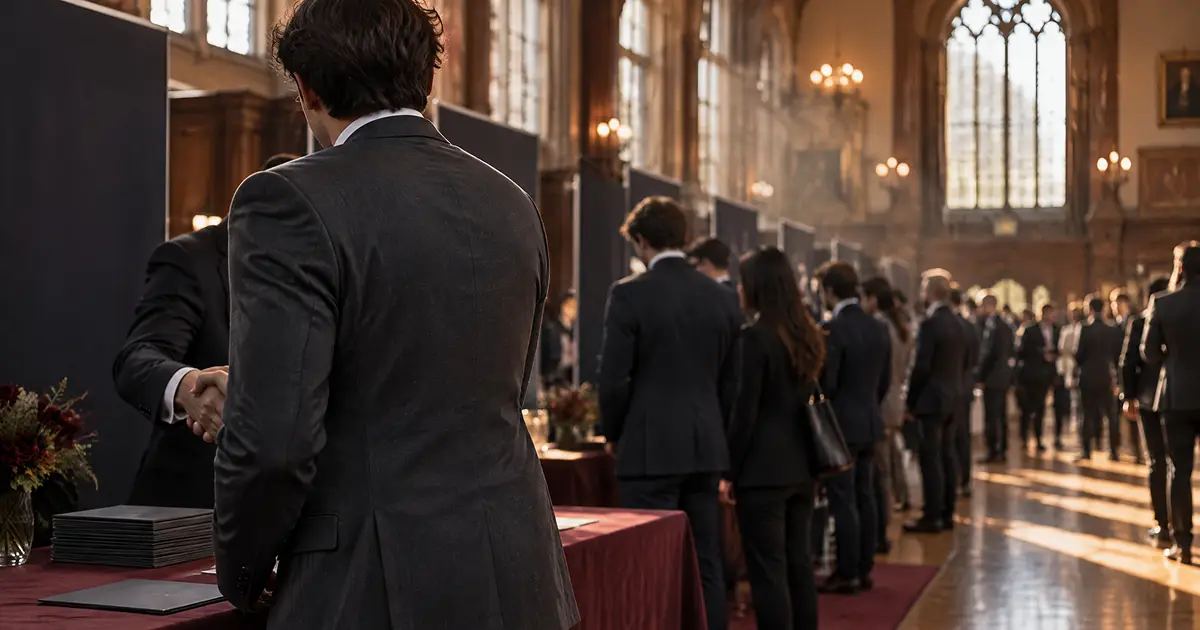
The last slide comes down, the managing director thanks everyone for coming, and eighty students stand up at once. Within a minute she has a ring of six people around her, the two analysts by the window have a ring of ten, and you are standing in the aisle with a name tag and a folded resume, deciding where to go.
Most of that room is forgotten before the bankers are back at their desks. The students who are not forgotten rarely talked the most: they knew which group the analyst worked in, asked a question that only made sense for that bank, and walked away with a name and permission to follow up.
Showing up makes you visible, along with everyone else in the room, so the real objective at an investment banking info session or career fair is narrower: one banker who can attach your name to a specific conversation. Below are the formats, where they fall in the sophomore-year recruiting calendar, how to prepare, how to work a crowded room, and the mistakes that get students forgotten or remembered badly.
Info Sessions, Career Fairs, Office Hours and Virtual Events Compared
Campus recruiting events look alike on a career-platform calendar but reward different behavior. What separates them is time with one banker, and with it, what a good outcome looks like when you walk out.
| Format | Who you meet | Time with one banker | Realistic goal |
|---|---|---|---|
| Bank-hosted info session | Alumni bankers and a recruiter | 3-5 minutes, in a group | One name, one real conversation |
| Career fair booth | Mostly campus recruiters | 1-3 minutes after a queue | Process details, a recruiter's name |
| Office hours or coffee chat slots | One or two bankers | 15-20 minute slots | A conversation you can cite |
| Virtual session | A banker and recruiter panel | One chat question, or a breakout | A question under your full name |
| Insight or diversity program | Bankers and a selected cohort | Hours, over one or more days | Relationships, sometimes a fast track |
The rows run roughly from open to selective. Anyone can walk into a career fair, insight and diversity programs require an application, and office hours sit in between: open to everyone, capped by the number of slots.
- Information Session (Info Session)
A recruiting event hosted by a bank, on campus or by video, where a team of bankers (often alumni of the school) presents the firm, its groups and its internship programs, then stays to talk with students. In investment banking the networking afterwards matters more than the presentation, because it is where students learn names and make an impression that can follow them into the application process.
Where Campus Events Sit in the Recruiting Calendar
Sophomore Fall: The Season That Matters Most
US banks recruit the junior summer internship, the one that converts into full-time analyst offers, during sophomore year, roughly 18 months before it starts. That makes sophomore fall the core of the event season: banks send teams to campus for info sessions, run office hours aimed at sophomores and host virtual sessions for schools they do not visit, mostly before their portals open.
For the summer 2028 cycle, one elite boutique opened months ahead of the rest. Evercore opened its summer 2028 analyst applications in early September 2026 with a November 15, 2026 deadline, a cap of two applications per candidate and no rolling review. Most bulge bracket and elite boutique applications are expected to open around December 2026 and January 2027, the window the summer 2027 portals used, though that is last cycle's pattern rather than a published schedule.
The scale explains why one remembered conversation matters. Goldman Sachs drew more than 360,000 applicants for its 2025 intern class, an acceptance rate of about 0.7%, according to Fortune's reporting on the bank's intern numbers. In a pile that size, a name a banker recognizes is a genuine edge.
Freshman Year and Junior Fall
Freshman year is for insight events, diversity programs and sessions open to all class years, where the point is learning what the groups do and less rides on any single conversation.
Junior fall still has value if you missed the sophomore cycle, because middle-market and regional banks post later than the bulge brackets and off-cycle roles appear through the year. Bank-by-bank application windows for the 2027 and 2028 summers are laid out in our guide to investment banking summer internship applications.
How to Prepare for an Investment Banking Info Session
Research the Bank, Its Groups and Its Recent Deals
An hour per event is enough if it goes into four things you can discuss without notes:
- Platform: bulge bracket, elite boutique or middle market, and what that means for deal size and the analyst's role.
- Groups: which industry and product groups take summer analysts, and whether interns are placed before the summer or after it.
- Deals: two or three recent transactions from the bank's press releases or the financial press, with its role noted.
- Your angle: the one group or sector where you can explain your interest in a sentence.
The deal research is where most students cut corners and where the difference shows. A structured method, built on league tables, recent mandates and team structure, is laid out in the guide to researching a bank's healthcare practice, and it transfers to any coverage group.
Find Out Who Will Be in the Room
Some event listings name the attending bankers. When they do not, your school's alumni at the bank are the likeliest attendees, and a LinkedIn alumni search filtered by employer produces a shortlist in minutes. Note each person's group, start year and anything you share, such as a major, a club or a hometown, because a shared detail is the easiest opening in a crowded room.
Build a 30-Second Introduction
Your introduction is a compressed version of your interview story: name, year and major, one fact that makes you specific, and a bridge to a question for this banker.
- Elevator Pitch
A short self-introduction, usually about 30 seconds and rarely more than a minute, that tells a listener who you are, what you are interested in and why you are talking to them. At a recruiting event the strongest elevator pitch ends with a question, which hands the conversation back instead of leaving the other person to fill a silence.
Build it around a specific hook the banker can ask about, so the natural reply is about you rather than the weather.
Questions That Help You and Questions That Hurt
Good questions show you have done the reading or ask for something only this banker can tell you. Bad questions show the opposite, or ask a stranger for something they cannot give.
| Questions that help | Questions that hurt |
|---|---|
| "How did you end up choosing your group?" | "What groups does the bank have?" |
| "What did the analyst team own on [a recent deal]?" | "What does an analyst actually do?" |
| "How do students from here usually find the program?" | "What's the first-year bonus?" |
| "What surprised you most in your first year?" | "Can you refer me?" |
The pay question signals the wrong priority to someone you met five minutes ago. The referral request fails on timing: a banker who will not vouch for a stranger after two minutes may offer help unprompted after a call two weeks later.
Info session small talk is interview practice in disguise: The why-banking, why-this-group and tell-me-about-a-deal questions you prepare for events come back in first rounds a few months later, so start practicing interview questions for free and have the answers ready before the portals open.
Working the Room After the Presentation
Approaching a Banker in a Crowd
The instinct is to head straight for the most senior person, and it usually wastes the evening. The managing director's circle is the largest in the room and runs more like a press conference than a conversation. Analysts and associates are easier to reach, went through recruiting more recently, and are the people you will most plausibly email next week.
Joining a circle that is already talking follows a sequence, and your own airtime should run three to five minutes, or one or two if a line is building behind you:
Stand at the edge
Join the outside of the circle where the banker can see you, and listen.
Catch the thread
Follow the discussion so your entry adds to it rather than resetting it.
Enter at a pause
When an answer ends, introduce yourself in a sentence and ask a connected question.
Share the floor
Build on other students' questions and bring in whoever has been waiting.
Exit cleanly
Thank the banker, confirm how to spell their name and ask whether you may email a follow-up question, since some bankers no longer carry cards.
What Bankers Actually Remember
Few bankers take notes in the room. What survives is a short impression attached to a name, the kind they can repeat later: knew our recent deal, sharp on why TMT, easy to talk to. Specific negatives survive just as well: asked about bonuses, talked over people, recited a script.
The positive version is built from habits covered above: one detail worth repeating, a calm manner in a noisy room, curiosity about their work rather than about what they can do for you, and an exit before the conversation fades.
Dress, Phones and Room Etiquette
Etiquette is mostly about giving nobody a reason to remember you for the wrong thing. Business casual is the usual baseline for campus sessions; follow the listing when it states a dress code, and when it is vague, a blazer puts you on the safer side.
- Phone: silent and in your pocket from arrival to exit, including while you wait for a circle to open.
- Food and drink: one item in your left hand so your right is free; at receptions with alcohol, one drink or none.
- Name tag: on the right side, in the banker's line of sight during a handshake.
- Timing: arrive early, sit near the front and stay until the networking ends.
Preparing for bank events is preparing for interviews: The 160-page PDF covers the firm research, behavioral stories and technical foundations that come up at both, and turn the questions you ask at info sessions into answers you can give in a first round.
Career Fairs, Office Hours, Virtual Sessions and Insight Events
Career Fair Booth Strategy
At a large fair, the line at a well-known bank's table can take longer than the conversation at the end of it. Banks at school-wide fairs are usually represented by campus recruiters and a few bankers, so the tactics shift from depth to efficiency.
- Career Fair
A recruiting event at which many employers set up booths in one venue so students can meet their representatives in a single afternoon. For investment banking candidates, career fairs, including finance-specific fairs run by business schools and student clubs, are best used to learn each firm's process and put a face to an application.
Map the floor in advance and warm up at a firm lower on your list. Visit priority banks early, before queues build, or late, when recruiters have more time, and do not skip middle-market banks, which often have the shortest lines. Expect to be told to apply online; what you take from the booth is the recruiter's name and one process question answered.
Office Hours and Coffee Chat Slots
Office hours are the most underrated format on the calendar. Penn's career services office describes employer coffee chats as 15- or 20-minute slots that students book first come, first served, and the same pattern of limited sign-up slots appears at many schools. The scarce resource is the sign-up link, so follow your target banks on your career platform and book within the hour a schedule opens.
Once you are in the chair, the session runs like any short coffee chat: bring a resume, prepare questions about the banker's group, and follow the norms in our coffee chat etiquette guide.
Getting Value From Virtual Sessions
Employers rate virtual recruiting well below the in-person kind. In NACE's 2025 Internship and Co-op Survey, more than two-thirds of employers across industries rated in-person fairs and on-campus recruiting as effective, against fewer than one-fifth for virtual fairs and virtual recruiting. Online, a passive attendee leaves no impression at all, so the tactics are about creating one:
- Display name: full name and school, so a chat question is attributable.
- Chat questions: one specific, well-written question beats five generic ones, ideally about something the panel just said.
- Breakout rooms: camera on, unmuted when it is your turn, a short version of your introduction ready, and a note of each panelist's name for your follow-up hook.
Diversity and Early-Insight Events
Diversity events and early-insight programs are usually application-based, smaller and longer than an info session, and some act as early identification for the junior summer class. Banks run them for freshmen, sophomores and underrepresented students, often alongside partner organizations such as SEO and MLT, though several former diversity programs are now open to all applicants. Programs, eligibility and timelines are covered in our guide to investment banking diversity programs; the room skills above apply unchanged, with more time per banker.
Mistakes That Get You Forgotten or Remembered Badly
Most students who leave no impression made a forgettable mistake. A few make a memorable mistake, which costs more, because a banker who remembers you for the wrong reason can repeat that too. Beyond the question and etiquette errors above, these are the ones that recur most.
Forgettable:
- Spending the whole networking hour at the back of the managing director's circle without speaking.
- An introduction with no specific detail, so nothing attaches to your name.
- Leaving with a name you cannot spell the next morning.
Remembered badly:
- Talking over another student, or staying put while a line builds behind you.
- Criticizing a rival bank, or a deal the host bank advised on.
- Claiming a connection to someone at the bank you have barely spoken to.
The First 24 Hours After the Event
Before you leave the building, write down each banker's name, group and the one specific thing you discussed, because that conversation detail is what makes the next message work. Then send a short, personalized email within 24 hours that references it; the structure, timing and examples are in our guide on how to follow up after networking events. Log each contact in a networking tracker so the next touchpoint is planned rather than left to memory.
Key Takeaways
- The objective at an info session is one banker who can attach your name to a specific conversation.
- The core event season for US junior summer internships is sophomore fall, ahead of most portals, which are expected to open around December and January.
- An hour of preparation per bank covers the platform, groups and recent deals, the likely attendees and a 30-second introduction.
- In a crowd, target analysts and associates, enter at a pause, stay three to five minutes and leave with a name.
Conclusion
Info sessions and career fairs reward a small amount of preparation more generously than almost anything else in recruiting. An hour of research before the event and a few minutes of disciplined conversation during it put you in a very small group: the students a banker can actually name.
None of it requires being the most outgoing person in the room. The students who do best at bank events are prepared, specific and brief. They know the group before they meet the banker, ask what only that banker can answer, and leave before the conversation runs dry.
Treat each event as one step in a longer sequence. The info session earns the follow-up email, the email earns the call, and the call can earn an internal advocate who speaks up for your application when the portal opens. Start with the next bank event on your school's calendar, and walk in knowing exactly who you want to meet.