

Overview
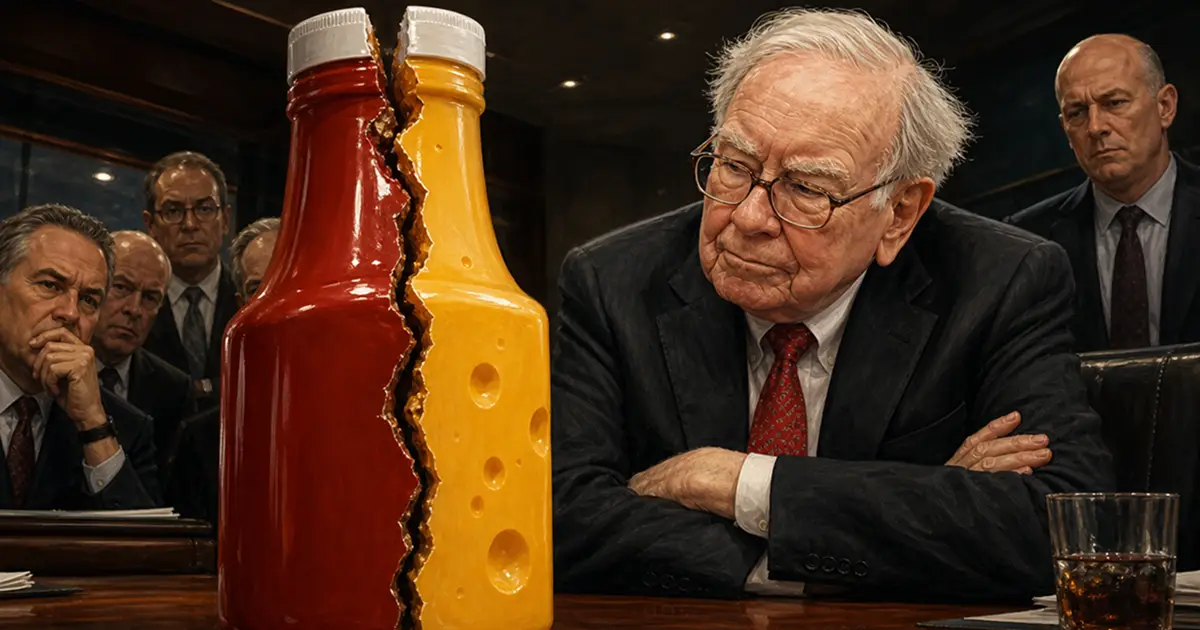
A ketchup company that swallowed a cheese company
On July 2, 2015, Kraft Foods Group merged into a wholly owned subsidiary of H.J. Heinz Holding Corporation, a private company controlled by Berkshire Hathaway and 3G Capital. Heinz was renamed The Kraft Heinz Company and took Kraft's listing. In the accounting that followed, Heinz was the acquirer and Kraft the acquired, and the total consideration exchanged came to $52,637 million: $42,502 million of stock, a $9,782 million special cash dividend, and $353 million of replacement equity awards, per the company's 2015 annual report on Form 10-K.
What emerged was a balance sheet unlike anything else in packaged food. At January 3, 2016, Kraft Heinz carried $43.1 billion of goodwill and $55.8 billion of indefinite-lived trademarks against total assets of $123.0 billion. Roughly four fifths of the company was an accounting estimate of what its brand names were worth.
The argument the numbers set up
For two years the deal looked like a vindication of the method its architects had used at Burger King, at Anheuser-Busch InBev and at Heinz itself: acquire a large incumbent, impose zero-based budgeting, and let margin do the work. Adjusted EBITDA margins reached roughly 29% in a category where a best-in-class operator makes low twenties. Then in one quarter Kraft Heinz wrote off $15.4 billion of the brand value it had booked, cut its dividend by 36%, and disclosed a subpoena from the Securities and Exchange Commission.
Warren Buffett's own verdict was that the price, not the strategy, was the error. Others concluded the opposite: that the cost method itself had hollowed out the brands. Those are different diagnoses with different lessons, and the ten years of evidence since 2015 support parts of both.
The Machine That Bought Kraft
What 3G had already proved at Heinz
The 2015 merger is unintelligible without the 2013 take-private that preceded it. On February 14, 2013, Berkshire and 3G agreed to buy H.J. Heinz for $72.50 per share in cash, a transaction valued at $28 billion including assumed debt. The equity came from committed contributions of $12.12 billion from Berkshire and $4.12 billion from 3G; J.P. Morgan and Wells Fargo committed $14.1 billion of debt, as Bloomberg reported at the time.
Berkshire's contribution was not ordinary equity. $8 billion of it bought 80,000 shares of 9.00% Series A cumulative redeemable preferred stock, carried alongside warrants to purchase 46 million Heinz common shares at $0.01 each. That left roughly $4.12 billion of common apiece, so the two sponsors split the ordinary equity evenly while Berkshire also held a security that paid $720 million a year before a cent reached the common.
| The 2013 Heinz take-private | Terms |
|---|---|
| Price per share | $72.50 cash |
| Transaction value | $28 billion incl. debt |
| Berkshire commitment | $12.12 billion |
| 3G commitment | $4.12 billion |
| Berkshire preferred | $8 billion at 9.00% |
| Warrants attached | 46m shares at $0.01 |
| Committed debt | $14.1 billion |
| Closed | June 7, 2013 |
The operating record over the next eighteen months is what made the second deal possible. The investor presentation the parties filed on March 25, 2015 states it flatly: $1 billion of annualized run-rate operating improvements, zero-based budgeting and management by objectives rolled out globally, individual performance targets for more than 3,500 employees, and an EBITDA margin that moved from 18% at closing in June 2013 to 26% in 2014.
- Zero-based budgeting
A budgeting discipline in which every line of spending must be justified from zero in each planning cycle rather than carried forward from the prior year with an adjustment. It is the operating signature of 3G Capital's portfolio companies. It reliably produces large early savings in acquired businesses with layered overhead, and it is criticized for stripping out the marketing, innovation and research spending whose payoff is measured in years rather than in the budget cycle being defended.
Why Kraft was the only target that fit
Kraft Foods Group had been separated from the international snacks business that became Mondelez in October 2012, leaving a mostly North American grocery company with $18.2 billion of net sales in the year to December 27, 2014. On the March 2015 call the parties described it in the language of a category leader: 98% household penetration in North America, the number one or number two position in 17 core categories, seven brands with annual retail sales above $1 billion.
It was also stagnant, domestic and, by 3G's standards, comfortable. That combination is precisely what the method requires. A business with entrenched shelf positions throws off predictable cash while its overhead absorbs cuts without an immediate revenue consequence, which is why the savings arrive early and the damage, if there is any, arrives late.
The strategic case offered publicly was different and thinner: Heinz would carry Kraft's brands into the 60% of its own sales that sat outside North America. That international repatriation never became a material earnings driver, and the deck itself hedged it as an opportunity "over time." The cost number was the case.
A private company buying a public listing
The structure deserves attention because it solved several problems at once. Heinz Holding was privately held by two sponsors who wanted a listed currency, permanent capital and control, and who did not want to run an initial public offering to get them.
The merger agreement
Kraft agrees to merge with a wholly owned subsidiary of H.J. Heinz Holding Corporation, with Kraft surviving as a subsidiary of Heinz.
The sponsor injection
Berkshire and 3G contribute $10 billion of new common equity to Heinz, sized specifically to fund the cash paid to Kraft holders.
The exchange
Each Kraft share converts into one share of the combined company, so Kraft holders keep a continuing equity interest rather than being cashed out.
The special dividend
Kraft holders receive $16.50 per share in cash, funded entirely by the sponsors' contribution rather than from Kraft's own balance sheet or new borrowing.
The listing
Heinz is renamed The Kraft Heinz Company, its shares are listed, and Heinz shareholders hold 51% against 49% for Kraft holders on a fully diluted basis.
That last line is the whole point of the reverse merger. The private company acquired the public one and inherited its listing, and the sponsors ended the day with a controlling stake in a Nasdaq-listed business without ever having marketed a share to public investors. Six of the eleven board seats went to Heinz appointees, including Buffett, Jorge Paulo Lemann, Marcel Telles and Greg Abel, with Alex Behring as chairman and 3G partner Bernardo Hees as chief executive.
What Kraft Shareholders Actually Received
The cash that came from outside the company
The dividend was the deal's most elegant feature and its least understood. Kraft holders received $16.50 per share, announced as approximately $10 billion in aggregate and recorded in the accounts at $9,782 million, and every dollar of it came from a sponsor equity injection rather than from Kraft's cash or from debt raised against the combined company.
Read one way, this was generous: Kraft shareholders took cash off the table and kept 49% of a larger business, and the stock rose about 37% on the announcement to trade near $84. Read another way, the sponsors were buying down their own dilution. Contributing $10 billion of fresh equity is what allowed Berkshire and 3G to hold 51% of a company whose public shareholders had brought the listing, the distribution and roughly four fifths of the combined group's North American food and beverage sales.
Neither reading is wrong, and the choice between them is largely a choice about what a Kraft share was worth standing alone. Kraft had replaced its chief executive months earlier, was losing volume in cheese and coffee, and had no obvious independent path to the margin its acquirer was promising.
Where fifty-two billion dollars landed on the balance sheet
Purchase price allocation is usually treated as post-closing housekeeping. Here it is the clearest available statement of what the buyers believed they were buying, because accounting rules forced them to say so line by line.
| Kraft purchase price allocation, 2015 | Amount |
|---|---|
| Identifiable intangible assets | $49,749m |
| Property, plant and equipment | $4,193m |
| Cash and other current assets | $3,737m |
| Long-term debt assumed | ($9,286m) |
| Deferred income tax liabilities | ($17,239m) |
| Other liabilities and payables | ($7,760m) |
| Net tangible and intangible assets | $23,608m |
| Goodwill on acquisition | $29,029m |
| Total consideration | $52,637m |
The rows condense the filing's fuller schedule, so the interior lines do not sum exactly; the goodwill and total consideration figures are as reported. Two lines carry the case. Of the $49,749 million of identifiable intangibles, $45,082 million was indefinite-lived trademarks, assets that are never amortized and are instead tested each year against a discounted cash flow model. And the $29,029 million of goodwill was entirely non-deductible for tax, meaning it produced no cash shield to offset the price.
- Indefinite-lived intangible assets
Acquired brand names and trademarks that a buyer judges to have no foreseeable end to their useful life. Unlike a customer relationship or a patent, they are not amortized against earnings, so they sit on the balance sheet at their acquisition-date fair value indefinitely. The trade-off is that they must be tested for impairment at least annually against a fresh forecast, which means that the only way their value ever changes is a write-off, and the write-off arrives all at once.
Together the trademarks and the goodwill came to $74.1 billion, more than the $52.6 billion headline because the intangible step-up also created $17,239 million of deferred tax liabilities and because $9,286 million of Kraft debt was assumed. Stripped of the accounting, the buyers had paid for brand names and for the expectation that those names would keep their shelf space. Our primer on how goodwill and intangibles behave after an acquisition covers why that expectation is tested annually and what happens when it fails, and the mechanics of the allocation itself are set out in our guide to purchase price allocation in M&A accounting.
The capital structure they promised
The financing plan announced with the merger was unusually specific, and it is the part of the deal that worked exactly as advertised. Kraft Heinz would refinance $9.5 billion of Heinz's existing secured high-yield debt with investment grade paper at closing, call Berkshire's $8 billion of preferred as soon as it became redeemable in June 2016 for annualized cash savings of $450 million to $500 million, pay down $2 billion of debt within two years, run no share repurchases for at least two years, and target net leverage below 3.0x in the medium term.
All of that happened. In 2016 the group issued senior notes and used the proceeds to redeem the preferred for $8.3 billion, and Berkshire exercised its warrants in June 2015, converting 46 million Heinz shares into roughly 20 million Kraft Heinz shares. The sponsor that had underwritten the 2013 take-private was made whole on the most expensive piece of its position before the operating thesis was ever tested.
Master the mechanics behind a deal answer: practice 1,000+ technical questions on M&A, financing, and accretion/dilution, download our iOS app for the full toolkit.
The Two Years When the Method Worked
A billion and a half promised, more than that taken out
The synergy target announced on March 25, 2015 was $1.5 billion of run-rate annual cost savings by the end of 2017, to come from zero-based budgeting applied to both cost of goods and overhead, from rationalized manufacturing and distribution, and from optimized advertising and marketing spend. That last phrase is worth remembering.
Execution was fast and, by the standard the market applies to cost synergies, complete. On November 4, 2015, four months after closing, Kraft Heinz announced the closure of seven factories and about 2,600 job cuts. By the end of 2018, with the Integration Program substantially completed the year before, the company had closed a net six factories, consolidated its distribution network and eliminated 4,900 positions, at a cumulative pre-tax cost of $2,146 million. By 2019 CNBC put the cumulative cost reduction at $1.7 billion, above the promise.
The margin followed. Adjusted EBITDA reached $7,574 million in 2016 and $7,664 million in 2017 on net sales of about $26 billion, a margin near 29% in an industry where the largest operators run closer to 20%. Measured on the numbers a sponsor watches, the deal had done everything it was designed to do inside eighteen months.
The line in the deck that nobody enforced
The same March 2015 presentation that promised the cuts also promised the reinvestment. Under the heading of Heinz's strategy for organic growth it committed to "reinvesting substantial fixed cost savings back into the business" and to increasing marketing spending to support the top line. The filings show what actually happened.
| Kraft Heinz spending and results | 2016 | 2017 | 2018 |
|---|---|---|---|
| Net sales | $26,300m | $26,076m | $26,268m |
| Adjusted EBITDA | $7,574m | $7,664m | $7,024m |
| Advertising expense | $708m | $629m | $584m |
| Total advertising and marketing | $1,221m | $1,115m | $1,140m |
Measured advertising fell 17.5% across two years while sales were flat, which is the empirical core of the case against the method. The company's defense is visible in the same table: total advertising and marketing costs, which include shopper marketing, sponsorships and agency fees, were roughly stable, so what changed was the mix rather than the aggregate. Organic net sales were flat to negative throughout.
Forty-Eight Hours in February 2017
Why the model needed a bigger target
By late 2016 the arithmetic that had made Kraft Heinz work was running down. The $1.5 billion had been captured, organic sales were not growing, and a business built on repeatedly applying a cost method to newly acquired overhead had no new overhead to apply it to. The answer, as it had been in 2013 and 2015, was another acquisition, and there were very few targets left at the required scale.
On February 17, 2017, Kraft Heinz confirmed it had made a cash-and-share proposal for Unilever at $50.00 per share, comprising $30.23 in cash plus 0.222 shares in the enlarged group, valuing the Anglo-Dutch group at roughly $143 billion and representing an 18% premium to the previous day's close. Alex Behring had put it to Unilever's chief executive Paul Polman directly.
The bid that died on a Saturday phone call
Unilever's rejection was categorical. Its statement said the board saw no merit, financial or strategic, for Unilever's shareholders, and that it saw no basis for further discussion. Within 48 hours the two companies issued a joint statement confirming that Kraft Heinz had withdrawn.
Buffett's later account, given to CNBC on February 27, 2017, explains the speed. He said the approach had not been intended as a hostile takeover, though "it may have been interpreted that way," and that once calls on the Saturday told him the offer was unwelcome, there was no offer. A bidder that will not go hostile has no leverage over a target that says no, which is why a $143 billion proposal died in a weekend without a single revised term.
The failed approach is the most useful single event in the case, because it dates the exhaustion of the strategy precisely. Kraft Heinz shares reached their record high in the same month. Everything after February 2017 is a company operating a cost method with nothing left to cut, in categories that were losing volume to private label and to fresh food, while carrying goodwill and intangibles that had reached $104.3 billion by the end of 2017.
February 21, 2019
Fifteen point four billion dollars of brand value
The reckoning arrived with fourth-quarter results. Kraft Heinz announced non-cash impairment losses of $15.4 billion, lowering the carrying amount of goodwill in certain reporting units, primarily U.S. Refrigerated and Canada Retail, and of certain intangible assets, primarily the Kraft and Oscar Mayer brands. The quarterly net loss was $12.6 billion. The dividend went from $0.625 to $0.40 a quarter, a 36% cut. And the company disclosed that it had received an SEC subpoena the previous October.
The shares fell about 27% the following day. For the restated full year, goodwill impairment losses were $7,008 million and intangible asset impairment losses $8,928 million, a total of $15,936 million, producing a net loss attributable to common shareholders of $10,192 million, or $8.36 a share. The fourth-quarter charge and the full-year total differ because of smaller impairments earlier in 2018 and because a subsequent recalculation added roughly $13 million to the number first announced.
- Goodwill impairment
An annual or triggered test comparing a reporting unit's carrying value with its fair value, usually estimated by discounting its projected cash flows. Where carrying value is higher, the excess is written off through the income statement. The charge consumes no cash, because the cash left the business on the day the acquisition was paid for. What the write-off records is the moment management's own forecast finally falls below the price it once paid, which is why impairments cluster after a change in outlook rather than tracking the share price down in real time.
The subpoena that unwound three years of savings
The accounting problem was smaller than the impairment and more damaging to the story. In October 2018 the SEC subpoenaed Kraft Heinz over its procurement function, specifically the accounting policies and internal controls governing agreements, side agreements and modifications with suppliers.
The subpoena
October 2018. The SEC requests documents on procurement accounting; the company opens an internal investigation with external counsel and forensic accountants.
The first disclosure
February 21, 2019. Kraft Heinz reports the subpoena alongside the $15.4 billion impairment and books a $25 million increase to cost of products sold it initially deems immaterial.
The escalation
May 6, 2019. An 8-K discloses that the misstatements are material, that prior statements must be restated, and that errors were also found in the fourth-quarter impairment calculations.
The restatement
June 7, 2019. The delayed 2018 Form 10-K restates 2016, 2017 and interim 2018, correcting $208 million of improperly recognized cost savings across nearly 300 transactions, and reports material weaknesses in internal control.
The penalty
September 3, 2021. The SEC settles with the company for a $62 million civil penalty; a former chief operating officer pays $300,000 and a former chief procurement officer $100,000 with a five-year officer and director bar.
The mechanism matters more than the sums. The SEC found that Kraft Heinz had booked unearned supplier discounts and maintained misleading supplier contracts, from the last quarter of 2015 through the end of 2018. That window begins one quarter after the merger closed, and the conduct sat in exactly the function where a zero-based budgeting regime applies the most pressure to produce savings on schedule. A securities class action covering purchasers from November 6, 2015 to August 7, 2019 settled for $450 million in May 2023.
What the sponsors did next
Berkshire took a $3.0 billion write-down on its Kraft Heinz holding in its fourth-quarter 2018 results, reported two days later. Buffett then went further in public than he generally does about a portfolio company.
We overpaid for Kraft.
His reasoning on the same broadcast is the sharpest single formulation of the price thesis. The underlying business, he said, uses about $7 billion of tangible assets and earns roughly $6 billion pre-tax on them, which is an extraordinary return. Berkshire and its predecessors, however, had put roughly $100 billion of capital behind those tangible assets, so the return that matters to the owner is calculated on the $100 billion, not the $7 billion. He was explicit that he did not think Berkshire had overpaid for Heinz.
Sell-side analysts drew the opposite conclusion from the same disclosure. Downgrading the stock, Piper Jaffray's Michael Lavery wrote that the impairments validated a fear about the operating model itself.
more focused on costs than building brand equity
3G, meanwhile, was selling. It had disposed of 20.6 million shares at $59.85 in August 2018, and sold a further 25.1 million at $28.44 in September 2019, roughly half the earlier price.
Go deeper before an interview: our 160-page PDF covers deal frameworks, technicals, and behavioral prep end to end, access the IB Interview Guide and pair it with these case studies.
Buying Back What Had Been Cut
Patricio inherits a cost machine
Bernardo Hees left on June 30, 2019 and was replaced by Miguel Patricio, a career marketer who had run global marketing at Anheuser-Busch InBev. His diagnosis, given to Reuters in April 2019 before he started, was a direct repudiation of the operating model he was inheriting.
obsession for efficiency has to be much bigger than the obsession for cutting costs
He added that cost cutting should be a priority for any company but that no company can cut costs every year, and said his focus was on organic growth rather than another acquisition. Edward Jones analyst Brittany Weissman put the market's reading of the appointment plainly, telling Reuters that the company had realized it cut a little too far.
The turnaround that followed was real but modest, and it was helped by a pandemic that pushed consumers back toward shelf-stable food. Patricio shrank the portfolio deliberately, selling the Planters nuts business to Hormel for $3.35 billion and the natural cheese business to an affiliate of Groupe Lactalis for about $3.2 billion in cash, both completed in 2021, and putting the proceeds into debt reduction and brand reinvestment. By 2023 Kraft Heinz reported net sales of $26,640 million, operating income of $4,572 million and net income attributable to common shareholders of $2,855 million, its best year since the merger.
The impairments never stopped
The balance sheet told a different story from the income statement, and it is the more reliable one. Having written off $15.9 billion in 2018, the company took further impairment losses of $662 million in 2023, $3,669 million in 2024, and $9,306 million in 2025, the last comprising $6,734 million of goodwill and $2,572 million of intangibles and producing a net loss of $5,846 million for the year, followed by a further $7,352 million in the second quarter of 2026 alone.
| Kraft Heinz balance sheet | Jan 3, 2016 | Dec 27, 2025 |
|---|---|---|
| Goodwill | $43.1bn | $22.2bn |
| Intangible assets, net | $62.1bn | $37.5bn |
| Total assets | $123.0bn | $81.8bn |
| Net sales | $27.4bn pro forma | $24.9bn |
| Total debt | $25.2bn | $21.2bn |
The reported 2015 net sales line was only $18.3 billion because it included Kraft for half a year, so the table uses the $27,447 million pro forma combined figure the company disclosed for the same period. On that basis, revenue fell about 9% in nominal dollars across a decade in which food prices rose substantially. The rest of the table shows roughly $45 billion of goodwill and brand carrying value removed from the balance sheet. That is the deal being unwound in accounting years before anyone proposed unwinding it in structure.
Taking It Apart, Then Not
Two companies, ten years apart
On September 2, 2025, Kraft Heinz announced that its board had approved a plan to separate into two independent public companies through a tax-free spin-off: a Global Taste Elevation business built on Heinz, Philadelphia and Kraft Mac & Cheese with approximately $15.4 billion of 2024 net sales and $4.0 billion of adjusted EBITDA, and a North American Grocery business built on Oscar Mayer, Kraft Singles and Lunchables with approximately $10.4 billion of sales and $2.3 billion of adjusted EBITDA. Centerview Partners, which had advised Kraft in 2015, advised again. Completion was targeted for the second half of 2026.
The plan was, in substance, the merger run backwards: the Heinz-centered international sauces business separating from the Kraft-centered North American grocery business, ten years after the two were joined. The market did not reward it, and the shares fell as much as 7.6% on the day. Our explainer on spin-offs and carve-outs covers why separations of this kind are usually a response to a valuation problem rather than an operating one.
Buffett said publicly that he was disappointed, objecting to roughly $300 million of additional overhead the separation would incur.
It certainly didn't turn out to be a brilliant idea to put them together
He completed the thought by saying he did not think taking them apart would fix it either.
Both sponsors head for the exit
3G Capital had trimmed for years before disposing of its entire remaining 16.1% holding in the fourth quarter of 2023, nearly nine years after engineering the merger. Berkshire's exit has been slower and more public. Its two representatives resigned from the Kraft Heinz board on May 19, 2025; in the second quarter of 2025 Berkshire recorded a pre-tax impairment of about $5.0 billion, $3.8 billion after tax, that took the carrying value of the investment to $8.4 billion, against more than $17 billion at the end of 2017.
Then on January 20, 2026, under new chief executive Greg Abel, Berkshire filed a registration statement covering its entire 27.5% stake, a step that clears the way for a sale without committing to one. Kraft Heinz shares fell as much as 7.5% the next day. Berkshire's cost basis in the shares, per Buffett's 2015 letter to shareholders, was $9.8 billion. In March 2026 Abel said the filing was precautionary and that Berkshire had no immediate plans to alter the stake, and he endorsed the decision to pause the split.
The pause
On December 16, 2025 Kraft Heinz named Steve Cahillane, previously chief executive of Kellanova, as its own chief executive from January 1, 2026, and made John T. Cahill, the last chief executive of Kraft Foods Group before the merger, chairman of the board. Cahillane had run the Kellogg separation and then sold the resulting company to Mars, which made him an unusually well-qualified person to judge whether this separation was worth doing.
He decided, for now, that it was not. On February 11, 2026, alongside 2025 results showing net sales of $24,942 million and a net loss of $5,846 million, Kraft Heinz said it was pausing work on the separation and would instead spend $600 million on marketing, sales, research and product development, saving roughly $300 million of dis-synergies and separation costs in 2026. By the second quarter results on August 5, 2026, that incremental investment had been raised to about $700 million, net sales were down 1.4% to $6,262 million against a consensus that had expected worse, and the organic sales outlook for the year was improved to a decline of 0.5% to 2.0%. The same quarter also carried another $7,352 million of non-cash impairments, $2,441 million of goodwill and $4,911 million of intangibles, and a net loss of $5,460 million. The separation survives in the filings as a forward-looking risk factor rather than as a live transaction.
Did the Price Kill It, or Did the Method?
What the record settles
Several things are no longer arguable. The merger closed on schedule and the cost program overdelivered: $1.5 billion was promised by 2017 and roughly $1.7 billion was taken out, lifting adjusted EBITDA margins to about 29%. The financing plan executed exactly as announced, including the redemption of Berkshire's preferred for $8.3 billion in 2016.
Equally settled is the outcome. Kraft Heinz wrote off $15.4 billion of brand and goodwill value in a single quarter and roughly $45 billion across ten years; it restated three years of accounts and paid $62 million to the SEC and $450 million to shareholders; the shares are down roughly 65% since the merger closed; 3G has exited entirely and Berkshire has registered its whole stake for possible sale; and the architect of the deal has said on the record that Berkshire overpaid.
The three explanations, and what each one predicts
The first is the method thesis, argued by Piper Jaffray in 2019 and by Patricio himself: zero-based budgeting starved the brands. It has the cleanest supporting evidence, in advertising spend that fell 17.5% in two years while the merger deck promised reinvestment, and in a restatement that originated in the procurement function under exactly the pressure the method creates.
The second is the category thesis. Center-of-store packaged food has lost share to private label and to fresh across the decade regardless of who owned it, and the breakups now running through the sector, including Kellogg's separation of its North American cereal business in 2023, suggest a structural problem rather than a Brazilian one. CNBC framed the Kraft Heinz and Kellogg breakups as a single trend of Big Food getting smaller, which is the strongest evidence that the operating model was not the whole story.
The third is Buffett's price thesis, and it is the only one that is arithmetic rather than interpretation. A business employing $7 billion of tangible assets and earning $6 billion pre-tax is a superb business. Paying roughly $100 billion for it converts a superb business into a mediocre investment, and no operating improvement available to any management team closes a gap of that size.
The reading the evidence supports
The three are not competing so much as sequential, and the sequence is what a candidate should be able to trace. The category thesis explains why the brands were worth less in 2019 than the models had assumed in 2015. The method thesis explains why Kraft Heinz lost share faster than peers who were merely coping with the same headwind. And the price thesis explains why either of those was fatal rather than merely disappointing: a purchase price allocation that put $45.1 billion into indefinite-lived trademarks and $29.0 billion into non-deductible goodwill left no margin for the brands to be worth even modestly less than the forecast.
What genuinely remains open is whether the structure can be fixed at all. The 2025 separation plan was the market's preferred answer and Buffett's objection to it was the most interesting dissent, because he argued that neither joining these businesses nor splitting them addresses the underlying problem. The company itself has now paused the split in favor of spending on the brands, which is a bet on the method thesis being right and reversible. That bet is roughly six months old at the time of writing, the volume declines have narrowed but not stopped, and anyone claiming to know how it resolves is guessing. The comparison with AB InBev's SABMiller acquisition, where the same operating method was applied to a deal whose goodwill has never been impaired, is the most instructive control in the corpus: the difference between the two outcomes is not the method, it is what the assets underneath the method turned out to be worth. Against the benchmark of AOL's Time Warner merger, Kraft Heinz is a smaller disaster with a longer fuse, and its writedowns arrived one forecast revision at a time rather than all at once.
Sources
- 1The Kraft Heinz Company, Annual Report on Form 10-K for fiscal 2015, SEC EDGAR, March 3, 2016.
- 2The Kraft Heinz Company, Annual Report on Form 10-K for fiscal 2018, as restated, SEC EDGAR, June 7, 2019.
- 3The Kraft Heinz Company, Annual Report on Form 10-K for fiscal 2025, SEC EDGAR, February 12, 2026.
- 4H.J. Heinz Holding Corporation and Kraft Foods Group, investor presentation filed under Rule 425, March 25, 2015.
- 5The Kraft Heinz Company, "H.J. Heinz Company and Kraft Foods Group Sign Definitive Merger Agreement", March 25, 2015.
- 6The Kraft Heinz Company, preliminary first-half 2019 results and impairment disclosure, Exhibit 99.1, SEC EDGAR, August 8, 2019.
- 7Securities and Exchange Commission, "SEC Charges The Kraft Heinz Company and Two Former Executives for Engaging in Years-Long Accounting Scheme", September 3, 2021.
- 8The Kraft Heinz Company, "Kraft Heinz Announces Plan to Separate into Two Scaled, Focused Companies", September 2, 2025.
- 9The Kraft Heinz Company, press release announcing the appointment of Steve Cahillane and the status of the planned separation, SEC EDGAR, December 16, 2025.
- 10"Heinz Gets $14.1 Billion Financing for Berkshire, 3G Capital Buy," February 15, 2013, Bloomberg.
- 11"Kraft Heinz shares tank after company writes down two iconic brands, slashes dividend and discloses SEC subpoena," February 21, 2019, CNBC.
- 12"Buffett, after last week's stock plunge, says Berkshire Hathaway 'overpaid' for Kraft," February 25, 2019, CNBC.
- 13"Warren Buffett: Kraft Heinz bid for Unilever was not a 'hostile offer'," February 27, 2017, CNBC.
- 14"Kraft Heinz's new CEO looks beyond cost-cutting, big M&A," April 22, 2019, CNBC.
- 15"Kraft Heinz sells nuts business, including Planters, to Hormel for $3.35 billion," February 11, 2021, CNBC.
- 16The Kraft Heinz Company, "Kraft Heinz Announces Agreement to Sell Its Natural Cheese Business to Groupe Lactalis", September 15, 2020.
- 17"Warren Buffett's public Kraft Heinz criticism is extremely unusual for the typically passive owner," September 6, 2025, CNBC.
- 18"Berkshire prepares to exit 28% stake in Kraft Heinz as new CEO aims to move on from rare Buffett gaffe," January 21, 2026, CNBC.
- 19"3G Capital quietly exited its Kraft Heinz investment last year," April 9, 2024, CNBC.
- 20"Kraft Heinz, Kellogg breakups show Big Food is getting smaller," January 31, 2026, CNBC.
- 21"Kraft Heinz pauses work to split the company as new CEO says 'challenges are fixable'," February 11, 2026, CNBC.
- 22The Kraft Heinz Company, "Kraft Heinz Reports Second Quarter 2026 Results; Updates 2026 Full Year Outlook", SEC EDGAR, August 5, 2026.
- 23"Misconduct at Kraft Heinz puts spotlight on employee pressure to meet bonus targets," May 7, 2019, CNBC.
- 24"Warren Buffett says he is 'disappointed' in Kraft Heinz split," September 2, 2025, CNBC.