


Overview
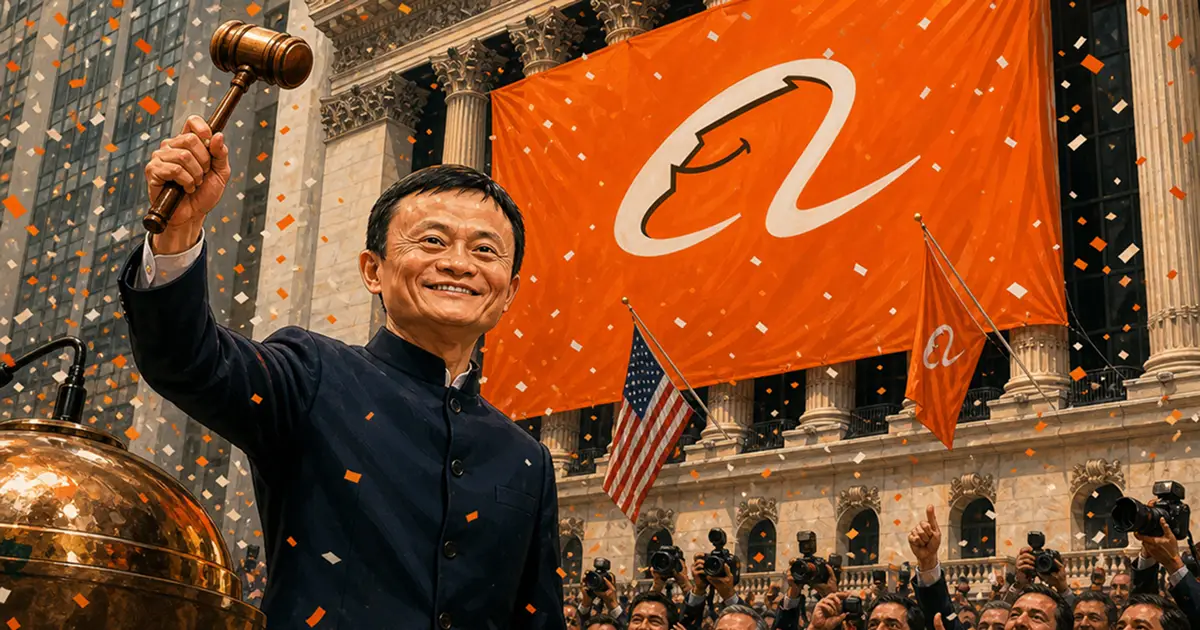
On September 19, 2014, Alibaba Group Holding Limited sold 320,106,100 American depositary shares at $68.00 each, raising $21.77 billion and making it the largest initial public offering ever completed on a US exchange. Three days later the underwriters exercised their over-allotment option in full, taking the gross total to roughly $25.03 billion and pushing Alibaba past Agricultural Bank of China's 2010 sale to claim the global record outright. The stock opened at $92.70 after what the exchange called the longest opening auction it could recall and closed its first session at $93.89, up 38%, valuing the company at about $231 billion.
None of that was supposed to happen in New York. Alibaba's first choice was Hong Kong, a market it knew, in a currency and time zone its shareholders understood, and it spent most of 2013 trying to get there. The Stock Exchange of Hong Kong refused, because Alibaba would not give up a structure that lets a self-selecting group of about thirty partners nominate a majority of the board while owning roughly a tenth of the equity.
The record that a governance fight created
The rejection is the reason the deal exists in the form it took. Hong Kong applied a one share, one vote rule that dates to a 1980s ban on dual-class listings; the United States applies a disclosure standard that permits almost any structure as long as it is described accurately in the prospectus. Alibaba announced on March 16, 2014 that it would start the US process instead, filed its Form F-1 on May 6, and priced five months later at the top of a range it had already raised once.
What investors bought was also unusual. Alibaba's Chinese internet licenses cannot legally be held by a foreign-owned company, so the listed entity is a Cayman Islands holding company that controls the licensed businesses through contracts rather than ownership. The offering therefore packaged two structural questions into the largest equity raise ever attempted: who controls the board, and what exactly does a share certificate entitle you to.
Why the verdict is still contested
Judged as a capital raise, the deal is close to flawless. Alibaba took roughly $10.0 billion onto its own balance sheet, its selling shareholders took roughly $14.7 billion, the syndicate was paid a gross spread of only 1.2%, the partnership's board rights survived intact, and the open was orderly at a moment when the market's memory of Facebook's broken Nasdaq debut was two years old.
Judged from the buy side the picture is very different, and this is the tension the case turns on. An investor who bought at $68.00 and held has compounded at a low single-digit rate over almost twelve years, well behind a US index fund. An investor who bought at the first-day close is barely ahead. The structure Hong Kong objected to never was the thing that broke; something Hong Kong did not name, the Chinese state's willingness to intervene directly in Alibaba's affairs, did far more damage than any board nomination right.
This account is built from the final prospectus, the parties' own statements and blogs, contemporaneous reporting from Bloomberg, Reuters, CNBC and the South China Morning Post, a US congressional commission's staff research, an independent pre-IPO valuation, and the documented aftermath through 2026.
The Company Hong Kong Turned Away
A platform priced on a scale Western investors had never underwritten
Alibaba did not arrive as a growth story that needed imagination. In the fiscal year ended March 31, 2014 it generated revenue of RMB52,504 million, about $8.46 billion, up 52.1% year on year, and net income of RMB23,403 million, about $3.77 billion, up 170.6%. Its three China retail marketplaces, Taobao Marketplace, Tmall and Juhuasuan, had produced combined gross merchandise volume of RMB1,833 billion, about $296 billion, in the twelve months to June 30, 2014, from 279 million active buyers and 8.5 million active sellers.
The economics were unusual because the model was unusual. Alibaba did not buy or hold inventory and did not compete with its merchants; it ran marketplaces and monetized them through online marketing services and commissions, which is why it earned a $3.77 billion profit on the RMB1,678 billion, about $270 billion, of China retail merchandise volume that crossed its platforms in the same fiscal year. Compared with a first-party retailer, that structure converts scale into margin almost immediately, and it is the single fact that made a $168 billion valuation defensible on the numbers rather than on faith.
- Gross merchandise volume (GMV)
The total value of goods sold across a marketplace in a period, measured before returns and before the platform's own take. It is not revenue. A marketplace's revenue is the slice it keeps, so the ratio of revenue to GMV, the "take rate," is the number that actually matters. Alibaba's fiscal 2014 take rate on its China retail marketplaces was roughly 2.5%, which is why merchandise volume measured in the hundreds of billions produced group revenue of about $8.46 billion.
There was also a visible risk in the trend line. Mobile GMV had reached 32.8% of the total in the June 2014 quarter, up from 12.0% a year earlier, and mobile monetized worse than desktop at the time. Alibaba disclosed the shift plainly, and the bull case treated it as a temporary drag on a metric that was otherwise accelerating.
The partnership Alibaba would not surrender
The structure at the center of the fight is not a dual-class share plan. Formalized in July 2010 as Lakeside Partners, the Alibaba Partnership had 30 members at the time of the offering: 24 from Alibaba management, five from what was then called Small and Micro Financial Services Company, and one from China Smart Logistics. New partners are elected annually and require the approval of at least 75% of existing partners. Every partner has one vote regardless of shareholding.
What the partnership holds is the exclusive right, written into the articles of association, to nominate a simple majority of the board. Shareholders still vote on each nominee, but if a nominee is voted down the partnership may appoint an interim director and put forward a replacement; and if the board ever falls below a partnership-nominated majority for any reason, the partnership may unilaterally appoint enough additional directors to restore it. The provision can only be changed by shareholders representing 95% of the votes cast at a general meeting.
- The Alibaba Partnership
A self-perpetuating body of senior Alibaba executives, not a legal partnership in the ordinary sense and not a share class. It elects its own members by a 75% vote, and under Alibaba's articles it alone may nominate a simple majority of the board of directors, backstopped by a right to appoint directors outright if that majority ever lapses. It concentrates board control without concentrating votes, which is why it sits outside the rules most exchanges wrote for dual-class shares.
Alibaba's own framing, set out in the prospectus, was that this is better than the alternative. The document argues that "unlike dual-class ownership structures that employ a high-vote class of shares to concentrate control in a few founders," the partnership embodies "the vision of a large group of management partners" and solves for the fact that founders eventually retire. The counter-argument is that it is worse: a dual-class founder at least owns the high-vote stock and is visible, whereas the partnership's membership can change without a shareholder vote and its aggregate economic stake, roughly 10% of the company, is far smaller than the control it exercises.
Both readings survived the IPO intact, and the case does not need to pick one. What matters analytically is that the structure was designed to be permanent and was disclosed as such, and Alibaba treated it as non-negotiable in a way it treated almost nothing else in the transaction.
Hong Kong's line, and why it held
The Stock Exchange of Hong Kong told Alibaba in late September 2013 that it would not list the company with the partnership's nomination right in place. The rule Alibaba ran into is old and specific: after Jardine Matheson and others attempted low-vote share issues in the late 1980s, the exchange and the securities regulator jointly banned new dual-class listings, and Swire Pacific survives as the sole grandfathered exception. The exchange's position was not that Alibaba's arrangement was a share class, but that it produced the same result and therefore breached the same principle.
Hong Kong's regulatory philosophy explains why the answer was no rather than a negotiation. The great majority of the exchange's issuers have a dominant shareholder, against a far lower share in Western markets, so the rulebook protects minorities by prescription at the listing gate rather than by disclosure and litigation afterwards. Chief executive Charles Li aired the internal argument publicly in a widely read blog post staged as a dream, in which invented characters including Mr Tradition, Mr Innovation and Ms Small Retail argued the case against each other, which is an unusual way for an exchange head to concede that his institution was genuinely torn.
ready to look forward as the rest of the world passes it by
Joe Tsai published his response on September 26, 2013, arguing on Alibaba's own blog that the question Hong Kong had to address was whether it was ready to look forward as the rest of the world passed it by. Li's public reply, made after Alibaba confirmed the US route in March 2014, conceded the competitive problem while defending the process: Hong Kong was proud of its adherence to principle, he said, but needed to make its market more responsive to new economy companies.
losing a generation of companies from China's new economy
Li's framing was that losing a listing or two is survivable and losing a generation of China's new economy companies is not, which is a remarkably clear-eyed statement of the cost his own institution was accepting. It also explains why the decision looked so different from inside Hong Kong than from outside it, a distinction that runs through the way capital markets work in Hong Kong and Singapore more broadly. For Alibaba the calculus was simpler: the United States would accept the structure, so the company went where the structure was legal.
| Question | Hong Kong, 2013 | New York, 2014 |
|---|---|---|
| Insider board nomination | Not permitted | Permitted if disclosed |
| Dual-class shares | Banned since the 1980s | Long established |
| Regulatory model | Prescriptive listing rules | Disclosure plus litigation |
| Minority protection | Screening at the gate | Class actions afterwards |
| Outcome | Talks ended Sept 2013 | $25.03 billion raised |
The columns are not a scorecard so much as two different theories of who protects an investor. Hong Kong's answer is that the exchange does it at the gate, before the retail buyer ever sees the stock; New York's is that full disclosure plus a plaintiffs' bar does it afterwards. Alibaba tested both theories at once, and the next section is where the second one started being priced.
Building the Book Without a Bank in Charge
Six bookrunners, no lead-left
Almost every large IPO has one bank at the top of the cover, the lead-left bookrunner, which runs the book, controls the allocation spreadsheet and holds the only complete picture of demand. Alibaba refused to appoint one. Credit Suisse, Deutsche Bank, Goldman Sachs, J.P. Morgan and Morgan Stanley each underwrote 50,291,578 ADSs, 15.7% of the base deal, and Citigroup took 25,145,798, or 7.9%. Twenty-eight further underwriters split the remaining 13.6%, for 34 firms in total.
- Lead-left bookrunner
The bank whose name appears leftmost on a prospectus cover. In a conventional syndicate it is the one that builds and holds the order book, advises the issuer on price, and drives allocation, which gives it both the largest fee and the most information. Removing the role, as Alibaba did, distributes the fee and the workstreams but also means no single adviser can see the whole book.
The syndicate was organized into paired workstreams, with Credit Suisse alongside Citigroup, Goldman Sachs alongside Deutsche Bank, and Morgan Stanley alongside J.P. Morgan, beneath which sat a second tier that participated in analyst meetings and a third that handled distribution. Rothschild sat outside the syndicate entirely as Alibaba's independent financial adviser, buying and selling nothing and reportedly paid around $9 million for the advice. Joe Tsai and corporate finance head Michael Yao ran the negotiation from the company's side.
The design has a clear logic and a real cost. Because each bank saw only its own slice, Alibaba was the only party with the full picture, which inverts the usual information asymmetry between an issuer and its underwriters and removes the conflict at the heart of allocation. Bankers involved told Reuters afterwards that the arrangement created duplication and delay precisely because no bank had an overall view of how the process was going, which is the same fact described from the other side.
| Bookrunner | Base ADSs | Share of deal |
|---|---|---|
| Credit Suisse | 50,291,578 | 15.7% |
| Deutsche Bank | 50,291,578 | 15.7% |
| Goldman Sachs | 50,291,578 | 15.7% |
| J.P. Morgan | 50,291,578 | 15.7% |
| Morgan Stanley | 50,291,578 | 15.7% |
| Citi | 25,145,798 | 7.9% |
| 28 other underwriters | 43,502,412 | 13.6% |
Whether the model worked is genuinely arguable and the evidence points both ways. The open was orderly and the price held, which is the outcome the structure was designed to protect; the process was slower and more repetitive than a conventional syndicate, which is the cost it imposed. What is not arguable is that no other issuer of this size has repeated it, which tells you something about how banks priced the experience afterwards.
A record fee that broke the record by being small
Alibaba paid an underwriting discount of $0.816 per ADS, exactly 1.2% of the offering. On the base deal that came to $261,206,578, of which the company paid $100,430,776 and the selling shareholders $160,775,802. With the over-allotment exercised in full, the pool rose to roughly $300.4 million, reported at the time as the largest nominal underwriting fee ever paid on an IPO and, as a percentage, far below the market.
The comparison that makes the number legible is the American convention. Small and mid-sized US IPOs routinely pay a 7% gross spread; large ones negotiate it down; Facebook, the previous benchmark for a hard-nosed issuer, paid roughly 1.1% in 2012. Alibaba landed a shade above Facebook on percentage while paying nearly twice as much in cash, because the deal was so large that a thin spread still produced a record cheque.
Alibaba's own offering expenses, exclusive of the discount, were about $50 million, and the underwriters agreed to reimburse a portion of them. Dealers taking stock from the syndicate received a concession of no more than $0.408 per ADS, half the total spread, which is the mechanism by which a fee negotiated at the top gets distributed down a 34-firm chain.
The roadshow that filled the book in two days
The marketing began at the Waldorf Astoria in Manhattan on September 8, 2014, where roughly 800 investors queued through the ground floor and basement to hear Jack Ma; the Boston and San Francisco sessions were similarly oversubscribed for seats before anyone had allocated a share. Reports at the time said the order book was effectively full within two days of launch, and bankers moved to close it early.
The pricing then walked up. The September 5 filing had proposed 320.1 million ADSs at $60 to $66, about $20.2 billion at the midpoint. On September 15 the range was lifted to $66 to $68, which by itself took the deal above $21 billion without issuing a single additional share, and on September 18 it priced at $68.00, the top of the raised range. At that price the roughly 2.47 billion shares outstanding after the offering were worth about $168 billion.
File the range
Sept 5: 320.1 million ADSs marketed at $60 to $66, roughly $20.2 billion at the midpoint.
Launch the roadshow
Sept 8: Jack Ma and the syndicate begin a two-week investor tour; the New York session draws about 800 attendees.
Build the book
Orders are collected by six bookrunners running separate workstreams; the book is reported full within two days.
Raise the range
Sept 15: the range moves to $66 to $68, lifting the deal above $21 billion on the same share count.
Close the book early
Orders shut ahead of schedule, US accounts first, then international.
Price the deal
Sept 18: priced at $68.00 per ADS after the close, raising $21.77 billion.
Allocate
Stock is directed toward a small group of institutions judged likely to hold rather than flip.
Trade and stabilize
Sept 19: the NYSE opening auction sets $92.70; the greenshoe is available for 30 days.
Allocation was where the deliberate choices show. Rather than spreading stock widely, the syndicate concentrated it: reporting at the time indicated the offering was concentrated on a group of roughly twenty-five to fifty large institutions, chosen for a stated interest in the long-term story rather than a first-day trade. That is a defensible way to build a stable register, and it is also a decision that hands the day-one gain to a very short list of names.
Master the mechanics behind a deal answer: practice 1,000+ technical questions on IPO pricing, capital markets, and valuation, download our iOS app for the full toolkit.
September 19 on the Floor of the NYSE
Two and a half hours to find a price
Jack Ma did not ring the opening bell. Eight Alibaba customers did, a piece of staging consistent with the priority order Ma had set out in his letter in the prospectus. The stock then did not trade for almost two and a half hours.
The delay was a feature of the venue, not a failure of it. The New York Stock Exchange opens an IPO through a manual auction run by a designated market maker, in Alibaba's case Barclays, which publishes indicative ranges, gathers buy and sell interest, and narrows toward a single opening print. Alibaba's auction started around $80 to $83 and took until roughly midday to clear at $92.70, the longest such process the exchange's own capital markets head could recall, and one he described afterwards as a textbook open.
The stock closed its first session at $93.89, up 38.1% from the offer price, giving Alibaba a market capitalization of roughly $231 billion. On the floor Ma told CNBC the company wanted to be bigger than Wal-Mart, and hoped that in fifteen years it would be spoken of alongside Microsoft, IBM and Wal-Mart as a company that changed the world.
The pop, and who captured it
A 38% first-day gain is conventionally read as a gift from the issuer to the buyers who received allocations. Measured the standard way, on the base deal alone, the gap between the $68.00 offer price and the $93.89 close was $25.89 per ADS across 320,106,100 ADSs, or roughly $8.3 billion of value that changed hands on day one rather than at pricing.
- Money left on the table
The shares sold in an IPO multiplied by the difference between the first-day closing price and the offer price. It measures the value transferred from the issuer and its selling shareholders to the investors who received allocations. A large figure is often read as mispricing, but it can also be the price of a stable aftermarket, and the two readings are rarely separable after the fact.
The generous interpretation, and it is a serious one, is that a deal this large needed a cushion. Alibaba was asking the market to absorb a Chinese company with an untested legal structure and a board it could not control, at a valuation that would immediately rank it among the largest listed companies in the world; a first day that closed below $68.00 would have been a global news event and would have damaged the register the syndicate had spent two weeks assembling. On that view the pop bought certainty, and the issuer's own choice to lift the range and then price at its very top shows it was already extracting most of the price the book would bear.
The critical interpretation is equally supportable. The book was full in two days, the range was raised only once and only by $2 at the top, and the stock then rose 38% in a single session, which suggests the clearing price was materially higher than $68.00 and that the syndicate knew it. Concentrating the allocation in a few dozen institutions did not eliminate the transfer; it decided who received it. Both readings are consistent with the same facts, and the honest position is that Alibaba traded roughly $8.3 billion of first-day value for an orderly debut and judged the trade worth making.
| Stage | Terms | What it signaled |
|---|---|---|
| Sept 5 filing | $60 to $66 | Anchor, ~$20.2 billion |
| Sept 15 revision | $66 to $68 | Book already full |
| Sept 18 pricing | $68.00 per ADS | $21.77 billion raised |
| Sept 19 open | $92.70 | Longest auction NYSE could recall |
| Sept 19 close | $93.89 | Up 38%, ~$231 billion |
| Sept 22 greenshoe | 48,015,900 ADSs | $25.03 billion total |
The greenshoe that made it the largest IPO in history
Alibaba's headline record was not created at pricing. The base deal of $21.77 billion was already the largest US IPO ever, but it sat below Agricultural Bank of China's 2010 sale, which Bloomberg put at $22.1 billion. What closed the gap was the over-allotment option, granted by the company, Yahoo, Jack Ma and Joe Tsai over an aggregate 48,015,900 additional ADSs, 26,143,903 from Alibaba itself and 21,871,997 from selling shareholders.
- Greenshoe (over-allotment option)
Underwriters typically sell up to 15% more stock than the base deal, creating a short position, and hold a 30-day option to buy that many shares from the issuer at the offer price. If the stock trades above the offer they exercise the option and the deal gets bigger. If it trades below, they instead buy in the open market to cover, which supports the price. The same instrument therefore produces either a larger raise or a price defence, depending entirely on which way the stock moves. The mechanics are set out in more detail in how the greenshoe and over-allotment work.
Because Alibaba traded well above $68.00, exercising was the only rational choice, and the syndicate exercised in full on September 22. Total ADSs sold reached 368,122,000 and gross proceeds approximately $25.03 billion, which took the global record and held it for five years until Saudi Aramco's 2019 listing. Net of the discount and expenses, Alibaba itself received about $10.0 billion and the selling shareholders about $14.7 billion.
That asymmetry is worth pausing on, because it is easy to misread as a technicality. Facebook's underwriters, facing a stock that would not hold, used the identical short position to buy stock in the market and defend the issue price. Alibaba's, facing a stock 38% above the offer, used it to sell more. Same instrument, opposite function, and the difference between them is the entire distance between the two deals' reputations.
What a Buyer of BABA Actually Owned
The Cayman company and the contracts
Alibaba Group Holding Limited is a Cayman Islands company incorporated on June 28, 1999. Chinese law restricts foreign ownership of the internet content provider licenses that Alibaba's marketplaces require, so the license-holding entities are owned by Chinese nationals, and the listed group controls them through contracts rather than equity. Those entities were owned 80% by Jack Ma and 20% by co-founder Simon Xie, other than the Taobao entity, which was split 90% and 10%.
- Variable interest entity (VIE)
A structure that gives an offshore listed company the economics and accounting consolidation of a Chinese operating business it cannot legally own. A wholly foreign-owned subsidiary signs a package of contracts with the licensed Chinese entity and its individual shareholders, typically service agreements that strip out the profits, equity pledges, powers of attorney and call options over the equity. Investors buying the offshore shares own the contracts, not the licenses, and the enforceability of those contracts had never been tested in a Chinese court.
The prospectus quantified the exposure precisely. In fiscal 2014 the variable interest entities generated RMB6,170 million, about $995 million, or 11.8% of revenue, and as of March 31, 2014 they held RMB18,874 million, about $3,042 million, or 16.9% of assets. Alibaba's PRC counsel opined that the arrangements complied with then-current law and were valid and enforceable, and the filing then said plainly that it was uncertain whether new rules on VIE structures would be adopted and what they would provide.
Independent assessments were less comfortable than the counsel opinion. A staff research report from the US-China Economic and Security Review Commission, published in June 2014 with an addendum in September, concluded that there was a high probability Chinese courts would not uphold the contracts, and warned about risks to unsuspecting US investors. Aswath Damodaran, valuing the company at roughly $66 per share on September 2, 2014, reached almost the same equity value the market did and still declined to buy it, on two grounds.
you are buying a corporate governance nightmare
Damodaran's framing, that a company can be fairly valued and still uninvestable, is the sharpest articulation of the bear case, and it is worth separating from a simple claim that the stock was expensive. He was not arguing the numbers were wrong. He was arguing that a shareholder in the Cayman entity has no way to enforce anything against the assets, and no way to influence the board, so the discount for those two facts is unknowable rather than merely large.
The Alipay precedent nobody could unsee
The VIE debate was not hypothetical for Alibaba's own shareholders, because a version of the question had already been tested in public four years before the IPO. In August 2010 Alipay, the payments business that processed the overwhelming majority of transactions on Alibaba's marketplaces, was transferred out of the group into an entity controlled by Jack Ma. Yahoo disclosed the following May that it had learned of the transfer only on March 31, 2011, and said it had not been consulted.
Ma's public position was that the move was necessary to secure a payments license under new People's Bank of China rules that would not permit foreign-invested ownership, and that it was, in his words to Forbes at the time, one hundred percent legal and one hundred percent transparent. Yahoo's and SoftBank's position was that a major asset had left the group without their knowledge. The dispute ran for months and ended in a compensation agreement rather than litigation; by the 2014 IPO, Alibaba held no interest in or control over Alipay and derived economics from it through yet another set of contracts.
Alibaba's defenders make a fair rebuttal: the regulator's licensing rules genuinely did force a change, the compensation agreement paid the offshore holders real money, and the alternative was losing the payments license entirely. That rebuttal is plausible and the case does not resolve it. What it does establish is that the 2014 buyer had one real-world data point on the value of a VIE contract under stress, it was ambiguous at best, and it was disclosed.
Who actually held the votes
Ownership at the offering was heavily concentrated and largely unsold. SoftBank, which had invested about $20 million in 2000, held 34.1% before the IPO and sold nothing, leaving it at 32.4% afterwards. Yahoo, which had paid roughly $1 billion for a 40% stake in 2005 and already monetized part of it in a 2012 buyback, sold 121,739,130 shares in the base deal and fell from 22.4% to 16.3%.
| Holder | Before IPO | Sold in base deal | After IPO |
|---|---|---|---|
| SoftBank | 34.1% | None | 32.4% |
| Yahoo | 22.4% | 121.7M shares | 16.3% |
| Jack Ma | 8.8% | 12.75M shares | 7.8% |
| Joe Tsai | 3.6% | 4.25M shares | 3.2% |
| Directors and officers | 14.6% | 18.7M shares | 13.1% |
Jack Ma sold 12.75 million shares in the base deal for $867 million at the offer price, rising to about 15.5 million shares once his portion of the greenshoe was taken up; Joe Tsai sold about 5.2 million on the same basis. Yahoo's total, including its greenshoe portion, reached 140 million shares and roughly $9.4 billion before tax, the second and larger instalment of what remains one of the most profitable venture positions ever taken by a US corporate.
The control arithmetic sat on top of the ownership. SoftBank and Yahoo agreed to vote their shares for the partnership's board nominees for as long as SoftBank held at least 15% of the company, which meant the partnership's nominees were assured a majority of votes cast without the partnership owning anything close to a majority. Lock-ups covered 2,016,482,796 shares, about 81.8% of the company, for periods running from 90 days to a full year, so the free float in the first months was a small fraction of the equity. Reading these three facts together, a small partnership nominated the board, two outside holders contractually backed it, and very little stock could actually trade.
Go deeper before an interview: our 160-page PDF covers deal frameworks, capital markets technicals, and behavioral prep end to end, access the IB Interview Guide and pair it with these case studies.
The Twelve Years After the Bell
From $93.89 to below the issue price
The unwind began within four months. In late January 2015 China's State Administration for Industry and Commerce posted a white paper referring to a July 2014 meeting with Alibaba and alleging widespread counterfeit and infringing goods on its platforms; the ADSs fell 12.8% across January 28 and 29. Seven lawsuits followed, consolidated in the Southern District of New York as Christine Asia Co. v. Alibaba, on the theory that the pre-IPO regulatory meeting should have been disclosed in the offering documents. Alibaba settled in April 2019 for $250 million without admitting liability.
The stock then broke its issue price. On August 24, 2015 Alibaba closed at $65.80, below the $68.00 IPO price, amid a broad China selloff and slowing sales growth. Barron's ran a cover story on September 12, 2015 arguing the shares could fall a further 50%, citing a rich valuation against eBay, China's slowdown, competition, and doubts about Alibaba's reported user and spending figures.
Anyone reading this sequence as a verdict on the IPO should be careful, because the parallel with Facebook cuts the other way. Facebook also fell far below its issue price and then compounded for a decade on a fixable operational problem. Alibaba's 2015 decline was likewise not a structural failure; it recovered, and by 2020 the stock had more than tripled from the offer price. The structural problem arrived later and from a different direction.
The homecoming Hong Kong finally allowed
Losing Alibaba changed Hong Kong more than it changed Alibaba. The exchange published a concept paper on weighted voting rights, absorbed a rejection of an early proposal by the Securities and Futures Commission, and finally amended its rulebook with effect from April 30, 2018, adding a chapter permitting weighted voting rights structures, a chapter for secondary listings by qualifying overseas issuers, and a chapter for pre-revenue biotech companies.
- Weighted voting rights (WVR)
Hong Kong's term for structures in which some shareholders hold voting power disproportionate to their economic interest, covering both high-vote share classes and non-share mechanisms such as contractual board nomination rights. The 2018 rules admitted them for the first time since the 1980s ban, subject to eligibility tests, safeguards and a requirement that the beneficiaries be individuals active in the business.
Alibaba returned in November 2019, pricing 500 million new ordinary shares at HK$176.00 each for roughly $11 billion, the largest share sale anywhere in the world to that point in 2019 and the largest secondary listing on record, and began trading in Hong Kong on November 26. In August 2022 the company applied to convert that secondary listing to a primary one after being added to the SEC's list of issuers at risk of delisting under the Holding Foreign Companies Accountable Act; the conversion took effect on August 28, 2024, making Alibaba dual-primary listed and eligible for mainland investors through Stock Connect.
The sequence resolves the 2013 fight in an uncomfortable way for everyone. Hong Kong did not persuade Alibaba to change; Alibaba did not persuade Hong Kong at the time; the exchange changed its rules five years later and got the company back, on terms it had refused. Whether that reads as pragmatic adaptation or as a principle abandoned once the cost became visible depends on which of Charles Li's dream characters the reader finds most persuasive, and the argument has not been settled in Hong Kong either.
Ant, the fine, and the risk nobody underwrote
On October 24, 2020 Jack Ma told a financial forum in Shanghai that the existing financial system was a legacy of the industrial age and had to be rebuilt. Ten days later, on November 3, the Shanghai Stock Exchange suspended the listing of Ant Group, the payments and consumer finance business that had grown out of the Alipay assets transferred out of Alibaba in 2010, citing changes in the fintech regulatory environment; the Hong Kong leg was pulled the same day. The offering would have raised about $34.5 billion and would have taken Alibaba's own IPO record. Alibaba shares, which held roughly a third of Ant, fell about 7% on the news, from a peak near $319 set days earlier.
What followed was a systematic reordering. In April 2021 the State Administration for Market Regulation fined Alibaba RMB18.228 billion, about $2.8 billion, or 4% of its 2019 domestic sales, for requiring merchants to sell exclusively on its platforms, the largest antitrust penalty in Chinese history. The shares fell through 2021 and 2022, bottoming near $60 in October 2022, roughly 80% below the 2020 peak and well below the 2014 offer price. SAMR declared the three-year rectification complete in August 2024, and in October 2024 Alibaba agreed to pay $433.5 million to settle a US securities class action covering both the exclusivity practices and the Ant suspension.
The Ant suspension also closes a loop with the Alipay episode, and the symmetry is not accidental. The same payments business had been moved out of the group in 2010 for regulatory reasons, compensated for by negotiation, and then blocked from listing in 2020 for regulatory reasons, at a cost measured in hundreds of billions. Both events are evidence for the same proposition: for a company of this kind, the binding constraint on shareholder value was never the corporate structure, it was policy.
Was the Largest IPO in History a Good Deal?
What the record settles
Judged as an execution, the deal is close to the ceiling of what an IPO can achieve for the people selling. Alibaba raised $25.03 billion gross, took roughly $10.0 billion net onto its balance sheet and delivered roughly $14.7 billion net to its selling shareholders, all at a gross spread of 1.2% when the American convention was 7% and the previous benchmark for a tough issuer was Facebook's 1.1%. It did so while keeping a governance structure that one of the world's major exchanges had refused to list, and it opened without a single technical failure on a day when the market was watching for one.
The issuer also proved a point about syndicate power. Removing the lead-left, splitting the book across six equal bookrunners and hiring an independent adviser to sit outside the syndicate left Alibaba as the only participant with a complete view of demand, which is the opposite of the normal arrangement. That the model has not been copied at this scale says more about the banks' appetite for repeating it than about whether it worked.
What the buyers got
The buy-side scorecard is where the case turns uncomfortable. On August 31, 2026 Alibaba's ADSs traded around $114, against the $68.00 offer price. That is a gain of roughly 68% over almost twelve years, a compound rate in the low single digits, and it is far behind what a US index fund returned over the same period. An investor who bought at the first-day close of $93.89 is up around 21% in twelve years.
| Whose interest | What they wanted | How the deal scored |
|---|---|---|
| Alibaba as issuer | Proceeds and control | Strong: ~$10.0 billion net |
| Selling shareholders | Size at a top price | Strong: ~$14.7 billion net |
| Allocated institutions | A first-day gain | Strong: ~$8.3 billion on day one |
| Long-term buyers | Compounding | Weak: low single digits a year |
| Hong Kong | The listing | Lost it, then changed the rule |
Those price figures are dated by nature and should be read as a snapshot rather than a settled number; the stock has been extraordinarily volatile, ranging from roughly $60 to $319 since 2014, and as recently as late August 2026 a $10.2 billion share placement to fund AI infrastructure knocked roughly a tenth off the price in a day. What is not a snapshot is the shape of the return: the largest reliable gain anyone made in this security was the 38% delivered on the first day, nearly all of it in the opening print, and it went to a few dozen institutions.
The question Hong Kong asked and New York did not
Set against the evidence, three things are settled. The offering did exactly what an offering is supposed to do for an issuer and its selling holders. The pop was large and was concentrated, by design, in a short list of accounts. And the governance objection that cost Hong Kong the listing was, in the event, aimed at the wrong risk.
Two things are genuinely unresolved, and it would be dishonest to pretend otherwise. The first is whether the partnership structure helped or hurt: it protected a management team through an extreme decade without producing the minority expropriation its critics feared, and it also insulated a board from shareholders during the period when the company's relationship with Beijing was deteriorating fastest, and there is no clean way to score that. The second is whether Hong Kong's 2018 reversal was adaptation or capitulation, an argument in which both sides can now point to twelve years of evidence and reach opposite conclusions.
customers first, employees second, and shareholders third
Ma wrote that line in the prospectus itself, which is a rare piece of candor in a document designed to sell stock, and it is the fairest note on which to close. Investors were told the priority order before they bought, in the same filing that told them they were purchasing a Cayman holding company with contractual claims on Chinese licenses and no ability to nominate a majority of the board. For anyone learning to work through a filing of this kind, the discipline that matters is set out in how to read SEC filings, and the wider mechanics of taking a company public are covered in the IPO process explained. The Alibaba IPO is not a case about hidden risk. Everything that later went wrong for shareholders, except the one thing nobody wrote down, was in the prospectus at $68.00 a share, and the market bought it anyway at $93.89.
Sources
- 1Alibaba Group Holding Limited, final prospectus (Form 424B4), filed with the SEC on September 18, 2014.
- 2Alibaba Group, "Alibaba Group Announces Exercise of Underwriters' Option to Purchase Additional ADSs", Business Wire (September 22, 2014).
- 3Bloomberg, "Alibaba's Banks Boost IPO Size to Record of $25 Billion" (September 22, 2014).
- 4Bloomberg, "Alibaba Vs Hong Kong Exchange Plays Out in Tsai-Li Blogs" (September 26, 2013).
- 5Harvard Law School Forum on Corporate Governance, "Open Sesame? Not for now, Alibaba" (May 12, 2014).
- 6Bloomberg, "Alibaba Starting U.S. IPO Process as Hong Kong Bid Falters" (March 16, 2014).
- 7CNBC, "Alibaba IPO demand heavily oversubscribed as investors jockey for shares" (September 12, 2014).
- 8Fortune, "Why did Alibaba's IPO take so long to price?" (September 19, 2014).
- 9CBS News, "Alibaba IPO: Stock opens for trading at $92.70 a share" (September 19, 2014).
- 10Institutional Investor, "Deals of the Year 2014: Alibaba Sets IPO Record with NYSE Debut".
- 11Aswath Damodaran, "Alibaba's coming out party: Valued right, but is it priced right?", Musings on Markets (September 2014).
- 12US-China Economic and Security Review Commission, "The Risks of China's Internet Companies on U.S. Stock Exchanges" (June 2014, addendum September 12, 2014).
- 13Forbes, "Yahoo Discloses Jack Ma Takes Control Of Alipay From Alibaba" (May 11, 2011).
- 14Bloomberg, "Alibaba Falls Below IPO Price as Rout Adds to China Concerns" (August 24, 2015).
- 15The Globe and Mail, "Alibaba to pay $250-million to settle U.S. lawsuit over pre-IPO counterfeiting warning" (2019).
- 16South China Morning Post, "Alibaba prices Hong Kong shares at HK$176, a slight discount to its New York shares" (November 20, 2019).
- 17Bloomberg, "Alibaba Raises $11 Billion in Biggest Hong Kong Listing Since 2010" (November 2019).
- 18Alibaba Group, "Dual Primary Listing on the Main Board of the Stock Exchange of Hong Kong Limited" (August 2024).
- 19CNBC, "Alibaba shares dive 7% as Ant Group's record $34.5 billion IPO is suspended" (November 3, 2020).
- 20CNBC, "China slaps Alibaba with $2.8 billion fine in anti-monopoly probe" (April 2021).
- 21CNBC, "Alibaba says will work to keep trading in U.S., Hong Kong after being added to SEC delisting risk list" (August 1, 2022).
- 22CNBC, "Alibaba shares rise after it completes three-year regulatory overhaul" (August 30, 2024).
- 23Bloomberg Law, "Alibaba to Pay $433 Million to Settle Antitrust Investor Suit" (October 2024).
- 24Bloomberg, "Agricultural Bank of China Sets IPO Record With $22.1 Billion Boosted Sale" (August 15, 2010).